Showing posts with label Bible. Show all posts

Sunday, January 10, 2016

Our Circle Time

I have four boys aged seven, five, three and one. At this stage in our homeschool, I divide our circle time into two parts. This helps with the wiggles.

Our first part of circle time comes immediately after breakfast each day. Actually, my boys refer to this part as "Read-and-Sing-and-Pray," which is as good a title as any. 

We read the Bible, usually from SA(7)'s Ambleside Online selection for narration. At the moment (Year 2, Term 2) we are working through Genesis and Matthew. After I read, SA narrates. 

Then we sing the hymn we are working on memorizing. This month, we are learning "Who Would True Valour See" by John Bunyan, mostly because we recently finished reading Pilgrim's Progress. I decided to use the tune Monk's Gate because I heard Maddy Prior sing it on the radio shortly before Christmas. For some reason, I'm having a hard time remembering the second part of the tune. This is not the sort of problem I normally have, being musically inclined. However, we're sticking with it, since SA seems to be doing fine with the tune. I just keep listening to Maddy Prior. I'll get it soon.

We're also learning O Canada, which is our national anthem. SA already knew the first verse, but I'm trying to teach them all the beautiful optional verses as well. 

Our Scripture memory this month is Colossians 3:12-17. I chose this specifically because of the section on forgiveness. One of my children has a hard time forgiving when his brother has offended him (or whacked him on the head, or, or...). For the longest time I didn't know what to do about it. After all, he is the one that was hurt, and that isn't necessarily all fixed when his brother says sorry and tries to give him a hug. But he was consistently showing an unwillingness to forgive. I decided in this case that it might be a first step in the right direction to hide this verse in his heart (and all their hearts). "If one has a complaint against another, forgiving each other; as the Lord has forgiven you, so you also must forgive."

Following this, I always pray with them. In our morning circle time, I always consciously try to model the different elements of prayer (found throughout Scripture) of adoration, confession, thanksgiving, and supplication. I have found that I need to be intentional about this, or I tend to skip right to the thanksgiving and supplication, perhaps with an occasional confession thrown in. Adoration makes us focus on the character of God and what he has done in history and our own lives. This gives us true reason for confessing our sin and thanking Him. It also gives us hope and confidence that He hears our requests. 

Then, it's chore time and play time until 10:00(ish).

We get together again for the second part of our circle time, which we call Poetry Teatime. We have our drinks and snacks at the table. I set the table with a tablecloth, but other than that I don't usually get too fancy. I have tea, but the boys usually have something else. After the novelty of "tea" time wore off, they figured out that they didn't really love tea all that much after all. We usually haul out several poetry books (Mother Goose, Stevenson, Milne, etc.) and the boys choose from them. We are focusing on Christina Rossetti this term. Ambleside Online has her poetry scheduled for the third term of Year 2, but I decided to go ahead with her this term because she has such beautiful Christmas poetry. We read a lot of that leading up to Christmas.

On Tuesdays we substitute Picture Study for poetry. This term we are studying Tom Thomson, a Canadian artist from the early 1900's. My husband got a calendar for Christmas with twelve of his paintings, and I decided then and there that now was the time for us to study his works.

On Thursdays we do Music Appreciation following the Ambleside Online rotation. This term we will be listening to music by Franz Schubert. We normally sit in front of our TV and watch YouTube videos of live performances, or perhaps of the Music Animation Machine. 

This is all we're doing right now. It's not a whole lot, but it's enough for four little boys. I want to add in some catechism memory again, but I still need to get my head around that. During the first term, I often read from Pilgrim's Progress during breakfast time. After we finished that, I started reading from Parables of Nature again (SA requested it, mostly because he likes to make sure our AO schedule is followed to the letter.), but I'm afraid I still am really not enjoying it. I am considering dropping it and reading Pilgrim's Progress Part 2: Christiana's Journey instead.

That's what we do for Circle Time! I'd love to hear how you do yours, particularly if you have little ones in the mix.

Wednesday, November 11, 2015

Review: Grapevine Studies (Bible Study Curriculum)

Bible study has always been done very simply in our homeschool. Immediately after breakfast, we read a passage of Scripture and I ask SA(7) to tell the story back to me. Then we may talk about it a little. We review our memory work, usually a passage with several verses such as a psalm. When I received Grapevine Studies to use and review, it was hard for me to take a break from our tried-and-true method of narration and try something new. However, it solved a problem that I've been having for a little while; keeping all of my children engaged in the Bible story at once, and I think I've learned some lessons from that!


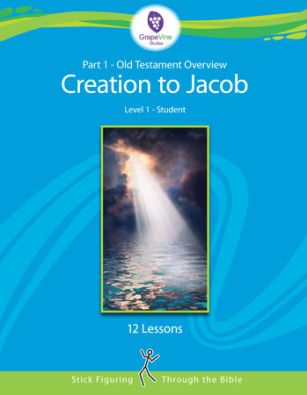
We received Grapevine Studies Old Testament 1: Level 1 Creation to Jacob as PDF e-books of a teacher's manual and a traceable student workbook for ages three to five.

Grapevine Studies teaches a timeline first in its Old Testament Overview, and then the individual stories within the timeline. The timeline is then reviewed repeatedly between stories so that children begin to have a strong concept of the order of events throughout the Old Testament.

The Bible Stories themselves are taught using "stick figuring" --simple line drawings done by the teacher and copied by the students. In the traceable workbook, children trace the line drawings.

Lessons can be done once a week, or divided over four days. A typical lesson at this level has:
- A review of the timeline
- Eight short passages of Scripture to read and stick-figure (two per page on our traceable student worksheets)
- One or two very short memory verses to learn
- Seven or eight review questions

How We Used it

I used the traceable student worksheets for Old Testament 1: Level 1 Creation to Jacob with three of my boys. SA(7) is a bit behind in his pencil skills, so using the traceable worksheets was appropriate for him. JJ(5) probably could have copied my stick figures without tracing, but he enjoyed it anyway. I'm not sure MM(3) got too much out of the stories, but he did love participating and doing what his big brothers were doing.

Every morning I printed off the worksheets for the day from the PDF student workbook and referred to the teacher's manual. After breakfast I read the suggested Scripture, drawing the stick figures on a blank piece of paper. (The manual recommends a dry-erase board and markers, but I made do with what I had, and that was fine.) The boys traced their stick figures on their worksheets as I read. Then we would review our Bible verse(s). On the last lesson day, I asked them the review questions.


What We Thought

As a Charlotte Mason homeschooler, I appreciate the directness and simplicity of Charlotte Mason's method for Bible lessons.
"Read aloud to the children a few verses covering if possible, an episode. Read reverently, carefully, and with just expression. Then require the children to narrate what they have listened to as nearly as possible in the words of the Bible. It is curious how readily they catch the rhythm of the majestic and simple Bible English. Then, talk the narrative over with them in the light of research and criticism. Let the teaching, moral and spiritual, reach them without much personal application." (Home Education, p. 251)
I have been following Charlotte Mason's method for a while now, and have been very pleased with how SA(7) has been retaining what he has learned, simply by narrating it. I felt that the Grapevine Studies' stick-figuring method was not as good as narration in getting him to pay attention and really know the Bible stories we studied. Of course, stick-figuring could be used as a form of narration for some children (have them tell back the story using stick figures). However, SA's skills would not be up to using any form of drawing as narration at this point.

However, I do have younger children who are not of an age to narrate yet. SA(5) and MM(3) often have a hard time sitting through SA's narration of the Bible story, and they tend to drift away from our Circle Time at that point. Using this curriculum ensured their enthusiastic participation throughout the Bible lesson. Unlike SA, both of them love drawing and colouring!

Yesterday, I noticed that JJ(5) is remembering things from weeks ago. He got out his notebook and pencil crayons and began drawing several of the days of creation from memory. He did not have them in quite the right order, but he did remember exactly how they were depicted in stick figures when we learned them.

The Bottom Line

Will we continue to use Grapevine Studies now that this review period is over?

Yes, for a while, and after a fashion. I am planning to go back to our old format of reading and oral narration for SA(7). While we are still in the "Creation to Jacob" time period, I will continue to print traceable worksheets for JJ(5) and MM(3) to work on while we read our Bible passage. I'm not sure what we'll do beyond that yet. I will not continue using it as written.

Stick figuring could not replace the power of narration for us, but it did have value in keeping my little people engaged in our Bible lesson.

For more reviews on Grapevine Studies' various subjects and levels, click on the link below:

Grapevine Studies Review

Crew Disclaimer

Sunday, April 12, 2015

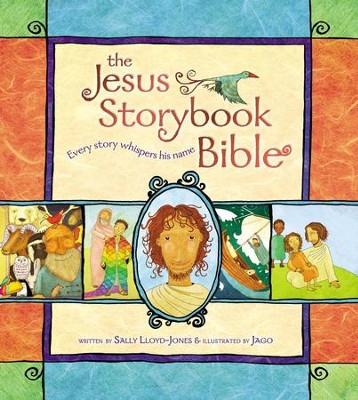
Review of the Jesus Storybook Bible

Everyone who has ever mentioned the Jesus Storybook Bible to me has loved it. Chances are, you love it, too. And I wish I did. After all, I love the heart of the book and believe truly that "Every story whispers his name." But I have problems with the Biblical inaccuracies in the book. I wish I could ask Sally Lloyd-Jones (kindly, because I love her heart) why she felt the need to embellish some parts and leave other parts out in just the way she did.

First of all, I do love the purpose the Sally Lloyd-Jones had in creating the Jesus Storybook Bible. The entire Church, not just its children, needs to see the Bible as a continuing story of redemption with Jesus at its very center. Too often the Old Testament has been neglected, or worse, presented as a collection of moral stories to encourage (or frighten!) Sunday School children to "be good." Lloyd-Jones shows clearly that it's all about Jesus. For example, in the story of Joseph, she writes simply about how Joseph foreshadows Jesus:
"One day, God would send another Prince, a young Prince whose heart would break. Like Joseph, he would leave his home and his Father. His brothers would hate him and want him dead. He would be sold for pieces of silver. He would be punished even though he had done nothing wrong. But God would use everything that happened to this young Prince --even the bad things --to do something good: to forgive the sins of the whole world."
Don't you love that? God not only wrote the story of redemption, He designed it. You can see it throughout the story Scripture tells, (yes, even the Old Testament!) and it's beautiful.

I also share Lloyd-Jones' concern in this interview:
"Children’s lives are so filled, it seems to me, with rules and lessons and instructions and directions and dos and don'ts. (Of course these are all important in their place; all children need guidance and that’s appropriate!) But I don’t always see much Grace being extended to children. We know, as adults, where to find Grace in the Bible. We go the Bible for strength and comfort in times of need, don’t we? But I worry that children aren’t always being offered that refuge, for when they are in need of strength and comfort. I worry that they don’t always know that this incredible, outrageous Grace is for them too. Children need to know that they are loved by the one who made them. No matter what. Always. Forever. Period. And it isn’t depending on how good or nice they are. It’s always and only depending on Jesus and what he has done for them."
Amen, I say.

But. 

Why can this story not be told without serious inaccuracies? And why can we not show the glory of God's love even to little children without glossing over the seriousness of sin and the magnitude of God's holiness, justice, and power?

I understand that this is a creative retelling. I understand that such a retelling for little children must be selective, and that it must be creative so that they will see the story in their mind's eye and understand the great truths being told. But in her retelling, Lloyd-Jones writes some things that are frankly not true.

There are cases where my discomfort may possibly be a matter of preference. Take, for example, the Creation story. "God said, 'Hello, light!' and light shone into the darkness." I would have preferred the majesty of God's "Let there be...and there was." I do not see why substituting "Hello" would be easier for a child to understand. And (call me a quibbler) "Hello" does not mean the same thing as "Let there be." Hello is usually more of a recognition of what is already there than a calling into being, and it does not convey authority. I like clarity in my words, even to children, and to me this is especially important when retelling God's Word. I will understand if you think I am being picky about this particular example. :)

However, there are other places where the inaccuracies are more serious. The story of the Fall is an example of this.
As soon as the snake saw his chance, he slithered silently up to Eve. "Does God really love you?" the serpent whispered. "If he does, why won't he let you eat the nice, juicy, delicious fruit? Poor you, perhaps God doesn't really want you to be happy."(p. 30)
Eve begins to wonder, and eats the fruit.
 "And a terrible lie came into the world. It would never leave. It would live on in every human heart, whispering to every one of God's children: 'God doesn't love me.'" (p. 30)
The original sin, according to this book, is not realizing how much God loves you. 

At worst, this is theologically unsound, at best it is a simple glossing over of the actual significance of the Fall. And I ask you, does it matter that we teach even little children the truth about the Fall? That the real temptation was to doubt God's Word ("Did God really say...?") and the real sin was rebellion against God's express command? I think it does matter, because we can't truly know how much God loves us until we realize what He has rescued us from: real sin, and real judgement.

I believe that we must teach even little children the whole truth from the beginning. They may not understand it all, but they will take what they can, and understand more and more as they grow. My concern is to lay a foundation of truth that will not change. If I begin with the Jesus Storybook Bible, I'm going to have to reteach this someday with the real truth about the Fall. What will happen in my children's minds when the new story doesn't match what I had first taught them? Which will they believe?

I'll give you just one more example. Jonah and the Fish. This is the message Lloyd-Jones says Jonah brought to Nineveh:
"'Even though you've run far from God, he can't stop loving you,' Jonah told them. "Run to him! So he can forgive you."'
In case you've forgotten, what Jonah really said was, "Yet forty days, and Nineveh shall be overthrown!" The people believed him, repented of their sins, and God had mercy and did not destroy them.

My only question here is why? Why did Lloyd-Jones substitute a message of grace for the real message of judgment? What is going to happen when little children graduate from this story to the real Bible and discover that God is not a "nice" God? That He is holy and just as well as loving and gracious?

Now, before you object, I love the message of grace. I believe God's love and his grace are amazing and beyond anything I can imagine. I believe that His message of judgment to Nineveh was full of grace. He could have destroyed them without warning, but He gave them opportunity to repent. But why should we put words in His mouth that were not actually there? Why change what He really said? The message of grace and redemption is indeed found throughout Scripture, and will come out clearly even if we stick to the truth.

The Bottom Line
I appreciate Lloyd-Jones' creativity in telling the story of the Bible. She does have a gift, and she is using it for the gospel. I love that she has taken the idea of the continuity of Scripture and the centrality of Christ and made it understandable for children (and in doing so, undoubtedly also made it understandable for many adults who have never thought of Scripture in that way before...what a blessing!).

But I also believe that God inspired the Scriptures, and that therefore even the details are important. That's why I can't get past the times when Lloyd-Jones writes specific details that actually contradict what the Bible says. I can understand and appreciate creativity in bringing a story to life for little children, I really can. But this crosses a line for me. And the sad thing is, it is completely unnecessary. All of Lloyd-Jones' aims could have been accomplished without being in any way untrue to Scripture.


What do you think? Have you read the Jesus Storybook Bible to your children? I'd love to hear what you have to say about it.

Tuesday, January 20, 2015

Reading Scripture with your Young Readers

SA(6) and I began to read Proverbs together at the beginning of Grade 1. He had been reading for about half a year at that point, and had just received his own Bible. I decided we would try to read a short passage every day after lunch, where he would read one verse, and I would read the next.

I should perhaps mention that we have a habit of reading Scripture aloud after meals anyway, whether I or my husband do so, or whether SA reads along with us. So this new habit was actually not a huge innovation on our part.

Still, it was a challenge, and we did not really begin to do it steadily every day until the beginning of the second term of Grade 1. For one thing, the vocabulary of Proverbs is really challenging. For another thing (and this is probably more to the point), any new habit requires committed, daily effort. I do have the blessing of a son who, once he makes a habit his own, never deviates from it. You could even call him a bit inflexible sometimes. However, in this case it has been a blessing. :)

As we've really gotten into the routine of this, I'm enjoying it more and more. I'm sure a case could be made for beginning with an easier Bible translation with young readers. We've chosen to simply use the version we normally use as a family and plan to keep using throughout our children's growing up years. (ESV) We do this to build our children's familiarity with the language of Scripture over time. Switching versions as they grow could take away from that.

Beginning with Proverbs was a personal decision, and not really one I put a lot of thought into. However, it has proven to be a good choice. The best thing about it is the repetition of words. While the vocabulary may be difficult, once a child has mastered a few big words, the same words keep coming up. (Righteousness, instruction, knowledge, reproof, prudence, integrity, understanding, discretion...) There is also a lot of repetition of ideas. Comprehension may or may not be complete at this point, but it would be hard for him not to get the idea that wisdom is good and foolishness is bad, that hard work is good and laziness is bad, that listening to instruction is wise and despising it is foolish.

We are now working through Proverbs 18. It takes us about three reading sessions to get through a chapter now. It took many more than that in the beginning, but there was no rush. I do not make him "sound out" big words when we're doing this. If he's struggling, I simply supply the word and we move on. I still help him quite often, but I notice that he usually reads a word effortlessly the second or third time he encounters it.

I don't know where we'll go once we're done Proverbs, though I am leaning towards the Psalms. I anticipate that as our children grow, we'll simply incorporate each new reader into our routine until we're all taking turns reading verses aloud. I have a distinct memory from my childhood of reading like this with my family...my father, my mother, myself, and two younger siblings. The youngest reader at the time was about five years old. It is a good memory. I'd like to pass it on to my children, and perhaps to you and yours as well.

Sunday, May 11, 2014

Two Sparrows

Are not two sparrows sold for a penny? And not one of them will fall to the ground apart from your Father. But even the hairs of your head are all numbered. Fear not, therefore; you are of more value than many sparrows. (Matthew 10:29-31, ESV)
We have two kinds of sparrows coming by our feeder these days. The song sparrows began to come at the beginning of April. They are small and timid, and eat from the ground under the feeder. If anything frightens them, they fly away low and fast. They are small and brown, but if you get a close look, you will see that they are not plain. They have beautiful black streaking on their chests.

The chipping sparrows began to come this week. At first glance I assumed they were song sparrows, because they are little brown birds. But I noticed that they were eating at the feeder, and they were much braver than the song sparrows. When I managed to look at them a little more 
closely, I noticed that they were slightly larger than the song sparrows, and had rusty-brown caps and plain grayish-white chests.

Watching them at the feeder this morning reminded me of Psalm 84, and how the person who wrote the psalm must have watched some sparrows building a nest at the temple.

How lovely is your dwelling place,
    O Lord of hosts!

My soul longs, yes, faints

    for the courts of the Lord;
my heart and flesh sing for joy
    to the living God.

Even the sparrow finds a home,

    and the swallow a nest for herself,
    where she may lay her young,
at your altars, O Lord of hosts,
    my King and my God.
 Blessed are those who dwell in your house,
    ever singing your praise!
(Psalm 84:1-4, ESV)

Wednesday, July 10, 2013

Curriculum Show and Tell: Leading Little Ones to God

Marian Schoolland's devotional Leading Little Ones to God is one of my favourite resources to teach children about God. It's also one my parents used when I was young.


How does this resource fit into your daily routine?

We read the Bible to our children every day. We've chosen to use the ESV (though any essentially literal translation would have done for us). It's important to us that the language of Scripture becomes familiar to our children, and using the same translation every time helps with that. Part of my Dutch Reformed heritage is that we anchor our Bible reading, singing and prayer to every meal. We nourish our bodies, we nourish our souls...it's part of the rhythm of life.
Leading Little Ones to God fits into our routine after breakfast each day. The boys and I go and sit on the couch. I begin by reading the Scripture passage suggested in the lesson. It's usually less than a chapter, appropriately short for a child-sized attention span. Then I read a chapter from the book. Chapters are generally about a page in length. The style is conversational and engaging. The book also includes two or three discussion questions, a hymn to sing, a memory verse, and a prayer. I use the discussion questions only if my 3-year-old is not standing on his head yet and my 5-year-old is still engaged with the lesson. (I figure I'll probably go through the book several times over the years...no need to cover everything the first time around.) I don't usually use the hymn. Instead, we sing one of the (five or so) hymns the children already know and love. Doing a different hymn every day will probably work better after they can read. I usually incorporate the ideas in the written prayer into my own prayer. This all doesn't usually take longer than 15 minutes (depending on how active the preschoolers are at the time...). I typically miss a day or two in the week (life happens...) so we generally end up using it four or five times a week.

What topics does Leading Little Ones to God cover?

This book is a book of Bible doctrine. It talks about the attributes of God, about sin, the law, grace, who Jesus is and what He did, the Holy Spirit, how we become children of God, growth, prayer, the church, and the Second Coming. There are 86 chapters in total. I would never suggest that this book is all you need. The most important thing is that you read the living Word of God to your children...after all, it is His own Word that God promises "will not return to Him void." (Can you tell the translation of Scripture I grew up with?) You will also want to tell or read Bible stories in a way little children can understand.

What distinguishes Leading Little Ones to God from other devotionals for children?

I think the most important difference is that there are no cutesy stories to artificially draw in the child's interest. It is assumed that the child is interested in learning about God, and that the child can appreciate the wonder of what is being taught. Each chapter usually does have an illustration from Scripture itself. Equally importantly, there is no artificial "moral" to each story...the object is more to draw out a response of worship, or wonder at God's greatness.
Another thing I appreciate about this devotional is that using it actually teaches me as a parent helpful and appropriate ways to talk about God with my children throughout our everyday life. I can be a fairly private person when it comes to my relationship with God, and I need to learn to be more open with my children.

How is Leading Little Ones to God illustrated?

The illustrations by Paul Stoub are beautiful, but there is less than one on every page. Where they are included with the lesson, I find they help keep the younger child's attention.

What ages would this resource be appropriate for?

I've had this book for several years now. I've started through it a few times before, but I'm just finding now that my 5-year-old is really getting it. He doesn't always display a lot of interest at the time, but later, during the run of a day, he'll make comments that show me he was listening. This is also the first time that I find he really has the attention span for us to read the Scripture passage and the chapter at the same time. I think the book is deep enough that it will continue to hold their attention up to the age of maybe eight or nine.

But speaking of my 5-year-old "getting it", I have to tell you what happened this morning.

We were reading about God's omnipresence.
"God is everywhere!" I read. "When you go to bed at night, God is there. The room may be dark, but you do not have to be afraid..."
I read on, but I noticed SA's face scrunching up the way it does when he's thinking hard.
"Mama," he interrupted. "God is there when I'm in bed."
"Yes," I said, glad he was thinking about it, waiting eagerly for his next thought.
"Mama, God throws my pillow on the floor and moves my blanket like *this* (motions with hands)."
I had to explain that sometimes our hands and feet move when we're asleep so our pillows and blankets aren't in the same place when we wake up... He took a bit of convincing.

May the Holy Spirit use our humble efforts in the lives of our children.