Showing posts with label Picture Books. Show all posts

Wednesday, December 2, 2015

Beginning our Picture Book Advent Calendar 2015

The Christmas picture books have been coming in quickly at the library. I wrapped a stack of them on Saturday.

We've been unwrapping them one by one at tea time this week. (Tea time doesn't always look like this...often it's just snack and a poetry book or two.)


The boys have been taking turns choosing the wrapped book from the stack and unwrapping it. JJ(5) had the first turn on Monday.


The book turned out to be Shooting at the Stars: the Christmas Truce of 1914. This was a new book for us, and while I probably wouldn't have chosen it for our very first Christmas picture book (we're choosing at random), it was a good bridge from Remembrance Day a few weeks ago to Christmas a few weeks in the future.


We wrapped up our tea time with some poetry by Christina Rossetti (who has wonderful Christmas poetry, by the way!), and then finally got to the part my boys had all been waiting for...


...the Jacquie Lawson Victorian Advent calendar a friend gave us for the computer. Each day has a special little activity, and the boys love it. (Thank you, Christina!)


We normally have no screen time before 4:00 PM, so having a bit in the morning is a special treat for them.

That's how our lesson time has begun each day so far this week and hopefully continuing on until Christmas. Homeschooling is fun! :)

Wednesday, September 16, 2015

In Our Book Basket: Rembrandt Resources

Picture study is very simple in our home. I choose an artist for each twelve-week term, and we study six of his paintings. At the moment we don't do a lot of learning about the artist, the focus is just on looking at the picture, becoming familiar with it, and storing it up in our "mind's eye." 
Since we do picture study once a week, this allows two weeks per painting chosen. The first week, we take five or ten minutes and just look at and talk about the picture. Then I put the picture on the wall or on a stand where it can be seen whenever anyone wants to look at it. The second week, we do a proper picture study and look at the painting until we can see it in our minds with our eyes closed. Then SA(7) and I describe it in detail, with occasional input from JJ(5). That's all there is to it right now.

This term, just on a whim, I decided to check if my library had any resources on the artist I chose: Rembrandt van Rijn. When the books came in I popped them into my library basket, intending to look at them more closely later. Later never fully came for me. What can I say? I'm a busy mom. But having them in the basket proved to be rewarding anyway.
JJ(5) discovered one of them, The World of Rembrandt, and pored over it for at least two days. Later, when I pulled out a print of "The Night Watch" for our picture study time, he jumped up with excitement, ran and got the book, and opened it to the same picture. But what surprised me the most was the morning two weeks later. I was reading the Acts 7 story of Stephen to the boys. JJ asked, "Excuse me, may I go get the book with that picture in it?" I gave my permission, expecting him to come back with an illustrated children's Bible or something similar. Instead, he came back with this book, opened to a black and white copy of Rembrandt's 1625 "Stoning of St. Stephen." I was amazed...this book is full of Rembrandt's paintings, most in full colour. Yet JJ recognized the story I was reading instantly and related it to one picture he had looked at long before.

Another worthy resource was Rembrandt: A Biography by Elizabeth Ripley. This was a lovely living book, well-written and engaging. It was completely illustrated with copies of Rembrandt's own paintings, though unfortunately these were all in black and white. (At least my library copy was...) I recommend this book for about age seven and up.

I also stumbled across Hana in the Time of Tulips, a lovely picture book about the tulip craze in Holland during the time of Rembrandt. It only had a brief reference to Rembrandt, but the boys were very excited to recognize his name in the book.

The last book I checked out was for me, not the children. Henri Nouwen's The Return of the Prodigal Son is a book about the spiritual impact Rembrandt's "The Return of the Prodigal Son" had on Nouwen's life. This type of meditation and seeing deep meaning in a painting was completely foreign to my own experience, yet I was moved and instructed by it. Being Protestant myself, I felt uncomfortable with some of his ideas (he is a Catholic priest), but it was well worth reading all the same.


Wednesday, June 17, 2015

In Our Book Basket: Brundibar

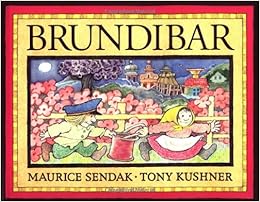
I'm not very dramatic when it comes to reading aloud. I think I read expressively enough, but I don't really "do" voices or accents. My boys don't seem to mind. However, I've come across a book that a person can't help but read dramatically. That book is Brundibar, adapted by Tony Kushner from a Czech children's opera and illustrated by Maurice Sendak. The book tells the story of two poor children who need milk for their sick mother. In their quest to get some, they have a run-in with an evil organ-grinder named Brundibar. In the end, with the help of a few animals and a lot of other children, they are victorious. Brundibar is chased away, the children get the milk, and their mother gets well again.

Try to say this without rolling your 'r's and adopting a voice you didn't know you had:


The book's language and illustrations are unusual, to say the least, but they work. They really give the dramatic feeling of a play.


But there is something else unusual about this book, and I came upon it slowly. First I noticed that the doctor in the book had a yellow (Jewish) badge on his coat. Then I started to notice the badge in other places. I turned to the book jacket to see if it said anything about this, and it did.
"This book is based on a Czech opera of the same name ("Brundibar" is Czech slang for "Bumblebee"), with a libretto by Adolf Hoffmeister, set to music by Hans Krasa. Completed in 1938, the opera was performed fifty-five times by the children of Terezin, the Nazi concentration camp. Krasa, who was Jewish, was also imprisoned in Terezin. He was killed in Auschwitz in 1944."
Now fascinated, I googled "Terezin" and "Brundibar" and came upon a video from CBS News entitled Brundibar: How the Nazis Conned the World. There I learned how music and art flourished in the concentration camp, and how "Brundibar" was the most popular show in town. The Nazis, who had begun to be questioned on what was happening to the Jews, briefly turned Terezin into a model town and produced a propaganda film highlighting a performance of Brundibar to show how well they were treating the Jews. I also learned that not only Krasa, but most of the children who acted in the opera were killed soon after in Auschwitz.

And so what seemed like an original and light-hearted children's book turned into a door into history for me. I have not passed this on to my young children. They enjoy the book simply, as it is. Some day they will know the heart-breaking history too, and appreciate the courage this book depicts that much more.

What about you? Is there a children's book that has become so much more for you? Tell me about it in the comments!

Tuesday, June 9, 2015

In Our Book Basket: Luba and the Wren

Many, if not most, of the books in our library book basket are ones that have been recommended to me. Blogs such as Hope is the Word or Little Book, Big Story regularly draw my attention to excellent children's books. In response, I go online and reserve them at my library if they are available in our provincial library system. I get an email when they come in, and I drop into the library on my next errand day to pick them up. We have discovered and enjoyed countless books using this method.

However, there is still something to be said for going into the library and browsing the shelves. Some of our very favourite books have been discovered this way. Flute's JourneyLynne Cherry's remarkable biography of a wood thrush, also Jonathan Bean's wonderful book Building Our House and Robert McCloskey's Time of Wonder fall into this category. With my family of three little boys and a baby, library visits happen less often than I would like, but we did manage to go one morning about two weeks ago. This time, I discovered Patrica Polacco.

Patricia Polacco is a prolific author and illustrator who actually did not begin to write children's books until she was forty-one years old! There is a wide variety in the type of stories she tells. There are legends and folk tales, poignant stories from history, and stories drawn from her own life and her Ukrainian/Russian heritage. Despite the diversity of her themes, Polacco's beautiful illustrations make her books instantly recognizable and unite them all.

Our (very small) library has quite a few of Polacco's books on its shelves, and we have just begun to explore them. John Philip Duck, Appelemando's Dreams, and Thunder Cake are three that we've really enjoyed. But our very favourite so far, and one that SA(6) has already asked to hear approximately ten times, is Luba and the Wren.

This is a Ukrainian version of the classic tale of the Fisherman and the Flounder. Instead of the fisherman, there is Luba, a sweet, gentle girl. Instead of the flounder, there is a wren. Instead of the fisherman's wife, there are Luba's discontented and demanding parents. I won't spoil the ending for you, but just tell you that I think the ending to this tale is much more satisfyingly thought-provoking than the original.

At our house, our 6-year-old enjoyed this book more than the younger children, and I do think it is best for children of his age and older. This is a library book that's so good that it's going on my to-buy list (a very select list, by the way...).

Go, check it out!

I'd also love to hear what wonderful books you've discovered on the shelves of your library.