Showing posts with label Kindergarten. Show all posts

Wednesday, July 16, 2014

Choosing Elementary Math Curriculum 1


About a year ago, I attended a meeting of our local Charlotte Mason group, and we fell to talking about Math. As it turned out, no one at the meeting had a really clear idea what Charlotte Mason says about math, and so we fell to speculating based on our limited knowledge of Charlotte Mason’s philosophy and method. “I think the math curriculum I use is very Charlotte Mason,” said one. “It weaves the mathematical concepts into stories. My children can’t get enough of them. To me they seem like living books.” “I think perhaps Charlotte Mason was not a ‘mathie’,” said another. “To me it seems like she has a very liberal arts focus, and math was probably not her strong point.”

I was very interested in learning how to teach math at the time. My eldest son, who was just about to start Kindergarten at the time, was showing signs of a particular interest in math –an interest I did not feel qualified to feed long-term. I bought a math program at the recommendation of our local homeschooling math expert. (Read "A Generous Education in Mathematics" by Alice Horrocks here.) Her advice was sound, and I was and am very happy with my choices. However, I have since learned that Charlotte Mason actually does have something to teach us about teaching math, and I want to share what I have learned. I am not an expert on math, or on Charlotte Mason. I am a mother beginning to homeschool, learning things as I go along. I hope this series will be helpful to mothers who are in the same shoes I was a year ago…wanting to homeschool the Charlotte Mason way, and intimidated at the thought of teaching math.

Over the next few weeks, I plan to address the following topics:
A Good Teacher
A Method, Not a System
Atmosphere, Discipline, and Life in Early Math Education
Spiral or Mastery?
Problem Solving
Manipulatives
Putting it all Together: Choosing Curriculum and Resources

I have entitled the series "Choosing Elementary Math Curriculum". As often happens with Charlotte Mason's methods, though, we are going to have to think through some philosophy first. But hang in there...we will get to the practical applications soon enough.


Wednesday, June 18, 2014

The Term that Fell Apart

All I can say is, it's a good thing this is only Kindergarten. After a very happy and productive Fall and Winter, we lost steam at the beginning of May. I signed up for a theatrical production that required rehearsals three times a week, and we started swimming lessons once a week for six weeks. Add in the garden, and suddenly the easy, calm routine we followed every day all winter just didn't work anymore. The worst thing was that I didn't seem to have the time or energy to sit down and fix it, so we just stumbled along in the chaos.

This is why I plan each season. A fresh start four times a year? Yes please. Things have settled down a little this week, and that has given me a chance to think about what happened with our Spring and plan for better things in our Summer.

I don't want to give the impression that everything fell apart. SA read about fifty books this term, and while he doesn't love reading the way he loves math, he is happy to read every day. Our math lessons did rather dry up after the beginning of May, but he hasn't lost ground. He continued to practice at Khan Academy daily, and has almost finished Early Math there (as far as I can tell, this level covers K-Gr 2). I don't consider Khan Academy a tool for significant growth in math for him, but at least it kept his math love somewhat satisfied. Another area of progress was piano. I started him off with a few lessons from an Alfred book I found at Value Village, and he took off. He practices for the joy of it every day, and that makes me very happy.

But what I felt was the best part of our homeschool this Fall and Winter, our "circle times" of morning devotions and poetry teatimes, really did fall apart this Spring, and I regret that. Every time I needed the car, we would have to go to work with Stephen in the morning. This meant that the breakfast-around-the-table anchor for our morning memory work was gone in favour of a quick sandwich in the car. Tea time also became sporadic, happening once or twice a week instead of every day. This meant that our memory work slowed down significantly. We kept up with Scripture and hymns, but learned only ten new catechism questions and no new poems. I have noticed something good coming out of this, though. The boys are eagerly requesting favourite poems whenever we do have poetry teatime, where before they were rather taking it all for granted.  JJ especially has really connected with some of A.A. Milne's poetry, which we began to read in this term.

Nature study was very informal and mostly related to gardening. They planted some seeds and watched them begin to grow. My nature journal has been sadly neglected.

Habits are another area that suffered. Not only did we not develop any new habits, our old ones have not been doing so well with our irregular routine.

I think the most important lesson for myself is just to pick myself up, adjust my expectations, and begin again. Now to work on my plans for Summer!


Thursday, April 3, 2014

Musings on Math

This post is just an unloading of thoughts onto a page. I've been thinking too much, and sometimes the only way to steer a clear path through all these thoughts is to write about it. So I warn you, this is going to be long, intense, and possibly tangled, and I might change my mind on some things in the future. This "thinking love" we have for our children is a long-term process. I fully expect to make mistakes and learn from them.


Let me tell you about my son SA. He is five and a half, and he has a special love for numbers and math. He seems to see the world through math-coloured glasses. 

- When we first began our poetry teatimes half a year ago, he spent weeks (months?) creating math equations out of the food on his plate. The strips of cheese were made into plus and minus signs, the slices of apples and crackers were added and subtracted. Similarly, if he has a stick at the beach, or sidewalk chalk on a sidewalk, he is making math problems for himself to figure out.

- He is always asking math questions and making math observations. My approach to this has always been to ask questions back to him to see if he can figure things out himself. He often can. If the question seems beyond the math building blocks he's already assimilated, I'll answer truthfully and make some comments about the process I used to get to the answer. 
For example, he was in the back seat of the car one day when I handed Stephen three $20's. 
"Here's $60," I said. 
SA had noticed the $20's. 
"How many 20's makes 60?" he wondered out loud.
"How many do you think?" we asked him. 
"Three," he said.
He thought for a couple more minutes. "60 is 20 3's," he said next.
Then his mind seemed to go to the number 23, (it sounds like 20 3's) because his next announcement was, "23+27=60."
"No, that's not right," we said. "Can you try again?"
It took him a few minutes, but he figured it out. 23+37=60.
This type of conversation is not untypical with him.

- He almost always understands the math concepts I've taught him immediately, without frustration. Now don't be thinking he's a genius...I still mean easy elementary school concepts. Borrowing and subtracting was the latest one. But hey, I distinctly remembering having considerable frustration with that concept...in grade two.

Charlotte Mason's insistence on a method, not a system, is making more and more sense to me. (See Volume 1, Home Education, p. 6-10) What is the difference, you ask? 

System implies:
- following a path of definite rules in order to achieve precise results.
- does not take the child into account as a self-acting, self-developing being.
- focuses on the development of a skill set, or subject matter, rather than the whole person.
- easier (and lazier) to contemplate for the parent.

Method implies:
- a way to an end
- step by step progress in that way
- begins with a vision of the end result
- is natural and easy, yet careful and watchful use of every circumstance in the child's life to bring him to the goal.

There is always the danger that a method (even a good method) can become a system.

Practically, this concept has meant more to me in this (seemingly) gifted area of my son's life than in any other area. 
- It means that I make my goals for his math development, and every curriculum, every game, every math activity I use serves that end.
- It means that I use the curriculum in ways that serve my son, even if that means using it differently than it was intended, or speed through things that he already knows intuitively. 
- It means that math is taught consecutively, in a logical order, but once it is mastered, we do not drag it out. 
- It means that I try to provide activities that give him the space to allow him to have his own "aha" moments, his own connections.

So far, in Kindergarten, this has been fairly "natural and easy." I introduce a new math game or activity every Monday. I do not choose these in advance, but try to either match them to something he's interested in at the time, or to something in his regular lessons. From Tuesday to Thursday, I aim to make our daily Miquon math lesson about 10 minutes long. We use manipulatives to introduce any concept, but I do not insist on their use for every problem if he doesn't need them. I do not necessarily have him do worksheets for every lesson. Friday, for variety, we do a worksheet from MEP Math (a program that emphasizes mental puzzles/problem solving, rather than manipulatives.). He also often does lessons from Khan Academy during his daily "screen time." I'm not sure yet how I feel about that (and yes, it's my fault he discovered it). Positively, it gives him a sense of how BIG the world of math is, and how much there is to learn. Also positively, it motivates him to become more fluent at the things he already knows. (It's practice drill, in other words.). 

It sounds like I'm very sure of myself, doesn't it? But I'm actually questioning myself all the time.
- Am I holding him back? I feel this especially in our daily math lessons, which are all very easy for him. My intuition tells me not to skip any foundational steps. But when he started playing with Khan Academy, within a day he had discovered adding and carrying, which before then I had no plans to teach him for a while yet. (I made sure to demonstrate with Cuisenaire rods.) As with all his math so far, he understood it immediately, and made no mistakes in his practice problems. Does this mean I should skip ahead?
- How much practice work should we do to gain fluency? When does it become useless busywork?
- Am I challenging him enough? I've read a lot on math, and one of the great values of math is supposed to be training to "try, try again," learning to persist even when problems are hard. But nothing has been hard yet. Does that even matter in Kindergarten? Will he eventually hit something that's challenging for him, or do I need to move through the material faster so we get there sooner?

And then I question myself because I'm questioning myself. I mean, lady, your boy likes math. What a problem to have! He's in love with it. He enjoys everything, even the things that are too easy. He is not bored (yet.).

I think all my struggling with this is because I'm a planner. I would like to be able to see precisely the steps and the speed and the direction I'm going. I like systems a bit too much! :) Lazy ol' me would like to find the perfect math program that I could plug him into and let him go. I have some goals, though. They may yet change, but they give direction to my methods for now.

At the end of all his learning at home, I want SA to have:
- A sense of awe and wonder in mathematics as the language God built into the universe. (I'm thinking of this quote from Galileo: "Philosophy is written in that great book which ever lies before our eyes — I mean the universe — but we cannot understand it if we do not first learn the language and grasp the symbols, in which it is written. This book is written in the mathematical language, and the symbols are triangles, circles and other geometrical figures, without whose help it is impossible to comprehend a single word of it; without which one wanders in vain through a dark labyrinth.")
- The foundational tools he needs to build on to figure out any math problem he wants to figure out.

- An attitude that is conducive to problem solving, especially persistence and determination.
- A big picture, an understanding of the historical context of the study of math. (Please note that I understand that my goals may be less lofty for another child, but because of the intense interest SA has in math, I feel this goal would be important for him.)

There. I feel a little bit better now that my thoughts are written down. I feel a little hesitant about posting this. Strangely, it would be much easier to write about real problems my child is having. But I've decided to put it out there in case anyone has any wisdom or experience to share with a young homeschool mom. Believe me, non-problem that this is, it has consumed a lot of my thoughts and energy in the last year and a half.

(Edit. I should make clear that Charlotte Mason would not have recommended math lessons this young. I'm just in a situation where withholding the knowledge his mind craves would be unkind. This child too is a born person. Charlotte Mason was also quite accommodating to mothers who wanted to begin teaching reading at a very young age, as long as it was done gently and naturally (no pressure), so I don't feel she was inflexible. Second, she was critical of the concept of Kindergarten. When I speak of him being "in Kindergarten," I'm simply referring to his age of five and a half.)

Thursday, March 27, 2014

March 2014 Favourite Read-Aloud Roundup

It's hard to believe it's already the end of March. We have just had the worst blizzard of the winter, and are expecting more snow on Sunday. It is not unusual for us to have snow in March (and April. and sometimes May.) but this was quite a storm. The boys were very happy to have their Papa home for a cozy snow day. In honour of the winter weather, I'd like you to introduce you to Snow Bears, our favourite winter book ever. It may also possibly be my favourite book by Martin Waddell, though I haven't read them all yet. 

This book is just so sweetly humorous. Three little bears get very white rolling around in the snow, and have a fun little game with their mother pretending they are not her little bears, but snow bears. When they go back inside, the snow melts and they transform into their mother's own little bears again. I recommend it especially for ages two to four, though my five-year-old loves it as well (especially as he can read it on his own now!).


The Mountain that Loved a Bird is a beautifully written story of a bird that visits a barren mountain once a year. The mountain always asks her to stay, but with nothing on the mountain to support life, the bird must go on. Finally the mountain's heart breaks, and the water of its tears is the beginning of a wonderful transformation. 
I think this book will be appreciated by all ages. The illustrations by Eric Carle make it accessible to even the youngest children, and the story itself will be appreciated even up into adulthood. I love reading this aloud as much as my children love listening to it.


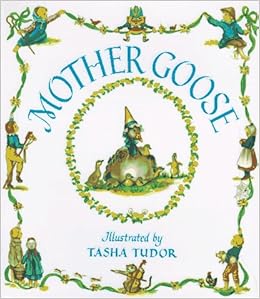
One of our favourite books for Poetry Teatime this month was Mother Goose, illustrated by Tasha Tudor. I believe it is out of print now, but we found it at our library. It is indubitably the most beautiful collection of Mother Goose I've seen to date, and my boys loved to choose from it. Of course, many of the rhymes are songs, and they love it that I sing those ones for them. 


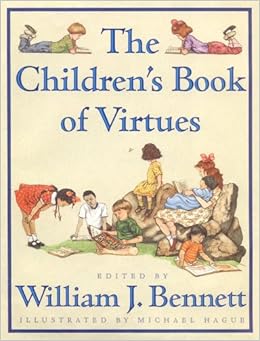
We also checked The Children's Book of Virtues out of the library this month. It is a collection of stories and poetry arranged according to the virtues they convey: courage, responsibility, compassion, honesty, and more. The author, William J. Bennett, speaks in the introduction of the purpose of the book:
"Today we talk about how important it is to 'have values,' as if they were beads or a string of marbles in a pouch. But these stories speak to morality and virtues not as something to be possessed but as the core of human nature, not as something to have but as something to be, the most important thing to be. To dwell among these stories and verses is to put oneself, through the imagination, into a different place and time, a time when there was little doubt that children were essentially moral and spiritual beings, when the verities were the moral verities, when the central task of education was virtue."
My boys' favourite story was "The Little Hero of Holland," the story of a brave little boy who kept his finger in a hole in the dike throughout the night to prevent the water from breaking through and flooding the land. (It may have helped that their Opa is from Holland.) The illustrations by Michael Hague are wonderful as well. Highly recommended for children aged four and up.


Sharing with Read-Aloud Thursday at Hope is the Word today, 


and also with Book Sharing Monday at Life on a Canadian Island.


Thursday, March 20, 2014

Winter Term Goals and Wrap-Up

I made some goals back in January for our winter term. It may seem a bit much to have such elaborate goals for what really amounts to less than an hour a day (not counting Nature Study), but hey, I'm a beginning homeschooler and this is still fun.

Bible: The Goal
-To read a Bible story every day, beginning at Genesis 1 and continuing through Judges using selected passages from Penny Gardner’s list.
-To memorize Psalm 100 and the Beatitudes from the Bible (ESV).
-To memorize one hymn per month:
January: Trust and Obey
February: All People That on Earth Do Dwell
March: How Great Thou Art

Bible: The Reality
We did read a Bible story every day, beginning at Genesis 1. We did not follow Penny Gardner's list after the first little while, choosing instead to simply read the chapters consecutively. (I did skip a few names...). As a result, we are still in Exodus instead of all the way in Judges. I am not unhappy with this. I feel that for the first time, they are really learning the stories. We memorized Psalm 100 with ease, but are still working on the Beatitudes. I simply read the passage for memory every day until they are able to say it with me. We memorized the hymns we planned, but are still in the middle of "How Great Thou Art" because "Trust and Obey" took more than a month to learn with its multiple verses. We also began work on the Children's Catechism, and while I haven't been as consistent with this as with the Scripture and hymn memory work, we memorized up to question 18. I am so thankful to have been introduced to Songs for Saplings songs based on the Children's Catechism. It amazes me how easily my children pick up these songs, even though they still can't carry a tune in a bucket! All of these items were memorized by simply taking five minutes after our meals every day to review them. Now I need to figure out a system to rotate review of things we've memorized in the past so we don't forget them.

Habits: The Goal
To learn habits of attention.
January: Listening to the Bible Story each day
February: Paying attention in church
March:

Habits: The Reality
Attention did not end up being our focus, as I noticed that obedience needed some attention. This ended up being quite difficult for me. Creating practical habits (such as putting away toys or getting dressed before breakfast, as we did in our Fall term) is fairly simple. Creating moral habits such as obedience require a much more constant vigilance and much more wisdom (which I may or may not have very much of...). I think we made progress. I found a way to communicate with my 3-year-old about it that we did not have before, a light-hearted way to get his will on my side.

In other habits, I began having the children do chores after breakfast each morning. They clear the breakfast table and collect the laundry.
I also am working hard on getting SA to sit quietly in church and participate in whatever he can. This also is not easy. He is a fairly calm person, but, boy-like, he does have a hard time sitting still.

Reading: The Goal 
To spend 10 minutes each school day in focused attention on learning to read. Use books that are interesting to SA. Teach sight words, then related phonics rules on alternate days. Use fun games as often as possible.

Reading: The Reality
Shortly after the term began, SA took off with reading. I got as many good, easy-to-read books from the library as I could, and allowed him to read them as he pleased. We recorded the books he read on "reading ladders" and later on a large poster. He is currently at book #30 since January. During this time, I have not done a lot of phonics (maybe once a week, casually, rather than every other day). I will have to pick that up again during our Spring term, but I'm not sorry I dropped it during our Winter term.

Math: The Goal
To introduce a math game from Games for Math once a week (on Mondays).
To spend 10 minutes three times per week in focused attention on learning math concepts presented in Miquon Math.

Math: The Reality
We did introduce a new math game almost every Monday. This was a happy success, and I really feel it helped to continue to build their "math sense." Kalah remains SA's favourite game, and we still play it often. We also did Miquon Math, continuing with the concept of addition and subtraction, and introducing the concept of multiplication. In just the last couple of weeks, SA became interested in adding and carrying, so I taught him that as well.

Pencil Skills: No Goals
SA did some printing incidentally, mostly numbers in his math. He is very neat and accurate. I don't feel the need to push this yet.

Read Aloud: The Goal
To read and enjoy several books from Ambleside Online’s list for Year 0. Begin reading from the Winnie the Pooh series this quarter.
-To read and enjoy poetry at a daily poetry teatime.

Read Aloud: The Reality
Poetry Teatime continued to be one of our favourite parts of the day. The boys memorized several poems. I simply read the same poem (from The Harp and Laurel Wreath) every day at the beginning of teatime until they could say it with me, then went on to the next one. They learned:
The Little Turtle (Vachel Lindsay)
Once I Saw a Little Bird (an old nursery rhyme)
Rain (R.L. Stevenson)
Bird Talk (Aileen Fisher)
At the Seaside (R.L. Stevenson)
Of course, we enjoyed many other poems and nursery rhymes as well. They were always excited to choose what they wanted to hear.
We did read Winnie the Pooh and The House at Pooh Corner, which they loved. (They preferred the first to the second, though. I'm not sure why.) We have also begun to read from When We Were Very Young and Now We are Six, and will continue with those into the next term.

Nature Study: The Goal
To spend time each week observing and learning about nature, choosing from the Outdoor Hour Challenges found at handbookofnaturestudy.blogspot.com. To buy a birdfeeder and observe and learn about birds there.

Nature Study: The Reality
After reading more from Charlotte Mason, I ended up making much larger goals of spending time outdoors. I failed to meet my lofty goals (10 hours a week). However, having these goals meant that we did go outdoors for at least an hour almost every weekday this winter (barring extreme wind chill conditions). This is an accomplishment to be celebrated, since my usual mode in our Canadian winter is hibernation.

We did get a bird feeder, and it was a wonderful, wonderful thing to see the boys so excited about the birds we saw there. Even MM shouts "Chickadee!" whenever he sees a bird. We saw a couple of unusual birds: a brownheaded cowbird and some snow buntings. We learned about the difference between crows and ravens.
We did not follow many challenges at the Handbook of Nature Study blog. To be honest, most of our outdoor time was spent shoveling snow or playing games of hide and seek tag. But I began my own nature journal, which I hope will be the beginning of a family hobby.

Field Trips: The Goal
To learn from people and activities outside our home. Examples might be homeschool co-op events, or trips to Opa’s bakery.

Field Trips: The Reality
I ended up being without a car for most of the winter, so we just stayed home. We made it to one Co-op event, a Valentine's party. I think SA in particular needs to get out a bit more. We went out this week and he got more and more anxious the farther we got from home. New and different situations take practice, with him.

I felt very happy with this term overall. I think I deepened in intention to do little things every day, and in understanding of how all those little things add up over time. It was exciting to see SA's reading take off, and his enjoyment in numbers and patterns continue to grow. I felt less satisfied with our work on habits, and I'm thinking of how to improve that this Spring.

Thursday, February 20, 2014

Favourite Books for Beginning Readers

I have not shared any of our reading lessons lately. There's a reason for that: I'm taking a break. I know it might seem crazy, now that SA has actually taken off with reading. The thing is, I think reading real books is doing as much for his reading ability as my lessons were. Each new book has a combination of words he already can read confidently and new words to learn. The new words are relatively easy to figure out in the context of the stories, and I see him reading these same new words elsewhere without any problem (He's not guessing and forgetting.). I do a bit of casual phonics teaching here and there as I notice he needs it (Peggy Kaye's Games for Reading are great for this), but my main method right now is just making sure he reads a book every day, whether it's a new one or one he's read before.

The books we use are a combination of books I already have and books I borrow from the library. I have not invested in readers (though I have nothing against them, as long as they're interesting.). Here are some of SA's favourites from the last month and a half:


A simple phonics reader, yes, but Dr. Seuss gives it rhythm and rhyme. SA often just picks this up and reads it for fun.

This book has a lot of repetition, which is great when you're building confidence in reading. The illustrations ensure that young readers do not get bored with the simple words.

The great thing about this little book is that it has three short stories, so it's not as intimidating as one long story. And of course Richard Scarry has a sense of humour that really appeals to children.

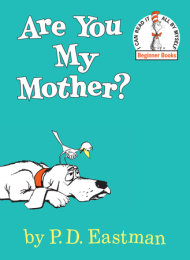
I've got to admit it, this is my favourite. But it works for SA, too. Other than the word Mother, almost all of the words in this book are simple, one-syllable words.


We have an out-of-print version called The Early Bird. The fun thing about this one is that we have a recording of my husband Stephen reading this book when he was four or five. It's too bad that even our old version has been abridged and is slightly different than the version Stephen read back in the early '80s. Once again, Richard Scarry always manages to make my children smile...Lowly Worm singing "O Sole Mio" in his bath in the sink is just so funny for them.


I'm sure I don't need to elaborate on these two. They were old favourites long before SA began to read. I've found that SA is much more likely to try to read familiar books. In the old days I might have questioned whether "reading" from memory is valuable (as opposed to sounding out every word), but I've found it one of the best, most confidence building practices in learning to read. Every time he looks at those words and says them aloud, he's reinforcing them in his mind.


Another old favourite. In fact, SA loved it when I read this to him when he was only six months old. (Honestly!) And now he can read it himself. Time flies... (sigh)


Every time SA reads a new book, we add it to his "I Can Read it All By Myself" ladder on the wall. We've filled one ladder and had to extend it on a new paper. He seems to find this quite motivating.

How about you? Are there books your beginning readers really enjoy? I'd love to hear of new ones I can look up at my library to try with SA!

Monday, February 10, 2014

Kalah: Our New Favourite Math Game!

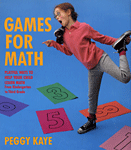
I have mentioned before that we learn a new math game every Monday and continue to play it throughout the week as much as we please. This week's game was once again from Peggy Kaye's excellent Games for Math.

Unlike many of the other games we've played, winning Kalah relies on strategy, not luck. Of course, dice-rolling games can often help even the playing field between Mama and children and make them equally likely to win or lose. Still, I found that this strategy game was simple enough that within three rounds, SA had figured out enough tricks for himself to be as likely to win as I was. This game has many variations (and names!), and after checking it out online, we found we enjoyed this version better than the Games for Math version.

While you can buy wooden boards to play on, Kalah works equally well with an egg carton, beans, and a couple of cups. There are already many places you can find directions online, so I won't repeat them here. I found these directions very clear. Peggy Kaye recommends this game starting in grades two or three, but if you have a child who likes math, they may be ready for it sooner.

If you'd like to try it out in order to get the hang of it before teaching your children, you can find an on-line version here.

Enjoy!

Friday, January 24, 2014

The Awesome Mystery of Growth in Reading

Something has happened over the last few weeks.

My eldest son has caught the reading bug!

He is working with a will now in our reading lessons. Eager, interested, proud.
He is asking to read his vocabulary cards and play games with them.
He is showing off what he can read to his Papa.
He is asking for his reading lesson before breakfast is over.
He is finding books everywhere that he can actually read, and he is reading them.

Now, I must admit that these are not difficult books. There is Chicka Chicka Boom Boom, Hop on Pop, Who is Coming to Our House?, and a few Bob Books and A Beka Readers. His ability has not taken a huge jump. Yes, his reading vocabulary has been slowly and steadily increasing with daily work, but this is not the difference I'm noticing. The real difference is that he wants to read now, and that he realizes he can do it.

How did this happen?
The truth is, I don't really know.
We have worked away steadily at the mechanics for several months now, learning phonics, memorizing sight words.
Charlotte Mason taught me to keep the lessons short and interesting. We have tried never to have a boring or a frustrating reading lesson. And yet, he would have liked some of those short lessons to be shorter yet.
But not anymore.
What is going on here?
Why is it that this sudden growth in interest seems to have little to do with the slow and steady work we've done up to this point?
And why am I getting the feeling that it really doesn't matter what I teach him from this point on? He will read, no matter what I do next. Oh, I'm sure I can still help the process along, but even if I don't, nothing will stop him now.

The mystery of growth in reading seems a lot like physical growth to me. You feed children meal after meal, day after day. You make sure they get plenty of fresh air and sunshine. And yet, they stay about the same height and weight for months at a time. Then suddenly, in the span of a week or two, they shoot up by an inch and a half! (This is often accompanied by eating everything in sight.) It's mysterious and a bit unpredictable, this process of growth.

And yet, would healthy growth have occurred in the same way without day-to-day nutrition and exercise? Our daily lessons, our games, our little motivational record of "Books I Can Read All By Myself," our newly instituted "Quiet Time" when he could choose to read or rest quietly...they were all healthy nutrition to support this growth spurt. And I will continue to supply him with his daily "meals," which will be taken in all the more voraciously now that he's so very hungry for them.


I've been trying to make the lessons a joy.
Now, they are a joy.

This, my friends, is success!

Tuesday, January 21, 2014

Math Game of the Week: Bean Count!

This term, we have been doing a "math game of the week" together on Mondays. Then we do the same game whenever we feel like it throughout the week. This week's game is from Peggy Kaye's Games for Math. In the book, it's called "Star Count", but since we used beans, we call it "Bean Count."
I got out a few papers, the pencil crayons, and a Dice. I divided a paper in two with a pencil crayon and wrote "SA" on one side, and "Mama" on the other. Then we took turns rolling the dice. For the first roll, we made large circles or squares. For the second roll, we put that number of beans in each circle or square. The person with the most beans won that round.
We actually started by drawing stars in the circles, but switched to beans when I noticed that drawing stars was taking more mental effort than the game. We played four rounds. I won twice, and SA won twice. He had the last win, and it was a good one, so we quit while he was ahead.
You can see that this game is meant to get him started thinking about the concept of multiplication. We didn't use any multiplication terminology yet...no "times" or "groups of." I just let him play the game and let him make whatever connections he's ready to make at this time. Later, when we do study multiplication, he'll think, "Hey, I know what this is!"

Thursday, December 19, 2013

{Big Red Barn Reading Lessons} Lesson 4


Today's lesson was fun. It had some cutting with scissors involved, and some nonsense sentences causing giggles. In the end it went off on a bit of a tangent, but that was OK. Interest is a key element of our reading lessons, and when SA is interested in something to do with reading, I (usually) happily follow him there.

Lesson 4

I started the lesson by printing the words
"By the big red barn in the great green field
there was a pink pig who was learning to squeal."
in blue crayon on a white piece of paper. I was going to cut the words out, but SA decided he wanted to do that, so he did.

Before we started to have fun with the words, SA pulled out the word "learning."
"I don't want to use this word, Mama," he said.
"That is a long word, isn't it?" I replied. "I think we can still use it. Look closely at it. It says 'learning.'"
(We have not yet focused on the word "learning" or "squeal" in our lessons. I decided we needed a fun lesson today, though.)

I picked out a few words and arranged them in a sentence for SA to read.
"There was a pink barn."
He hesitated over the word "there," saying "three" instead. I simply corrected him, without making a big deal about it. This lesson is all about practice, after all. He should know the word well by the time we're done with it. He read the rest smoothly, smiling about the pink barn.
I grabbed the word "green" and substituted it for the word "pink." He read the sentence smoothly, but by this time he was ready for it to be a red barn.
"OK," I said. "You find the word 'red' and put it in the right place."
He did so, and read the sentence again. Wait a minute, it should be a big red barn. He hunted among the words, found the missing word, and put it in.
I had a trick up my sleeve. I took away the word "barn" and substituted "pig."
"There was a big red pig."
Giggles all around. While he looked for the word "pink" to put in, I grabbed the word "green," put it in, and got him to read it again.
More giggles.
Finally we got it right, and I scrambled up the words again.

I arranged a new sentence.
"There was a great big squeal."
SA read it correctly, but thought the sentence needed more. He found the words "in the red barn" and added them to the end. He looked around for the word "big," then realized we had already used it.
"Should we make another one?" I asked.
"Yes," he responded. So we did, and he put it in the right place.
"There was a great big squeal in the big red barn."

We continued in this way for about ten minutes, and our reading lesson was over for the day.

Or was it?

SA had the scissors again. He cut the "g" off the word "big."
"I want to make another word," he said.
"OK," I said. "You can write another letter on the paper and add it to make a new word."
I went off to do some dishes.
He came to me a minute later. He'd printed the letter "s" and added it to make the "word" "bis."
"What does this say, Mama?"
"It says 'bis.' That's not really a word. How about you try a different letter? What letter would you need to add to the end to make the word 'bit?'"
"No, I want to make the word 'biscuit,'" he said.
"Mrs. Koughan makes biscuits!" shouted JJ.
So I printed the letters "cuit" on a paper, cut it out, and added it to make the word biscuit.

The end. For today, anyway. :)


Big Red Barn Reading Lesson 1
Big Red Barn Reading Lessons 2 and 3
Big Red Barn Reading Lessons 5, 6, and 7
The Awesome Mystery of Growth in Reading

Tuesday, December 17, 2013

{Big Red Barn Reading Lessons} Lessons 2 and 3


We've had some bad colds at our house in the last week, and with some holiday busyness, we didn't manage to do much "school". We have done two more Charlotte Mason style reading lessons on the book Big Red Barn. Here they are:

Lesson 2

Objective: To learn the words "great", "green", and "field" by sight.
Method: I wrote each word in turn, telling SA what they said. Then I mixed it up, writing the words in different order and at different angles on a piece of paper until I was confident he knew each one by sight. Later, I pointed out each of these words in other stories we were reading, and he read them confidently.

I hadn't intended to do related phonics work until the next lesson, but SA brought it up himself. He noticed that "great" and "green" both started with "gr", and offered some other words beginning with the same blend on his own, without my prompting: "Grandma" and "grapefruit." I wrote these words down for him as well so he could see how they looked.

Lesson 3

Objective: To learn the "ink" family (in relation to the word "pink" in the story)
Method: I found a list of "ink" words in Phonics Pathways, and had SA sound them out. (I use this book as a resource. I do not really recommend it as a phonics program for young children...it seems more suited to remedial work. Sayings and humour seem more suited to older students. Lists and lists of words to read can be mind-numbing for children if you're not careful. There's a reason I'm using real books to teach reading, at least for the child I'm teaching now.)

Later in the day, SA found the Big Red Barn book, and read the first two pages on his own. Though we had not gone over the words "learning" and "squeal" yet, he read them confidently from memory. We'll still have to go over them so I'm certain he'll know those words anywhere, but next lesson I think I may make a puzzle for fun. I'll write out the first two pages on a sheet of paper, cut apart the words, and let him put them together correctly. We may also make other sentences using these words.

If you missed my introduction to these lessons, you can find it here.


Big Red Barn Reading Lesson 1
Big Red Barn Reading Lesson 4
Big Red Barn Reading Lessons 5, 6, and 7
The Awesome Mystery of Growth in Reading

Tuesday, December 10, 2013

{Big Red Barn Reading Lessons}: Day 1


This morning SA asked me to read Big Red Barn to him. I looked at it and decided it would be a great book for his next reading lessons. While I can't claim to have put a lot of thought into this decision, there are a few reasons why I think it will prove to be a good choice:

1. It has a good mixture of short, three-letter words and longer words.
2. It has a bit of repetition, but not so much that it becomes boring.
3. It is interesting and fun for SA.

I have written before about using Charlotte Mason's approach to reading. To summarize our process here,
1. I choose books or poems that are interesting and fun for SA to read.
2. He learns the words of that book by sight so that he can recognise those words anywhere he sees them.
3. We base our phonics lessons on the words he has learned by sight.
I believe this summarizes the heart of the Charlotte Mason learning-to-read process. She gives specific examples of reading lessons in Volume 1 of her Original Homeschooling Series that are very helpful. I don't slavishly follow the mechanics of her process, (using loose letters and words) though I do this occasionally. Most of the time, I simply make use of a notebook.

My intention with this series is to give a concrete example of a reading lesson in our homeschool. It may be appropriate to note here that SA knows all his letter sounds and can sound out three-letter words quite easily. He reads some words quite confidently. For this reason, we started by finding out how much of the book he could already read. (I am starting to think it may be helpful to keep a notebook of all the words he knows so far. For now, this works, though.)

Lesson 1

SA and I read Big Red Barn together. I allowed him to read the words he could. Any time he hesitated, I smoothly supplied the word. I did not prompt him to "sound out" anything at this point. This read-through was simply to find out what words he already knows so we can focus on the ones he doesn't.

When we were finished reading the book, I pointed out to him how many words he already knows, and that it would be pretty easy to learn to read the whole book. He didn't say anything, but I'm pretty sure he's interested and looking forward to being able to read the whole thing.

Words He Already Knows: (He reads these words confidently, without hesitation.)
by
the
big
red
barn
in
there
was
a
pig
to
horse
little
on
is
weather
of
pile
hay
but
are
an
his
Cock-a-doodle-doooo!
too
hen
leg
egg
ten
moo
cow
old
cat
red
dog
bow
wow
with
puppy
all
day
grass
sun
went
one
last
out
end
day
play
moon

These are the words that need to be learned by sight:
(He is able to sound some of these out, but there was hesitation when we were reading through it, so they need reinforcement.)
great
green
field
pink
who
squeal
learning
very
every
vane
golden
flying
course
that
where
children
story
away
only
animals
here
today
sheep
donkey
geese
goats
were
making
funny
noises
down
their
throats
old
scarecrow
leaning
hoe
mouse
born
corn
rooster
pigeon
white
under
quiet
bantam
clutch
count
them
brown
black
meow
tiger
tomcat
yeow
some
round
warm
they
lived
together
played
when
down
lowed
squealed
stomped
sweet
gave
bray
sleeping
nests
even
took
rest
bats
flew
away
night
long
sound
asleep
mice
left
rustling
squeaking
while
sailed
high
dark
sky

Now that I look at it, that looks like a long list! I will start at the beginning, working through the book in order. As he can read the words, he will be able to read that portion of the book. Every other day, we will do phonics lessons related to the sight words he learns. For example, I anticipate teaching him the words great, green, and field by sight in lesson two. Then the next day, I'll make up a phonics lesson using the "gr" beginning blend. (Why choose that particular phonics lesson? I won't use "great" to teach other "eat" words, because "eat" usually sounds like "eet," not "ate". We have learned about "ee" before, so I won't go through that now. "Field" uses "ie" to say the "ee" sound, but the same combination can be used to say the long i sound (pie), or even the short e sound (friend). If he was familiar with the meaning of "wield" and "yield", I would teach him those words in connection with "field," but since he's not, I won't focus on it right now.) As you can see, my plan is highly individual to my own son.

As I usually do, I will feel my way along, deciding what to teach as I go along. This time, though, I'll blog through it. Maybe this will give me some insight into my own process.


Big Red Barn Reading Lessons 2 and 3
Big Red Barn Reading Lesson 4
Big Red Barn Reading Lessons 5, 6, and 7
The Awesome Mystery of Growth in Reading