Showing posts with label Books. Show all posts

Friday, February 1, 2019

Reading My Shelves in 2019: Literature Shelf 2

As I settle into reading my shelves, I'm feeling a bit overwhelmed by the magnitude of the project. At the same time, I am really looking forward to making progress, small as it may be.

On my February Shelf, I have 8 read books and 21 unread books. (In volumes containing more than one book, I have counted each book separately.)


Read: (and these are all books I consider worth re-reading, otherwise I wouldn't be keeping them)
The Tenant of Wildfell Hall by Anne Bronte
Jane Eyre by Charlotte Bronte
Shirley by Charlotte Bronte
Villette by Charlotte Bronte
Wuthering Heights by Emily Bronte
The Innocence of Father Brown by G.K. Chesterton
The Man Who Was Thursday by G.K. Chesterton
The Murder of Roger Ackroyd by Agatha Christie

Unread:
Bridge on the River Kwai by Pierre Boulle
Lorna Doone by Blackmore
Prester John by John Buchan
The Good Earth by Pearl S. Buck
The Arabian Nights - Sir Richard Burton
The Way of All Flesh by Samuel Butler
The Plague by Camus
The Outsider by Camus
My Early Life (excerpt) by Churchill
The Island Race by Churchill
Call for the Dead by le Carre
My Antonia by Willa Cather
Don Quixote by Cervantes
Don Quixote (abridged by Susan Sheridan)
Don Quixote (retold by Judge Parry)
The Riverside Chaucer
Selected Stories by Anton Chekhov
The Mystery of the Blue Train by Agatha Christie
Dumb Witness by Agatha Christie
After the Funeral by Agatha Christie
Death on the Nile by Agatha Christie

Of these, I find myself particularly attracted to Selected Stories by Anton Chekhov, Don Quixote retold by Judge Parry, My Antonia, and The Good Earth. I will probably read one or two of the Agatha Christie titles when I need light reading, too. There's a lot of good reading on this shelf.

I expect that, like last month, I will only be able to get through a couple of these books. I have several additional books to read with my study group (on Saint Patrick and Saint Columba and the Brendan Voyage), and Middlemarch to read with my book club (though I have till the end of March for that).

Thursday, January 31, 2019

Reading My Shelves: January Update

I read two and a half books from my January shelf:

Death of a Ghost by Margery Allingham
-This was the first book in the Crime and Mr. Campion volume. I enjoyed it, but it wasn't a keeper...I probably wouldn't read it again. Still, the book stays because I do want to read the other books in the volume.

The Little Minister by J.M. Barrie 
-I loved this book so much! I would never have thought this was by the same author as Peter Pan (which I've never been able to get through yet). A sweet romance with deep insight into a particular cultural context (An Auld Licht church in a Scottish small village). I'm so glad I still have another couple of Barrie books to look forward to next time I visit this shelf.

Eugenie Grandet by Balzac
-I'm about halfway through this one, and I'm debating whether to drop it as I head into February. It didn't grab me the way The Little Minister did. I don't like dropping books, but I also don't want a book I'm only half enjoying to take away from the excitement of exploring my February shelf. 

Also finished this month:
From other shelves:
Who Has Seen the Wind by W. O. Mitchell

Audiobooks:
Virgil Wander by Leif Enger (very good, but not as wonderful as Peace Like a River)
Respectable Sins by Jerry Bridges
Atomic Habits by James Clear (So good! Will read again soon.)
The Minimalist Home by Joshua Becker

Borrowed books:
Hallelujah: A Journey through Advent by Cindy Rollins (loved it)
Miss Buncle's Book by D. E. Stevenson (fun bit of fluff)
Educated by Tara Westover (fascinating, worth reading, still thinking about it)
The Benedictine Tradition edited by Laura Swan (excellent walk through church history)
Saint Benedict (Dialogues book 2) by Gregory the Great, trans. Myra Uhlfelder (amazing!)

Total finished: 12 books! (That's a lot for me. I set my goal for the year at 80 books.)
3 from my shelves, 9 borrowed including audiobooks
7 nonfiction, 5 fiction
7 male authors, 5 female
5 written in the last 10 years (Actually, the last 2 years. This is an unusually high number for me.)
2 written more than 100 years ago. (6th century and 1891)

I'll be back tomorrow with my February shelf. I'd love it if you could help me choose what to read next!


Thursday, October 4, 2018

Book Man

Last night just before lights out JJ(8) said to me, "I don't know what to read next."
Of course, that's just the right sort of thing to say to a mama like me.
I started to pull books off the shelf: The Moffats, Rascal, The Prince and the Pauper...

"I've been thinking I might like to read Sherlock Holmes," he said timidly.
"Of course you can. You may read any of the books on these shelves, you know," I replied.
He started to get excited.

This morning he kept finding more books he thought he might like: The Indian in the Cupboard, Hans Brinker, Peter Pan. 

He added in some books he wanted to re-read: Robinson Crusoe, The Phantom Tollbooth, Seven-Day Magic.

He sorted the books, now numbering about twenty, into two piles: the thick books and the thinner books.

I started envisioning these books scattered all over the house. This worried me a little, but I didn't want to squash that enthusiasm. "You could pick four or five for now, then pick more when you finish them?" 

This suggestion did not meet with his approval.

He did take out a couple of books that he thought he might not want to read right now after all: Mr. Popper's PenguinsHey World, Here I Am!

Then he asked me for a basket like the one I have for my current reads. Of course, I found him one. He now has a leather stool with storage space for all those books.

He pulled the seat in front of the couch and demonstrated how he can sit on the couch, reach over and open the stool, pull out a book, close it, and use it for a foot rest as he relaxes and reads.

I heard him talking confidentially to his younger brother this evening as he went up to bed:
"Hey MM, I'm a book man."

Wednesday, December 27, 2017

Reading Goals of 2017 and 2018

This year, I started out with big reading plans. Here's how I did with them:

1. Learn from C.S. Lewis
At the beginning of the year, I lined up all of our C.S. Lewis books in chronological order. At the time, I said "I'm pretty sure I will not get through all of them this year." Well, I didn't. I got through five, and am still working through another two.

The Pilgrim's Regress (1933)
Out of the Silent Planet (1938)
The Problem of Pain (1940)
The Screwtape Letters (1942)
Perelandra (1943)

The Abolition of Man (1943) (in progress)
That Hideous Strength (1945) (in progress)

Now that I know my pace, I am setting a new goal of reading seven more C.S. Lewis books in 2018 in addition to finishing the ones in progress.

The Great Divorce (1945)
George MacDonald: An Anthology (1946)
Miracles (1947)
The Weight of Glory (1948)
The Lion, The Witch and the Wardrobe (1950)
Prince Caspian (1951)
The Voyage of the Dawn Treader (1952)

2. Keep up with my book clubs.
I read some good books with my book clubs this year! With them, I finished 
The Iliad
The Brothers Karamazov
The Innocence of Father Brown
Northanger Abbey
Oliver Twist
The Man Who Was Thursday

In 2018, we are continuing with The Odyssey and reading Wives and Daughters by Elizabeth Gaskell. I anticipate we will read an additional four or five classics or other worthy books.

3. Keep reading Charlotte Mason.
I finished following Brandy Vencel's study guide Start Here with an online study group. It was great! Using it, I read For the Children's Sake and most of Charlotte Mason's Volume 6. Then, in the summer I read through Charlotte Mason's Volume 3 again: School Education

I also read Laurie Bestvater's The Living Page. What a great addition to any Charlotte Mason library! It is carefully researched, beautifully written, and clearly demonstrated.

In 2018, I plan to read Charlotte Mason's Volume 2: Parents and Children. Also, in our local Charlotte Mason study group, we're watching the video series from Ambleside Schools International and reading the accompanying study guides which contain passages from Charlotte Mason's volumes.

4. Pre-read at least some of next year's school books for SA.
Well, I did do this, but often it was the night before. In other words, I did not get very far ahead of him. At all. But still, I read some excellent books. Some of my favourites were:
Robinson Crusoe (almost finished)
"MacBeth"
Romulus (Plutarch)

Looking ahead into 2018, I know I need to allot a significant amount of time to pre-reading, especially considering that SA is now at an age that he will be reading most of his school books on his own. Beginning Term 2 of Year 4, I will be reading
"Twelfth Night"
Publicola (Plutarch)
George Washington's World
Kidnapped
The Ocean of Truth
Madam How and Lady Why (already in progress)
Age of Fable (in progress)
Great Canadian Adventures (in progress)

And of course, later in 2018 I will be beginning Ambleside Online Year 5 as well. By necessity, this will likely become my primary reading goal. 

5. Read through the ever-expanding list of books people have recommended and/or lent to me.
I didn't do very well with this in 2017. I have so much to read, I often don't prioritize books that other people want me to read. The one I did manage to finish was probably one of my least favourite books of the year (Wild at Heart). So I'm going to change this goal in 2018:

5. Read books on my own shelves that I have been wanting to read but just haven't gotten to yet.
Krakatoa (Winchester) (in progress)
John Adams (McCullough)
Respectable Sins (Bridges)
As these are all pretty hefty, I doubt I'll get through more than four or five on this list. Still, it's good to set a goal, as if I don't, I may not read any of them.

I know I haven't listed any light reading, and not much fiction. That's not because I won't be reading any. Those just tend to be more spontaneous choices. I will also probably be reading a fair amount of books on health this year, but I can't tell exactly what direction that will take at this point. (psoriasis, autoimmune disease, diet...)

This is almost an afterthought for me this year...I love the idea of it, but with so much else to read I'm not sure how far I'll get. Still, I would like to check off the categories of a "Light" reader (and it's great that I can use books that I'm already reading for other goals to check off several of them.). The categories are:
A biography
A book about Christian Living
A book published in 2018
A book by an author who is no longer alive
A novel
A book for teens or young adults
A book more than 100 years old
A book targeted at the opposite gender
A book your best friend recommends
A book with at least 400 pages
A book of your choice
A book about theology
A book about current events

Do you make reading plans, or do you just read whatever comes your way? I like planning for about half of my reading, and allowing the rest to be more spontaneous.


Monday, February 13, 2017

Living & Learning Update #7: Fitbit, Canadian History, The Brothers K, MBTI

Living

We are finally anticipating a big snowstorm tomorrow! We are hoping for 25-30 cm from Monday morning to Tuesday morning. We have had comparatively little snow so far this winter, but this will make up for it. It's time for some nice, cozy snowed-in time, maybe some hot chocolate and a movie.

I told you that I now have a fitbit. I have since brought my steps up from 5,000 per day to 7,500 per day. For a little while I was annoyed because my life seemed to be revolving around getting my steps in, and that's not something I want my life to revolve around. Also, I would find myself having to play catch-up at the end of the day. But now I have discovered the secret to getting enough steps: divide the amount of steps by the number of hours in the day, and never let myself get too far behind. It seems to be working, and I think I'm ready to bump it up to 8,000 per day this week. I am still amazed at people who get 10,000 steps in, but I'm starting to hope I'll get there someday.

Learning


I am really enjoying Canadian history with my boys. This term we are reading portions from The Story of Canada by George W. Brown, Eleanor Harman and Marsh Jeanneret; The Story of Canada by E.L. Marsh; and Great Canadian Lives by Karen Ford. I have talked about these titles before. Now that I am using them, I think I can add to my assessment then. I am finding that my boys (year 1 and 3) are not narrating particularly well from Brown's Story of Canada, and I think it may be a bit too fact-heavy. The funny thing is, I think they are finding it interesting (SA in particular loves facts!), but it is not translating into good narrations. I am continuing with it, though, as I like to give books a fair trial. On the other hand, Great Canadian Lives is turning out to be a particularly valuable resource. As I said in my previous post, the quality of the chapters in this book is uneven. Some are well-written, and others are choppy lists of facts. I have been reading the well-written chapters, and the narrations from the boys have been outstanding. I would recommend this book to all Canadian Charlotte Mason homeschoolers for use as a supplement in grades 1-3. This book is valuable for its table of contents alone --a list of a wide variety of Canadian people by time period. While a number of its chapters are not really well-written enough to be usable for reading and narration, the ones that are make the book worthwhile to have on your shelf, assuming you can find one! (This title is out of print, but keep an eye out at your local library sales and BookFinder.com. My own library system has this book in circulation as well, and yours may too.)

Reading

I've been reading The Brothers Karamazov with my book club. This is the first time I've ever read a Russian novel, so I don't know if they're all like this. It's hard to describe. The story seems melodramatic, almost unbelievable in places. On the other hand, there are the most amazing speeches and conversations that go very deep, that present ideas that you can chew on for days (and maybe a lifetime). For me it is impossible to race through this book. I read a few chapters and have to stop and let it digest for a while. This week I read Father Zosima's words about the beauty and power of God's Word, and how little it would take for priests to teach it to the people, even children, and it encouraged me in my own teaching to my children:

"So, one evening a week, to begin with, let them gather the children round them--and the fathers will hear of it and they too will start coming [...] Open this book and start reading to them in simple language and without conceit, but warmly and humbly, without elevating yourself above them, just enjoy reading them a well-beloved text and take pleasure in their listening to you and understanding you, pause once in a while to explain the odd word which may be beyond the grasp of simple folk, but don't worry, they'll understand it all, the truly believing heart will understand everything!...

..."Fathers and teachers, forgive me, and do not take offence that I talk like a small child about something which you have known for a long time already, and which, indeed, you can teach me a hundred times more skillfully and eloquently. I am talking merely out of happiness and excitement; forgive my tears, for I do so love this book! Let him, God's priest, also weep, and he will see how his listeners' hearts will tremble when they hear his words. All that is needed is a small, a tiny seed: if he sows it in the heart of the common man, it will not die, but will live in his soul all his life; it will hide there in the darkness, in the stench of his sins, as a glimmer of light, a sublime reminder. And there is no need, no need to explain or to teach much, he will understand everything simply."

Where else will you find this kind of passage in a novel? And yet I'm not sure how well I love the book as a whole...I'll let you know when I'm finished it, maybe. Right now, I'd say it's Original, Fascinating, Wordy, Incomprehensible, and Amazing. And definitely well worth reading. I can't wait to discuss this with my book club.

Listening

If you're interested in MBTI (personality types), you'll want to listen to the latest Schole Sisters podcast episode on cognitive functions. This episode laid to rest any lingering doubts I may have had about myself as an ISFJ. I had just been rereading one of my own posts on this blog, and as Mystie was talking, I recognized myself in that review as quintessentially ISFJ...the way I tried to be kind and fair (extroverted feeling) and the way I see the factual details as foundational (introverted sensing). I still think I'm right there... how can you have a true big picture when the details are not quite right? Anyway, it laid to rest my doubts about my ISFJ-ness. My doubts usually spring up because so many of the ISFJs I know seem to be naturally excellent housekeepers, and I am definitely not. (Though hope springs eternal, and I never stop working at it. I am loving Simplified Organization!)

At the same time, I have some questions about this podcast, and I almost joined the Schole Sisters forum just to have a chance to discuss it. I know I don't have time for another forum, though, so writing my thoughts here will have to do. The Schole Sisters had recorded an earlier podcast on learning styles (Episode 13: Learning Styles are Bunk). Without going back and listening to it again, the point I took away from that episode was that you and your children may have learning preferences, but it is counterproductive to cater to those learning preferences. Catering to them does not result in better learning, and could result in a person never learning to learn in ways outside of their preference. 

So my questions are, how are how much should we cater to our children's personality types in our homeschooling? And how are our learning preferences (styles) related to personality type? 

I have found it very helpful to think through MBTI personality types, especially when it comes to understanding and dealing with family members whose personalities are very different from my own. It has been helpful to realize that "different" does not mean "wrong", and to appreciate others' strengths where I might otherwise have been blinded with irritation at their weaknesses. However, I feel cautious about beginning to cater to a child's personality type. Obviously, children will each take what they are ready for and in their own way from the feast we lay out for them educationally. It may even be beneficial in some ways for a parent to understand how and why. But I worry that understanding could result in a parent laying out a lesser feast, assuming the child will not appreciate this or that based on their personality type, and the child will be poorer for it. Does that make sense?
Another concern I have is that I could have a tendency to excuse my own children's weaknesses based on their personality type, and children often live up (or down) to the expectations we place on them. For one small example, I still need to expect kindness and considerateness from my "thinking" child who is not naturally sensitive to others' feelings.

I would love to hear what you think.

Sunday, October 30, 2016

Minimalism for Homeschooling Book Lovers

Is there such a thing?

I have been reading about minimalism for a while now, but I have never found a good article or book on minimalism that directly addresses the kind of book lovers that we are in my family.

We love books. They are not merely entertainment for us. We homeschool, not using textbooks, but real, living books. We already have many books, but with our oldest child only in grade three we still have many future years of homeschooling to collect books for. It is quite possible we will never be quite done. When the kids leave home, we'll have more time for reading ourselves, right?

However. All these books must have a home.

Our home is not large. We have eleven bookcases, each with four shelves: four in the boys' room (categories: children's fiction, children's nonfiction, adult fiction, biographies, poetry), four in our bedroom (categories: theology, other nonfiction), and three downstairs (categories: school books up to grade 5, current school books, Canadian books, music and art books). That doesn't include the picture books in plastic bins for the little children's easy reach. We already have too many books for our shelves, and are keeping some in boxes.

I am attracted to minimalism, and working towards it in the areas of my home that I have control over. At the same time, I know that our book collection will continue to grow. Books are what spark joy around here. They are also the tools of my trade (homeschooling), and will be for some time to come.

Here are some ideas if you are like me.

1. Only keep books that spark joy.
This concept is borrowed from Marie Kondo. I know, I know, the section of The Life-Changing Magic of Tidying Up dealing with books probably horrified you to your core, and no wonder.
And yet... it has been very helpful for me to ask of every book on my shelves, "Does this particular book spark joy?" Since I am quite selective about books anyway, most of the books on my shelves did indeed spark joy. Still, by removing the few that didn't, I really concentrated the joy. My bookshelves really, really make me happy now.

If, like me, you are into Charlotte Mason's philosophy and methods, you could also ask, "Is this a living book?" If it is not, it generally can go. There is no need to keep mediocre books when there are so many excellent ones out there!

This also means getting rid of the "What if I will need it some day?" books. For example, I had some books on great artists. They were not living books. They were not even beautiful (a lot of black and white prints of paintings). I thought I wanted to keep them as references for when we did picture study in our homeschool. And yet, when we studied one of the artists in those books, I did not pull it out. I got a variety of books from the library instead. I realized that this was likely to be a pattern, and I truly did not need these books. It took me a long time, but eventually I did let them go. I have other art books that I am keeping because they are beautiful and bring me joy. If you are saying to yourself, "It's not a living book, but what if I need it some day?" Let it go and make space in your life for more living books.

2. Get rid of duplicates.
We have a lot of classic children's literature. That kind of literature is the very kind that people like us "don't mind having more than one of." However, that kind of literature is often easily replaceable (even used, cheap) if you ever do need another copy. In the meantime, where space is finite, getting rid of duplicates frees up space for more titles. Of course, there will be exceptions, such as different translations to compare, or favourite vintage titles that are hard to get and must be passed down to several children.

3. Organize your books.
Until your books are organized, you will not realize how many duplicates you have, and you will not be able to find what you need when you need it. My books are organized by category, and by author within each category. If I accidentally buy a duplicate, I notice immediately when I am putting it away. I am working on putting our books into libib, a lovely cataloguing website and app, but I'm not sure I will ever be done... this takes time!

4. Accept that some books have their seasons.
There will be a time when I will no longer need my early reading books. I will probably keep a few of my favourites (Frog and Toad!), but at some point most of them will be passed on to someone who needs them. Some day I will be finished homeschooling, and while it is probable that by then many of our school books will be such favourites that I will never part with them, others will be able to be culled.

5. Keep only the books that reflect the kind of "book person" you actually are, not the one you want to see yourself as.
This is one I'm struggling with. I have several vintage books. I have had them for ten years now, have never read them, and never will. I might like to think of myself as a collector of vintage books, but really, I'm not. I buy and will continue to buy vintage books that we will actually read. I personally do not keep books just to look pretty on my shelf. That's not the kind of "book person" I am. Realizing this might help me to let these books go. We'll see... they're not gone yet!

Be careful, though. If I had been following this principle two years ago, I could have gotten rid of a lot of my adult literature (hypothetically speaking, in case my husband is reading this...). I could have thought to myself that my husband and I don't really read anymore. It was true, there were several years when we didn't read much. But now I'm back into reading again. It was just a really busy time of babies and diapers and beginning homeschooling. If this is you, ask yourself, "Am I really not a book person, or am I just in a stage of life that makes it difficult to read?"

6. Always have enough shelves for your books, and keep no more books than fit on your shelves.
This is a rule I aspire to, but do not follow right now. I have three large boxes of books that do not fit on my shelves. But it's what I'm working towards. In this case, the solution will have to be to build more shelves.

7. Accept the process.
To quote Sarah MacKenzie, I have made the decision to "build [my] family culture around books." In doing so, I am accepting the work it takes to curate and maintain a collection that reflects what we love and who we are as a family. I am accepting the tension created by limited space, and that books we like will have to make their way out to make room for books we love. This is hard work, but it's work that I must accept if I want to have and keep the books we love. If ever I am not willing to accept responsibility for taking care of these books, it will be time to let them go.

What about you? Do you see minimalism and book collecting as competing goals? What ideas have helped you as your book collection grows?


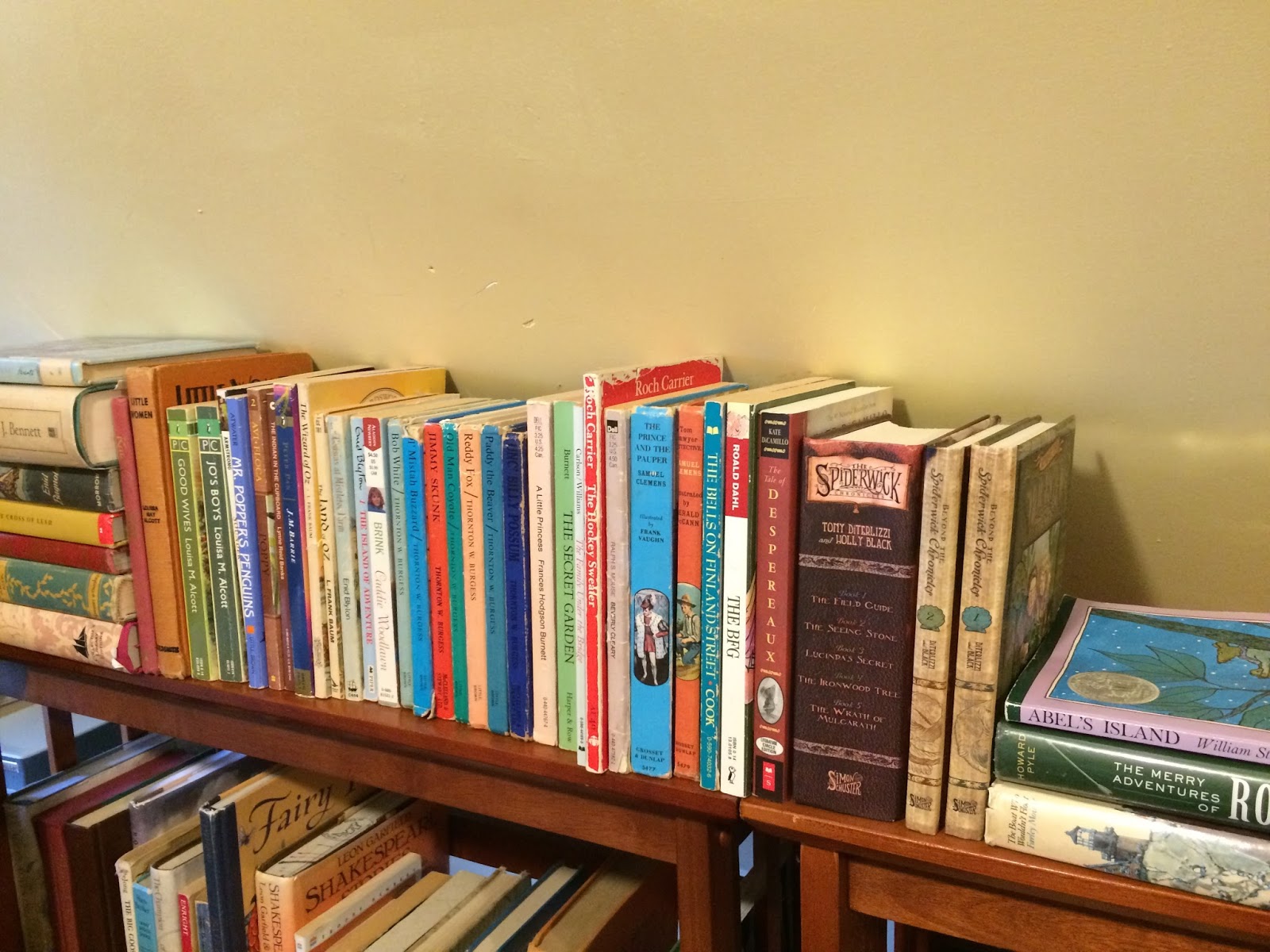
Edited to add some pictures of my "children's fiction" section, because I know you like looking at other peoples' bookshelves. :) You're welcome.


Thursday, December 10, 2015

What Book Has Changed Your Life?

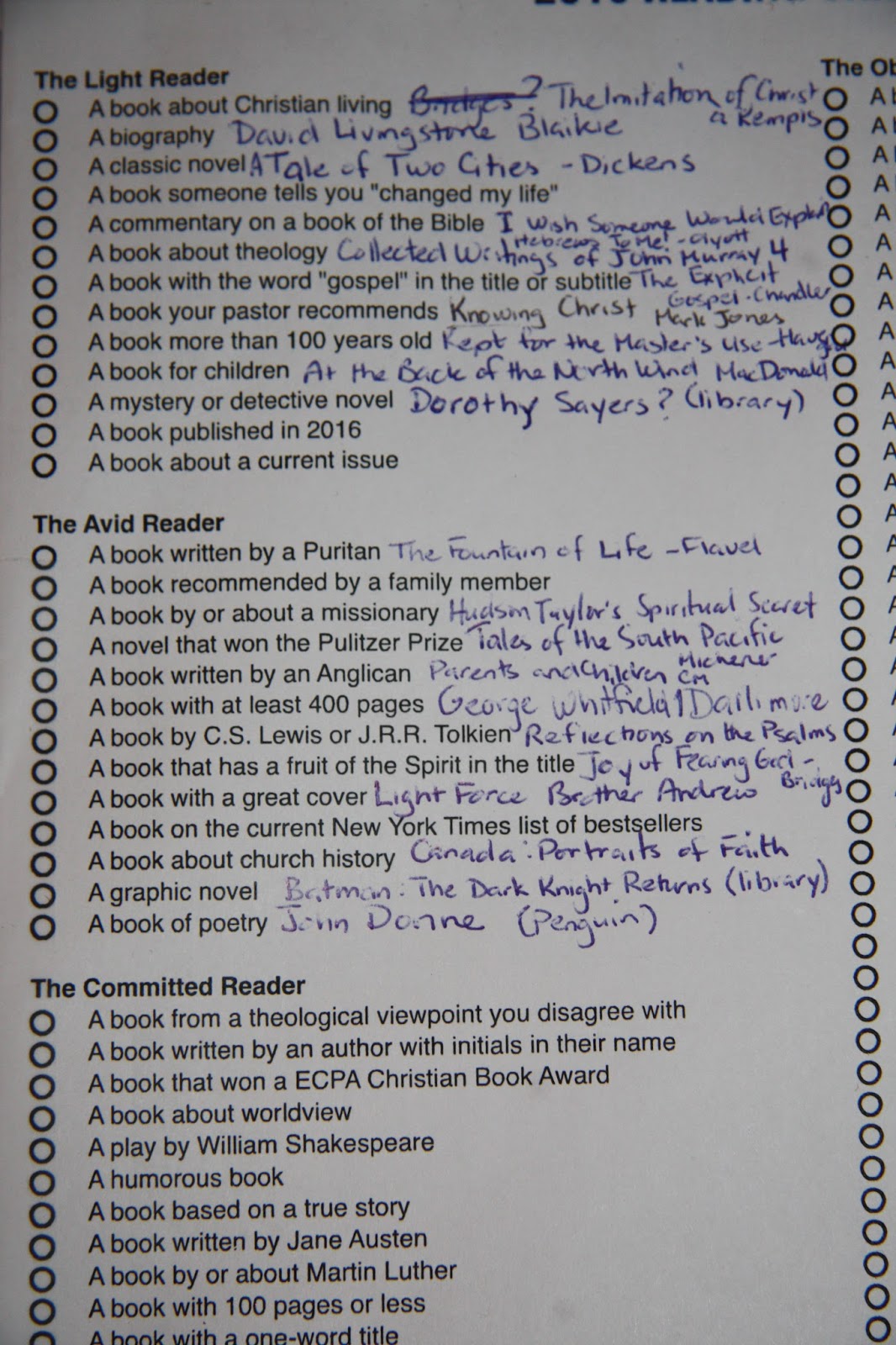
I've spent the last couple of days deciding what books I want to read in 2016. This was sparked by The 2016 Reading Challenge on Tim Challies' blog this week. I printed off the challenge, taped it in my bullet journal, and started marking it up with the titles I would like to read.

My husband and I have an embarrassing number of books on our shelves that we have not read yet. We have always been readers, but have slowed down quite a bit (with the adult reading, anyway) since having children. Somehow our book acquisition rate has not slowed with our reading rate. The truth is, we still want to be avid readers, and are not willing to let that image of ourselves go. We need a plan.

Given our shelves full of books, I populated most of the list with titles from our bookshelves. Books we don't own will hopefully come from the local library.

Here are some of my picks so far:
A book about Christian living: The Imitation of Christ by Thomas a Kempis (on my shelf)
A biography: The Personal Life of David Livingstone by William Blaikie (on my shelf)
A classic novel: A Tale of Two Cities by Charles Dickens (already started, will finish in 2016)
A commentary on a book of the Bible: I Wish Someone Would Explain Hebrews to Me by Stuart Olyott (on my shelf)
A book with the word "gospel" in the title or subtitle: The Explicit Gospel by Matt Chandler (on my shelf)
A book more than 100 years old: Kept for the Master's Use by Frances Havergal (on my shelf)
A mystery or detective novel: Arthur & George by Julian Barnes (at my library) or something by Dorothy Sayers (also at my library)
A book with at least 400 pages: George Whitefield Vol. 1 by Arnold Dallimore (on my shelf)
A graphic novel: Batman: The Dark Knight Returns by Frank Miller (at my library)

One recommendation stopped me, though. "A book someone tells you 'changed my life.'" So I decided to turn to you, dear readers. What book has changed your life?

I can't exactly return the favour, because I don't really tend to think in dramatic terms like that. Usually if a book has come close to "changing my life" it's because it was at the culmination of a long process of life or thought change anyway. Other books have changed my life for a few years or a decade, but the change has not been permanent. But I will give you a list of a few of the best books of my life, if you like. (Amazon links included for your reference. I am not an affiliate. If you're buying, I'd suggest supporting someone who is.)

Literature:
Jane Eyre by Charlotte Bronte
A Sacrifice of Praise: An Anthology of Christian Poetry in English from Caedmon to the Mid-Twentieth Century ed. by James H. Trott

Theology: 
When Grace Comes Home: How the Doctrines of Grace Change Your Life by Terry Johnson
Dynamics of Spiritual Life: An Evangelical Theology of Renewal by Richard F. Lovelace

Christian Life:
Each for the Other:Marriage As It's Meant to Be by Bryan Chappell
Family Vocation: God's Calling in Marriage, Parenting, and Childhood Mary Moerbe and Gene Veith

Education:
Home Education:Training and Educating Children Under Nine by Charlotte Mason

There. Now I'd like to hear from you. What are the books that have changed your life?