Showing posts with label Living Book Discoveries. Show all posts

Thursday, July 26, 2018

Great Stories of Canada

Today I'd like to introduce you to a whole series of living books on Canadian history!

Published between 1953 and 1968, "Great Stories of Canada" are the Canadian equivalent of the popular Landmark series in the US. Sadly, they are long out of print, but you can still find them at library sales and thrift stores. I'm including lots of pictures so you can recognize them when you see them there, and snap them up!

The True NorthThe Bold HeartRed River AdventureKnights of the AirThe First CanadianRevolt in the West

This past year, we read Kerry Woods' The Map-Maker: The Story of David Thompson from this series. We read it as a Canadian substitute for a book on Lewis and Clark in the American curriculum we follow, and it was a worthy substitute. It held the interest of all my students, from SA(9) down to MM(5), and I am confident that they will "know" David Thompson for the rest of their lives. We also made great use of the map in the front of the book for our Canadian geography lessons.

The books in the Great Stories of Canada series are written by various authors. I have not read all of them yet, but skimming through the ones I have I am confident that the writing quality is consistently good. We did find one author, Joseph Schull, (Battle for the Rock, about the Battle on the Plains of Abraham) was not ideal for reading and narration in grade 3 because my student was losing track of the many characters. However, I would still recommend the book, and it would probably have worked for an older student in grades 4-6. Other authors include Pierre Berton, Thomas Raddall, Edward McCourt, and Roderick Haig-Brown.


One of my favourite features of this series are the historical maps in the beginning of each book. Thus far in my experience with these books, I have found that the maps contain all the places mentioned in the story and no more, allowing children to follow along easily as they read.

There are also a few illustrations, in most books one or two pen-and-ink drawings per chapter. The quality of these varies a little depending on the artist employed.


The series was originally published by MacMillan, but you may also find editions published later by The Canadiana Company with two titles per volume, like these.
The Canadiana Company

I also include a list of titles and authors for your convenience. Please note that I do not endorse the contents of each individual book, as I have not read them all. Please do your own due diligence!

1. The Scarlet Force: The Making of the Mounted Police by T. Morris Longstreth
2. The Force Carries On by T. Morris Longstreth
3. Raiders of the Mohawk: The Story of Butler's Rangers by Orlo Miller
4. The Nor-Westers: The Fight for the Fur Trade by Marjorie Wilkins Campbell
5. The Golden Trail: The Story of the Klondike Rush by Pierre Berton
6. Buckskin Brigadier: The Story of the Alberta Field Force in 1885 by Edward McCourt
7. The Map-Maker: The Story of David Thompson by Kerry Wood
8. Arctic Assignment: The Story of the "St. Roch" by Sgt. F.S. Farrar, RCMP
9. Captain of the Discovery: The Story of Captain George Vancouver by Roderick Haig-Brown
10. The Bold Heart: The Story of Father Lacombe by Josephine Phelan
11. Redcoat Sailor: The Story of Sir Howard Douglas by R. S. Lambert
12. Red River Adventure: The Story of the Selkirk Settlers by J. W. Chalmers
13. The True North: The Story of Captain Joseph Bernier by T. C. Fairley and Charles E. Israel
14. The Great Chief: Maskepetoon: Warrior of the Crees by Kerry Wood
15. The Salt-Water Men: Canada's Deep-Sea Sailors by Joseph Schull
16. The Rover: The Story of a Canadian Privateer by Thomas H. Raddall
17. Revolt in the West: The Story of the Riel Rebellion by Edward McCourt
18. Knights of the Air: Canadian Aces of World War I by John Norman Harris
19. Frontenac and the Iroquois: The Fighting Governor of New France by Fred Swayze
20. Man from St. Malo: The Story of Jacques Cartier by Robert D. Ferguson
21. Battle for the Rock: The Story of Wolfe and Montcalm by Joseph Schull
22. The Queen's Cowboy: James Macleod of the Mounties by Kerry Wood
23. Fur Trader: The Story of Alexander Henry by Robert D. Ferguson
24. The First Canadian: The Story of Champlain by C. T. Ritchie
25. Adventurers from the Bay: Men of the Hudson's Bay Company by Clifford Wilson
26. Ships of the Great Days: Canada's Navy in World War II by Joseph Schull
27. Mutiny in the Bay: Henry Hudson's Last Voyage by R. S. Lambert
28. Runner of the Woods: The Story of Young Radisson by C. T. Ritchie
29. The Good Soldier: The Story of Sir Isaac Brock by D. J. Goodspeed
30. Tecumseh: The Story of the Shawnee Chief by Luella Bruce Creighton
31. The Row-Boat War: On the Great Lakes 1812-1814 by Fred Swayze
32. The Ballad of D'Arcy McGee: Rebel in Exile by Josephine Phelan
33. The Savage River: Seventy-One Days with Simon Fraser by Marjorie Wilkins Campbell

Happy hunting!

P.S. Have you read any of these books? I'd love to hear how you liked specific books in the series.

Monday, March 7, 2016

Dear Canadian CM Homeschoolers,

Let's Help Each Other Find Living Books!

There is such a wealth of resources and book lists for homeschoolers using Charlotte Mason's methods. I appreciate these even more when I realize how difficult it is to start from scratch to find living books for a particular subject. I need all the help I can get to find living books on Canadian history, geography, literature, and art!


Yes, I have found little helps here and there. These are some helpful websites I've seen:

-Ambleside Online's Canada page has a number of suggestions.

- The Ambleside Online forum has a post entitled "Comparison of Canadian History Books" with excerpts from several books that could be used as "spines" for Canadian history. 

-The Simply Charlotte Mason bookfinder has quite a few pages of Canadian resources. Not all of them are living books, though. This resource will become more helpful as more people leave reviews for the books listed. 

-O Canada History is the blog of a Canadian homeschooling mom listing many Canadian history resources by time period.

-Maple Hill Academy. This is the personal blog of a Canadian Charlotte Mason homeschooler. It has not been updated very often lately, but it has several posts with her past plans for Canadian history.

-The Canadian Homeschooler has a "Canadian History Through Living Books" page. I haven't explored it yet, but it looks like it might be a great starting point for living books from different time periods in Canadian history. (post edited to add 08/03/16)

-Tea Time with Annie Kate has reviews of several Canadian books that Annie Kate has used with her family over the years. (post edited to add 08/03/16)

Still, there is a lot of trial and error in finding living books, especially when you buy online and can't actually see what you're buying beforehand. One of my early mistakes was The Story of Canada by Isabel Barclay (not to be confused with any other books with the same title). It was mentioned briefly as an overview of Canadian history for early elementary on the Ambleside Online Canada page, and I ordered it. It was written in simple, short sentences, perhaps suitable for early readers, but lacking any detail that might capture the imagination. So even with the help of recommendations from websites like the ones I mentioned above, you can end up with a book that is not suitable for reading and narration. 

I think the best way we Canadian CM homeschoolers can help each other is to share whatever wonderful living books we're finding on Canadian history, biography, geography, literature, or art. I think it's also important to share in places others will find our help. Sharing on a Facebook wall in response to a question is great for the moment, but a few days later it's hard to find again. Some places you can share that might help others for the future:

-Charlotte Mason Canada FaceBook group. Click on "Files." There are several documents, including a "Canadian History" document with an editable list of books.

-Simply Charlotte Mason bookfinder. With a basic (free) subscription, you can review books already in the bookfinder, which will really help others who are trying to sift through the many, many options listed (16 pages of books come up when you search for "Canada."). Not all of the titles included in the bookfinder are in fact living books, and it will be so helpful to the rest of us if you share even a brief review of the books you know.
With an upgraded (paid) subscription, you can also share resources publicly.

-Ambleside Online forum. If you are a member of the forum, you can add a short excerpt to the "Comparison of Canadian History Books" thread that will enable other forum members to compare different texts and decide what to buy.

-On your own blog or website. If you have a blog, please review Canadian living books and resources you have used. If you leave a link in a comment below, I'll add your links to my "CM in Canada" page so others can reference them long-term from my page.


And now over to you. What is your favourite place to go for recommendations for Canadian living books? Where would it be most helpful for you if others were to share their recommendations and reviews? Let's talk!

Wednesday, September 16, 2015

In Our Book Basket: Rembrandt Resources

Picture study is very simple in our home. I choose an artist for each twelve-week term, and we study six of his paintings. At the moment we don't do a lot of learning about the artist, the focus is just on looking at the picture, becoming familiar with it, and storing it up in our "mind's eye." 
Since we do picture study once a week, this allows two weeks per painting chosen. The first week, we take five or ten minutes and just look at and talk about the picture. Then I put the picture on the wall or on a stand where it can be seen whenever anyone wants to look at it. The second week, we do a proper picture study and look at the painting until we can see it in our minds with our eyes closed. Then SA(7) and I describe it in detail, with occasional input from JJ(5). That's all there is to it right now.

This term, just on a whim, I decided to check if my library had any resources on the artist I chose: Rembrandt van Rijn. When the books came in I popped them into my library basket, intending to look at them more closely later. Later never fully came for me. What can I say? I'm a busy mom. But having them in the basket proved to be rewarding anyway.
JJ(5) discovered one of them, The World of Rembrandt, and pored over it for at least two days. Later, when I pulled out a print of "The Night Watch" for our picture study time, he jumped up with excitement, ran and got the book, and opened it to the same picture. But what surprised me the most was the morning two weeks later. I was reading the Acts 7 story of Stephen to the boys. JJ asked, "Excuse me, may I go get the book with that picture in it?" I gave my permission, expecting him to come back with an illustrated children's Bible or something similar. Instead, he came back with this book, opened to a black and white copy of Rembrandt's 1625 "Stoning of St. Stephen." I was amazed...this book is full of Rembrandt's paintings, most in full colour. Yet JJ recognized the story I was reading instantly and related it to one picture he had looked at long before.

Another worthy resource was Rembrandt: A Biography by Elizabeth Ripley. This was a lovely living book, well-written and engaging. It was completely illustrated with copies of Rembrandt's own paintings, though unfortunately these were all in black and white. (At least my library copy was...) I recommend this book for about age seven and up.

I also stumbled across Hana in the Time of Tulips, a lovely picture book about the tulip craze in Holland during the time of Rembrandt. It only had a brief reference to Rembrandt, but the boys were very excited to recognize his name in the book.

The last book I checked out was for me, not the children. Henri Nouwen's The Return of the Prodigal Son is a book about the spiritual impact Rembrandt's "The Return of the Prodigal Son" had on Nouwen's life. This type of meditation and seeing deep meaning in a painting was completely foreign to my own experience, yet I was moved and instructed by it. Being Protestant myself, I felt uncomfortable with some of his ideas (he is a Catholic priest), but it was well worth reading all the same.


Wednesday, June 17, 2015

In Our Book Basket: Brundibar

I'm not very dramatic when it comes to reading aloud. I think I read expressively enough, but I don't really "do" voices or accents. My boys don't seem to mind. However, I've come across a book that a person can't help but read dramatically. That book is Brundibar, adapted by Tony Kushner from a Czech children's opera and illustrated by Maurice Sendak. The book tells the story of two poor children who need milk for their sick mother. In their quest to get some, they have a run-in with an evil organ-grinder named Brundibar. In the end, with the help of a few animals and a lot of other children, they are victorious. Brundibar is chased away, the children get the milk, and their mother gets well again.

Try to say this without rolling your 'r's and adopting a voice you didn't know you had:


The book's language and illustrations are unusual, to say the least, but they work. They really give the dramatic feeling of a play.


But there is something else unusual about this book, and I came upon it slowly. First I noticed that the doctor in the book had a yellow (Jewish) badge on his coat. Then I started to notice the badge in other places. I turned to the book jacket to see if it said anything about this, and it did.
"This book is based on a Czech opera of the same name ("Brundibar" is Czech slang for "Bumblebee"), with a libretto by Adolf Hoffmeister, set to music by Hans Krasa. Completed in 1938, the opera was performed fifty-five times by the children of Terezin, the Nazi concentration camp. Krasa, who was Jewish, was also imprisoned in Terezin. He was killed in Auschwitz in 1944."
Now fascinated, I googled "Terezin" and "Brundibar" and came upon a video from CBS News entitled Brundibar: How the Nazis Conned the World. There I learned how music and art flourished in the concentration camp, and how "Brundibar" was the most popular show in town. The Nazis, who had begun to be questioned on what was happening to the Jews, briefly turned Terezin into a model town and produced a propaganda film highlighting a performance of Brundibar to show how well they were treating the Jews. I also learned that not only Krasa, but most of the children who acted in the opera were killed soon after in Auschwitz.

And so what seemed like an original and light-hearted children's book turned into a door into history for me. I have not passed this on to my young children. They enjoy the book simply, as it is. Some day they will know the heart-breaking history too, and appreciate the courage this book depicts that much more.

What about you? Is there a children's book that has become so much more for you? Tell me about it in the comments!

Tuesday, June 9, 2015

In Our Book Basket: Luba and the Wren

Many, if not most, of the books in our library book basket are ones that have been recommended to me. Blogs such as Hope is the Word or Little Book, Big Story regularly draw my attention to excellent children's books. In response, I go online and reserve them at my library if they are available in our provincial library system. I get an email when they come in, and I drop into the library on my next errand day to pick them up. We have discovered and enjoyed countless books using this method.

However, there is still something to be said for going into the library and browsing the shelves. Some of our very favourite books have been discovered this way. Flute's JourneyLynne Cherry's remarkable biography of a wood thrush, also Jonathan Bean's wonderful book Building Our House and Robert McCloskey's Time of Wonder fall into this category. With my family of three little boys and a baby, library visits happen less often than I would like, but we did manage to go one morning about two weeks ago. This time, I discovered Patrica Polacco.

Patricia Polacco is a prolific author and illustrator who actually did not begin to write children's books until she was forty-one years old! There is a wide variety in the type of stories she tells. There are legends and folk tales, poignant stories from history, and stories drawn from her own life and her Ukrainian/Russian heritage. Despite the diversity of her themes, Polacco's beautiful illustrations make her books instantly recognizable and unite them all.

Our (very small) library has quite a few of Polacco's books on its shelves, and we have just begun to explore them. John Philip Duck, Appelemando's Dreams, and Thunder Cake are three that we've really enjoyed. But our very favourite so far, and one that SA(6) has already asked to hear approximately ten times, is Luba and the Wren.

This is a Ukrainian version of the classic tale of the Fisherman and the Flounder. Instead of the fisherman, there is Luba, a sweet, gentle girl. Instead of the flounder, there is a wren. Instead of the fisherman's wife, there are Luba's discontented and demanding parents. I won't spoil the ending for you, but just tell you that I think the ending to this tale is much more satisfyingly thought-provoking than the original.

At our house, our 6-year-old enjoyed this book more than the younger children, and I do think it is best for children of his age and older. This is a library book that's so good that it's going on my to-buy list (a very select list, by the way...).

Go, check it out!

I'd also love to hear what wonderful books you've discovered on the shelves of your library.

Friday, November 28, 2014

November 2014 Favourite Read-Aloud Roundup

I am late for this month's Read-Aloud Thursday Link-up at Hope is the Word, but I still have to participate. This month has been so incredibly rich in wonderful picture books that I simply must share!

First, we discovered Bonny Becker's Bear and Mouse books. The Sniffles for Bear has to be one of the funniest picture books I've ever read. If you think "man colds" are funny, you will enjoy this book. At the same time, there is a real sweetness in the loving friendship between Bear and Mouse.

SA(6) enjoyed reading the entire series on his own, so if you're looking for books at about a level 2 or 3 reading level, these books are a great choice.


Friendship was also the theme of another favourite this month. William Steig's Amos & Boris has gone straight to my list of the top 5 best ever picture books. Amos is a mouse, and Boris is a whale. They become fast friends when Boris rescues Amos after he is shipwrecked in the middle of the sea. I can't tell you why their friendship touched my heart so deeply. You will have to read it yourself and feel the magic of this tender, sweet story.
There. Another picture book that's not just for kids.


In nonfiction, we enjoyed Snowflake Bentley by Jacqueline Briggs
Martin. Our nature focus this term is weather and climate, and I got this book from the library to fit in with that. Wilson Bentley had a passion for snow and for capturing it on film. His story is beautifully told, and the illustration and design of the book are deserving of the Caldecott Medal they received. We spent some time exploring Bentley's photographs online after reading this book. SA(6) wanted to know why snowflakes always have six sides, and as usual, I did not explain it as well as I could wish. How do you explain the chemistry of snowflakes to a 6-year-old?


Last but not least, we read several of Jim Arnosky's books: Thunder
Birds, Slither and Crawl, and Wild Tracks. I would highly recommend all three of these as living books. Arnosky clearly loves the subjects of his books, and passes on his keen interest and the sort of detail one can only get from first-hand observation. My boys loved the large, fold-out pages of illustrations. Arnosky is a wonderful artist. I look forward to discovering more of his books.


I am linking up with Read-Aloud Thursday. Click through for more book recommendations!


Thursday, October 23, 2014

Living Book Discoveries: Lynne Cherry

As a Charlotte Mason homeschooler, I am always on the lookout for "living books" for my children. Starting out, it can be hard to discern whether a book is, in fact, living. (I'm hoping it will get easier over time. I'll let you know.) I am so grateful for Ambleside Online and other booklists that take away some of the burden of finding the very best books. However, I also like poking through the library and discovering wonderful books for myself.

What do I look for in a living book?
- Written by someone with a love for the subject who communicates that passion directly to the readers
- Well written, engaging, not dumbed down
- Not just dry facts, but ideas

I know I mentioned Lynne Cherry in my last read-aloud post, but I wanted to shine a brighter spotlight on her. She is an environmentalist and the author and illustrator of many children's books. Our library had four of them, so I am basing my opinions on those four. I would love to hear from you in the comments if you have read others of her books, and how you liked them.

Flute's Journey: The Life of a Wood Thrush was our favourite book so far. I used it as a school book with my six-year-old. He narrated well, perhaps better than any other of his school books so far. A week or two later, he and his four-year-old brother told their grandma about the book, and I was amazed at the details they remembered. Comparing it to the Burgess Bird Book (our regular school book about birds), this book's vocabulary is a little more accessible, though not dumbed down. It has the same level of detail, perhaps more, but that detail is communicated in a straightforward, active story rather than in conversational style. Finally, Lynne Cherry's illustrations are meticulous as well as beautiful, and I appreciated not having to go elsewhere for illustrations of the wood thrush at various stages or for maps of its migration.
Most importantly, this book was a delight for my son. If like us, you are struggling a bit with the style of the Burgess Bird Book in Ambleside Online's Year 1, may I suggest substituting this book for a chapter or two, just for the sake of joy in learning and in narration? You will not be short-changed in the knowledge gained.

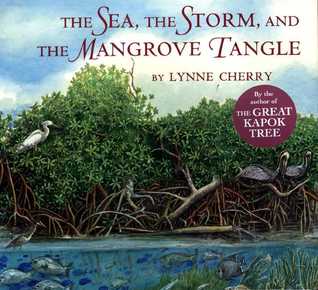
The Sea, the Storm, and the Mangrove Tangle is much in the same style as Flute's Journey. It is the story of how a mangrove grows from a propagule into a huge tangle that shelters fish, seahorses, birds, and other wildlife. We read it aloud together, and the boys enjoyed it. I did not require narration, but I think it would work well as a school book too. It also includes maps of where mangroves grow.

How Groundhog's Garden Grew is quite different from the first two books. It is a make-believe story of how a squirrel helps a groundhog grow his own garden. I think it may be aimed at slightly younger children (3 and up). It weaves in many interesting details about gardening: collecting seeds, transplanting, pollination, perennials. The story ends with groundhog sharing his bounty at a big Thanksgiving dinner with all his garden friends. Like all of Lynne Cherry's books, the illustrations in this book are wonderfully detailed. My boys especially liked the pictures of how a seed grows from seed, to seedling, to full-grown plant. I think I'll take this one out of the library again before our next gardening season.

I mentioned at the beginning that Lynne Cherry is an environmentalist. I am not, at least, not in the same sense. (I believe it's our God-given responsibility to care for the earth and its creatures. I balance that with the belief that the earth's resources are there for us to use. I am cautious about environmentalism for its own sake.) The Great Kapok Tree is the book I enjoyed least of all the ones I picked up from our library, though it was just as beautifully illustrated. To be honest, I would have appreciated a straight-forward, honest look at the species of the rainforest and how they are affected when the trees are cut down. I only disliked the way it was communicated in this book, where it seemed like Cherry was trying to manipulate the emotions of her readers and convert them to environmentalism. However, this book has won many honours, and you may like it even if I didn't.

Check out this video of Lynne Cherry working on one of the illustrations for How Groundhog's Garden Grew.