Showing posts with label Science of Relations. Show all posts

Friday, August 11, 2017

The Goal of Education is Relationship: My Theme for This School Year

Having just read School Education by Charlotte Mason, one of the things I have been thinking about most deeply is her principle "Education is the Science of Relations." In the past 3-4 years as I have been following Charlotte Mason's philosophy and methods, I think that I have focused more on the instruments of education: "Education is an Atmosphere, a Discipline, a Life." "Education is the Science of Relations" is a different kind of statement. It is not about the instruments of education, it is about the goal of education.

Yesterday I was half listening to the latest "Close Reads" podcast (the Q&A on Brideshead Revisited), when Andrew Kern said something that arrested me:
"The goal of education is friendship."
Now, I don't pretend to know how he would expand on that statement, but my mind immediately went back to Charlotte Mason's "Science of Relations". I believe that she would say something quite similar: The goal of education is relationship.

Here's Charlotte Mason's Principle 12:
Out of this conception [that the child’s mind comes fit to deal with knowledge, and that facts must not be presented without their informing ideas] comes our principle that, – "Education is the Science of Relations"; that is, that a child has natural relations with a vast number of things and thoughts: so we train him upon physical exercises, nature lore, handicrafts, science and art, and upon many living books, for we know that our business is not to teach him all about anything, but to help him to make valid as many as may be of--
 "Those first-born affinities
 "That fit our new existence to existing things."
Children are born persons. God has made them so that they are naturally equipped to form relationships with the world around them (things), with themselves (self-knowledge), with the people around them, with people and things of all times in history and all places in the world, and most importantly with Himself. Our job in education is to make the introductions; to facilitate with the goal that they will form relationships of friendship, of duty, of affection, or whatever is proper to each particular relationship.

There is one hitch for teachers, though. We don't know which introductions will result in friendship. Children form their own relationships with things and people they have a natural affinity for. One thing we do know, however, is that as human beings they have a natural affinity to many things. This is why we introduce children to such a feast in a Charlotte Mason education: "physical exercises, nature lore, handicrafts, science and art, and many living books." We know that if we make enough introductions, somehow, somewhere, they are going to "take to" something or someone. And the more relationships they form, the more relationships they are able to form.

The Goal of Education is Relationship is my theme for this school year. I'm going to write it on my wall and think about it as we're going through our daily routine. I hope it will make me ask questions of myself:

-Am I too focused on "covering everything"? (a common failing with me...)

-What kind of relationships am I facilitating here? Relationships of delight and affection? Of stress and animosity? Of indifference? (Of course, I do not control my children's responses, but I may have an effect on them by the way I present things.)

-Is there any way I can help with the relationships my children are forming? Resources? A well-placed question or comment? Standing aside? 

-How can I create a culture of sharing as both they and I form our own relationships with the things and books we study?

-How can I present this thing or book in a winsome way that will not hinder or manipulate my child's potential relationship with it?


Are there other questions I should be asking myself? How do you work out the principle "Education is the Science of Relations" in your day-to-day work as a home educator?

Friday, August 4, 2017

School Education Chapters 20-22: Suggestions Towards a Curriculum

This blog post is part of an on-going daily series this month as I read (very quickly) through School Education by Charlotte Mason. Join me! Pick up your book and read a chapter, or find it free online at Ambleside Online.

Summary

Charlotte Mason leaves her ideas for the selection of curriculum till last, and before she does, she reiterates all the principles that have come before in this book. "...because a curriculum is not an independent product, but is linked to much else by chains of cause and consequence."

Curriculum needs to be selected with several principles in mind:
-We do not have the right to pick and choose a limited number of subjects for children to study.
-Children are intelligent, though there is much they do not know yet.
-Our aim is knowledge, not mere information.
-We want to make children "at home in the world of books," putting them in direct communication with the minds of the authors.

Some do's and don'ts for teachers:
-Do find the right living book.
-Do let the author speak for himself, don't get in the way with too much explaining.
-Do be cautious about the use of "appliances" other than ones that allow children to observe things for themselves. (Microscopes, telescopes, and magic lanterns are good, elaborate models and diagrams not so much.)
-Do co-ordinate studies in a natural way, don't make artificial connections between subjects (as in unit studies).

Because education is all about making relationships with things, with people past and present, and with God, the curriculum we choose needs to cover a broad range of subjects: religion, philosophy, history, languages, mathematics, science, art, physical exercises, and manual crafts. Charlotte Mason gives some general guidelines as to what curriculum a child between twelve and fourteen should use, and what they should know:
Religion: curriculum is the Bible itself.
History: English history, contemporary French history, and Greek and Roman history by way of Plutarch's Lives.
Language: A fair knowledge of English grammar, some literature, more or less power in speaking and understanding French (able to read an easy French book), beginning German, ability to read at least 'Fables' in Latin.
Mathematics: "I need not touch upon the subject [...] it is rapidly becoming an instrument for living teaching in our schools."
Science: Nature study, the power to recognise and name natural things, keeping of personal nature-journals. Supplemented with occasional object lessons.
Drawing: No use of mechanical aids. Free rendering of objects observed. Illustrations of stories don't have value as art instruction, but are useful imaginative exercises.
Art Appreciation: Some study of the lines of composition, light and shade, and style with the object of appreciation, not reproduction.
Manual and Physical Training

Using living books as curriculum is efficient! Even given all the subjects to be studied, in the Parents' Review School all book work was done between 9:00 and 11:30 for the lowest class, and 9:00 and 1:00 for the highest class. One or two hours in the afternoon were devoted to handicrafts, field-work, and drawing, and the evenings were free for children's own hobbies, family reading, or other things.

Six reasons for failure in education:
-Oral lessons by a teacher, which are far inferior to treatment of the same subject by an original thinker in a living book.
-Lectures, also inferior to living books
-Textbooks, both the dry and uninteresting kind and the easy and beguiling kind.
-Motivations for learning other than desire for knowledge
-Dependence on apparatus and illustrative appliances
-Use of readers. Even if they have good selections, they can't match a whole book.
Teachers must also be careful not to follow educational fads.

Quotes

Chapter 20
"--education should aim at giving knowledge 'touched with emotion.'" (Quoting Matthew Arnold) (p. 220)

"Therefore we do not feel it is lawful in the early days of a child's life to select certain subjects for his education to the exclusion of others; to say he shall not learn Latin, for example, or shall not learn Science; but we endeavour that he shall have relations of pleasure and intimacy established with as many as possible of the interests proper to him; not learning a slight or incomplete smattering about this or that subject, but plunging into vital knowledge, with a great field before him which in all his life he will not be able to explore." (p. 223)

"there is no such thing as the 'child-mind'; we believe that the ignorance of children is illimitable, but that, on the other hand, their intelligence is hardly to be reckoned with by our slower wits. In practical working we find this idea a great power; the teachers do not talk down to the children; they are careful not to explain every word that is used, or to ascertain if children understand every detail." (p. 223)

"Not what we have learned, but what we are waiting to know, is the delectable part of knowledge." (p. 224)

"The distinction between knowledge and information is, I think, fundamental. Information is the record of facts, experiences, appearances, etc., whether in books or in the verbal memory of the individual; knowledge, it seems to me, implies the result of the voluntary and delightful action of the mind upon the material presented to it." (p. 224)

"Perhaps the chief function of a teacher is to distinguish information from knowledge in the acquisitions of his pupils. Because knowledge is power, the child who has got knowledge will certainly show power in dealing with it. He will recast, condense, illustrate, or narrate with vividness and with freedom in the arrangement of his words. The child who has got only information will write and speak in the stereotyped phrases of his text-book, or will mangle in his notes the words of his teacher." (p. 225)

"It seems to me that education, which appeals to the desire for wealth (marks, prizes, scholarships, or the like), or to the desire of excelling (as in the taking of places, etc.), or to any other of the natural desires, except that for knowledge, destroys the balance of character; and, what is even more fatal, destroys by inanition that desire for and delight in knowledge which is meant for our joy and enrichment through the whole of life." (p. 226)

"no education seems to be worth the name which has not made children at home in the world of books, and so related them, mind to mind, with thinkers who have dealt with knowledge." (p. 226)

Chapter 21
"A book may be long or short, old or new, easy or hard, written by a great man or a lesser man, and yet be the living book which finds its way to the mind of a young reader. The expert is not the person to choose; the children themselves are the experts in this case." (p. 228)

"The master must have it in him to distinguish between twaddle and simplicity, and between vivacity and life. For the rest, he must experiment or test the experiments of others, being assured of one thing--that a book serves the ends of education only as it is vital." (p. 229)

"The business of the teacher is to put his class in the right attitude towards their book by a word or two of his own interest in the matter contained, of his own delight in the manner of the author. But boys get knowledge only as they dig for it. Labour prepares the way for assimilation, that mental process which converts information into knowledge; and the effort of taking in the sequence of thought of his author is worth to the boy a great deal of oral teaching." (p. 229)

"Do teachers always realise the paralysing and stupefying effect that a flood of talk has upon the mind?" (p. 229)

"For the same reason, that is, that we may not paralyse the mental vigour of children, we are very chary in the use of appliances (except such as the microscope, telescope, magic lantern, etc.)." (p. 230)

"the co-ordination of studies is carefully regulated [...] solely with reference to the natural and inevitable co-ordination of certain subjects. Thus, in readings on the period of the Armada, we should not devote the contemporary arithmetic lessons to calculations as to the amount of food necessary to sustain the Spanish fleet, because this is an arbitrary and not an inherent connection; but we should read such history, travels, and literature as would make the Spanish Armada live in the mind." (p. 231)

"Writing, of course, comes of reading, and nobody can write well who does not read much." (p. 233)

"The teachers are careful not to make these nature walks an opportunity for scientific instruction, as we wish the children's attention to be given to observation with very little direction. In this way they lay up that store of 'common information' which Huxley considered should precede science teaching; and, what is much more important, they learn to know and delight in natural objects as in the familiar faces of friends."(p. 237)

Chapter 22
"To educate children for any immediate end--towards commercial or manufacturing aptitude, for example--is to put a premium upon general ignorance with a view to such special aptitude. [...] Excellent work of whatever kind is produced by a person of character and intelligence, and we who teach cannot do better for the nation than to prepare such persons for its uses. He who has intelligent relations with life will produce good work." (p. 241)

"...[theorists] feel it to be more important that a child should think than that he should know. My contention is rather that he cannot know without having thought; and also that he cannot think without an abundant, varied, and regular supply of the material of knowledge."

"Let us, out of reverence for the children, be modest; let us not stake their interests on the hope that this or that new way would lead to great results if people had only the courage to follow it. It is exciting to become a pioneer; but, for the children's sake, it may be well to constrain ourselves to follow those roads only by which we know that persons have arrived, or those newer roads which offer evident and assured means of progress towards a desired end. Self-will is not permitted to the educationalist; and he may not take up fads." (p. 245)

"Knowledge is, no doubt, a comparative term, and the knowledge of a subject possessed by a child would be the ignorance of a student. All the same, there is such a thing as an educated child--a child who possesses a sound and fairly wide knowledge of a number of subjects, all of which serve to interest him; such a child studies with 'delight.'" (p. 245)

"My plea is, and I think I have justified it by experience, that many doors shall be opened to boys and girls until they are at least twelve or fourteen, and always the doors of good houses, ('Education,' says Taine, 'is but a card of invitation to noble and privileged salons'); that they shall be introduced to no subject whatever through compendiums, abstracts, or selections; that the young people shall learn what history is, what literature is, what life is, from the living books of those who know." (p. 247)


That's it for this week, and the book is done! I'll be back next week with the appendices.

Thursday, August 3, 2017

School Education Chapters 17-19: Educated by Our Intimacies

This blog post is part of an on-going daily series this month as I read (very quickly) through School Education by Charlotte Mason. Join me! Pick up your book and read a chapter, or find it free online at Ambleside Online.

Summary

In these three chapters, Charlotte Mason uses autobiographical works "The Prelude" by William Wordsworth and Praeterita by John Ruskin to illustrate how education is the science of relations.

Because children are born persons, we are limited to the use of three external instruments of education: atmosphere, discipline, and life. Any other instrument would encroach on the child's personality by playing on his vanity, or his love, or his desire to please, or even his fears. Even atmosphere, discipline, and life are limited by our respect for them as persons: we do not manipulate their environment to shield them too much from real life, and we help them develop habits in the context of real life.

 Education is the science of relations: "we personally have relations with all that there is in the present, all that there has been in the past, and all that there will be in the future--with all above us and all about us--and that fulness of living, expansion, expression, and serviceableness, for each of us, depend upon how far we apprehend these relationships and how many of them we lay hold of." (p. 186) In education, our role as parents and teachers is "to remove obstructions and to give stimulus and guidance to the child who is trying to get into touch with the universe of things and thoughts which belong to him." (p. 188)

Neither Wordsworth nor Ruskin had perfect educations, but the ideas that took hold of them and bore fruit in their lives were the result of their intimacies. Charlotte Mason gives examples from Ruskin of how he handled and made with material objects, from Wordsworth of his intimacy with wildflowers, from both of their love of books by specific authors. There were limitations in the educations of each of them, but their autobiographical works show how children latch on to "their proper affinities" when they are given the opportunity to do so.

Education as the science of relations should not be seen as an excuse to be lazy or unintentional in our schooling. Strenuous effort has to be put into making these relationships. Often this effort is made for the joy of it, but it is work all the same. Quiet, steady, daily effort is more conducive to "Captain ideas" than taking random special opportunities to learn.

Quotes

"habits, ideas, and circumstances are external, and we may all help each other to get the best that is to be had of these; but we may not meddle directly with the personality of child or man." (p. 183)

"All I would urge is a natural treatment of children, and that they be allowed their fair share of life, such as it is; prudence and not panic should rule our conduct towards them." (p. 185)

"habits, whether helpful or hindering, only come into play occasionally, while a great deal of spontaneous living is always going on towards which we can do no more than drop in vital ideas as opportunity occurs." (p. 185)

"Our deadly error is to suppose that we are his showman to the universe; and, not only so, but that there is no community at all between child and universe unless such as we choose to set up." (p. 188)

"It is enough for the present if they have shown us in what manner children attach themselves to their proper affinities, given opportunity and liberty. Our part is to drop occasion freely in the way, whether in school or at home. Children should have relations with earth and water, should run and leap, ride and swim, should establish the relation of maker to material in as many kinds as may be; should have dear and intimate relations with persons, through present intercourse, through tale or poem, picture or statue; through flint arrow-head or modern motor-car: beast and bird, herb and tree, they must have familiar acquaintance with. Other peoples and their languages must not be strange to them. Above all they should find that most intimate and highest of all Relationships,--the fulfilment of their being." (p. 209)

"We must get rid of the notion that to learn the 'three R's' or the Latin grammar well, a child should learn these and nothing else. It is as true for children as for ourselves that, the wider the range of interests, the more intelligent is the apprehension of each." (p. 209)

(quoting Sir Walter Scott in Waverley:) "Alas, while he was thus permitted to read only for the gratification of his amusement, he foresaw not that he was losing for ever the opportunity of acquiring habits of firm and assiduous application, of gaining the art of controlling, directing, and concentrating the powers of his mind for earnest investigation--an art far more essential than even that intimate acquaintance with classical learning which is the primary object of study." (p. 210)

"we cannot catch hold of any one of the affinities that are in waiting for us without strenuous effort and without reverence." (p. 211)

Tuesday, August 1, 2017

School Education Chapter 14: A Master-Thought

This blog post is part of an on-going daily series this month as I read (very quickly) through School Education by Charlotte Mason. Join me! Pick up your book and read a chapter, or find it free online at Ambleside Online.

Note: I'm sorry this is post took me two days! It was a very challenging chapter for me to understand, let alone summarize. I read it three times: twice in the original, and once in the modern paraphrase at AO. I'm sure I didn't capture it, but I tried!

Summary

Education is an atmosphere, a discipline, a life. It is a challenge to live up to our motto. One of the most common problems is when people take "a part for the whole, and a part of the part for the whole of that part." (p. 149) 

If we focus only on education as an atmosphere, there will be a resulting lack of vigour in our children's curiosity, attention, and effort. If we focus only on education as a life (ideas), the result will be a lack of balance in understanding the relative importance of different ideas. If we focus on education as a discipline, we will expect a system of effort to produce a specific result, and that result will be rather narrow.

Having made sure we understand this balance, Charlotte Mason turns to consider "Education is a Life."

In the Spanish Chapel of the church of S. Maria Novella, there is a fresco which shows the Holy Spirit descending in the form of a dove. Immediately below him are the disciples who were first inspired by Him. Under them is a diverse crowd of many nationalities who received the benefits of that outpouring. In the lower part of the fresco, there are the cardinal virtues floating above the apostles and prophets, who "spake as they were moved by the Holy Ghost." Interestingly, the seven liberal arts are also pictured as coming from the Holy Spirit: grammar, rhetoric, logic, music, astronomy, geometry and arithmetic, though the representatives of each were not Christians. 

In this fresco, Charlotte Mason sees a unifying principle, not only for education, but for all of life. "Our piety, our virtue, our intellectual activities, and, let us add, our physical perfections, are all fed from the same source, God Himself; are all inspired by the same Spirit, the Spirit of God." (p. 155)

But doesn't this principle contradict science, and particularly, evolution? Evolution was the "master-thought" of Charlotte Mason's own age, and she had no reason to distrust its truth. To her, evolution provided a key to the interpretation of science. However, Charlotte Mason does not believe that evolution explains everything and eliminates a basis for belief in God and the soul.

Charlotte Mason believes that all truth, however discovered, is God's truth. Ultimately, no truth will contradict another truth. Also, no single aspect of truth that is discovered will be found to explain everything and eliminate Personality. The knowledge of God gives us a broader view than even a knowledge of history affords. [I'm not sure exactly what she means, but I think she is saying that as a Person, God is in control of all of science and history, including what truths people discover when. He is working out his purposes in all of it. -np] Recognizing this, we can pass on to our children reverence for God, respect for science, and open-mindedness.

It is tempting to take the great ideas of our own time and make them the basis for our children's education. However, there are so many of them that we cannot possibly use them all. We pick and choose and end up with a one-sided education. We need a universal principle to evaluate all the ideas and put them in their proper place. Charlotte Mason proposes this one: Education is the science of relations.

A child should be put into relationship with the material world, with people and ideas from both the present and the past. This is such a broad aim, but it can be accomplished by the time a child is thirteen or fourteen because it does not depend on how much is learned, but how things are learned. They need to be given a broad curriculum, learning from first-hand sources. Teachers guide, but do not mediate the knowledge to their students. Subjects are not chosen or rejected on utilitarian grounds, because that would limit a child's exposure to ideas. An idea that truly captures a child will do more for his education than years of slogging.


Quotes

"...a broad divergence in practice often arises from what appears to be a small difference in conception, in matters educational." (p. 151)

"We are apt to think that piety is one thing, that our intellectual and artistic yearnings are quite another matter, and that our moral virtues are pretty much matters of inheritance and environment, and have not much to do with our conscious religion. Hence, there come discords into our lives..." (p. 154)

"In truth, a nation or a man becomes great upon one diet only, the diet of great ideas communicated to those already prepared to receive them by a higher Power than Nature herself." (p. 156)

"Let us set ourselves to labour with purpose and passion to restore to the world, enriched by the additions of later knowledge, that great scheme of unity of life which produced great men and great work in the past." (p. 156)

"Many of us feel, and, I think, rightly, that the teaching of science is the new teaching which is being vouchsafed to mankind in our age. Some of us are triumphant, and believe that the elements of moral and religious struggle are about to be eliminated from life, which shall run henceforth, whether happy or disastrous, on the easy plane of the inevitable; others are bewildered and look in vain for a middle way, a place of reconciliation for science and religion; while others of us, again, take refuge in repudiating 'evolution' and all its works and nailing our colours ot religion, interpreted on our own narrow lines. Whichever of these lines we take, we probably err through want of faith." (p. 156)

"Let us first of all settle it with ourselves that science and religion cannot, to the believer in God, by any possibility be antagonistic." (p. 156)

"If parents take no heed of the great thoughts which move their age, they cannot expect to retain influence over the minds of their children. If they fear and distrust the revelations of science, they introduce an element of distrust and discord into their children's lives. If, with the mere neophyte of science, they rush to the conclusion that the last revelation is final, accounts for all that is in man, and, to say the least, makes God unnecessary and unknowable, or negligible, they may lower the level of their children's living to that struggle for existence--without aspiration, consecration, and sacrifice--of which we hear so much." (p. 159)

"If, lastly, parents recognise every great idea of nature as a new page in the progressive revelation made by God to men already prepared to receive such idea; if they realise that the new idea, however comprehensive, is not final nor all-inclusive, nor to be set in opposition with that personal knowledge of God which is the greatest knowledge, why, then, their children will grow up in that attitude of reverence for science, reverence for God, and openness of mind, which befits us for whom life is a probation and a continual education." (p. 159-160)

"two things are incumbent upon us,--to keep ourselves and our children in touch with the great thoughts by which the world has been educated in the past, and to keep ourselves and them in the right attitude towards the great ideas of the present." (p. 160)

"Give children a wide range of subjects, with the end in view of establishing in each case some one or more of the relations I have indicated. Let them learn from first-hand sources of information--really good books, the best going, on the subject they are engaged upon. Let them get at the books themselves, and do not let them be flooded with a warm diluent at the lips of their teacher. The teacher's business is to indicate, stimulate, direct and constrain to the acquirement of knowledge, but by no means to be the fountain-head and source of all knowledge in his or her own person." (p. 162)

Thursday, July 20, 2017

School Education Chapter 8: Certain Relations Proper to a Child

This blog post is part of an on-going daily series this month as I read (very quickly) through School Education by Charlotte Mason. Join me! Pick up your book and read a chapter, or find it free online at Ambleside Online.


Summary

What are the "Relations proper to a child"?

Relationships with the universe - Scientific knowledge gained first-hand, the ability to move freely and gracefully in many different ways, the ability to make with their hands using its materials, understanding of and kindness to animals.

Relationships with people - 
Relationships of love, obedience, duty, friendship, and kindness with many kinds of people of all places and times. These relationships can be personal, through daily life, languages, and travel. They can also be mind to mind through living books of history and literature, art and archaeology. And we must not neglect a child's relationship with himself: some knowledge of philosophy and psychology will help him to understand himself and other people.

A Relationship with God - A relationship of love and service based not only on sentiment, but on an understanding that this is what we owe to God. An "intimate, ever-open, ever-cordial, ever-corresponding relation with Almighty God, which is the very fulfillment of life; which, whoso hath, hath eternal life;..." (p. 90)

Quotes

"There are...dynamic relations to be established. He must stand and walk and run and jump with ease and grace. He must skate and swim and ride and drive, dance and row and sail a boat. He should be able to make free with his mother earth and to do whatever the principle of gravitation will allow. This is an elemental relationship for the lack of which nothing compensates." (p. 79-80)

"He should be able to make with his hands and should take delight in making." (p. 80)

Intimacy with animals: "a relation of intelligent comprehension as well as of kindness." (p. 80)

"Perhaps the main part of a child's education should be concerned with the great human relationships, relationships of love and service, of authority and obedience, of reverence and pity and neighbourly kindness; relationships to kin and friend and neighbour, to 'cause' and country and kind, to the past and the present. History, literature, archaeology, art, languages, whether ancient or modern, travel and tales of travel; all of these are in one way or other the record or the expression of persons; and we who are persons are interested in all persons,..." (p. 80-81)

"It rests with us to give the awakening idea and then to form the habit of thought and of life." (p. 81)

"...there seems good reason to believe that the limit to human intelligence arises largely from the limit to human interests, that is, from the failure to establish personal relations on a wide scale with the persons who make up humanity, --relations of love, duty, responsibility, and, above all, of interest, living interest, with the near and the far-off, in time and in place." (p. 82)

"I think we should have a great educational revolution once we...realised ourselves as persons whose great business is to get in touch with other persons of all sorts and conditions, of all countries and climes, of all times, past and present.... We should tend to become responsive and wise, humble and reverent, recognising the duties and the joys of the full human life."

"...when our ideal for ourselves and for our children becomes limited to prosperity and comfort, we get these, very likely, for ourselves and for them, but we get no more." (p. 83)

"If you ask, 'But how are we to get a scheme of ethical teaching for our children?' I really do not know, if we choose to forego the Ten Commandments and the old-fashioned teaching of exposition and example founded upon them. There are a thousand supplementary ways of giving such teaching; but these are apt to be casual and little binding if they do not rest upon the solid foundation of duty imposed upon us by God, and due to each other, whether we will or no. This moral relation of person to person underlies all other relations." (p. 85)

"...our power to conduct our relations with other people depends upon our power of conducting our relations with ourselves. Every man carries in his own person the key to human nature, and, in proportion as we are able to use this key, we shall be tolerant, gentle, helpful, wise and reverent." (p. 86)

"But duty and sentiment are two things. Sentiment is optional; and young people grow up to think that they may believe in God, may fear God, may love God in a measure--but that they must do these things, that there is no choice at all about the love and service of God, that it is their duty, that which they owe, to love Him 'with all their heart, with all their mind, with all their soul, with all their strength,' these things are seldom taught and understood as they should be. Even where our sentiment is warm, our religious notions are lax; and children, the children of good, religious parents, grow up without that intimate, ever-open, ever-cordial, ever-corresponding relation with Almighty God, which is the very fulfilment of life; which, whoso hath, hath eternal life; which, whoso hath not, is, like Coleridge's 'lovely Lady Geraldine,' ice-cold and dead at heart, however much he may labour for the free course of all other relations." (p. 90)


Wednesday, July 19, 2017

School Education Chapter 7: An Adequate Theory of Education

This blog post is part of an on-going daily series this month as I read (very quickly) through School Education by Charlotte Mason. Join me! Pick up your book and read a chapter, or find it free online at Ambleside Online.

Summary

Why are ideas such an important thing in education? It is because a human being is a whole person, "a spiritual being invested with a body." He is capable of relationships with many things (with God, with people of every age and place, with things...Charlotte Mason will elaborate more on this later in the book), and once these relationships are established, there is almost no limit to how much he can grow. If he makes few relationships, his ability to grow is limited, though there is no reason he cannot form new relationships at any time. These relationships are formed through idea and habit. "Every relation must be initiated by its own 'captain' idea, sustained upon fitting ideas; and wrought into the material substance of the person by its proper habits." (p. 71) This is the work of education.


But what is an idea? Nobody fully knows...we are only able to make 'guesses.' Charlotte Mason uses Plato's definition as a working hypothesis: "an idea is an entity, a live thing of the mind." (p. 69) An idea is "begotten" when mind meets mind: perhaps you read a book and a notion in it germinates and sprouts and grows in your own mind. After that, there is no telling where the idea may end up or how long it may live, whether it is expressed in a picture, or a song, or simply repeated to someone else. Different people are attracted to different ideas, just because of who they are by nature. 


What should education do for a person? An education does not need to "cultivate the senses" or produce intelligence. He is already fully a person, and these things are inborn and develop naturally. Instead, education should facilitate the formation of all the relationships "proper to him." How can we describe these relationships, and how are they formed? Charlotte Mason calls them "ties of intimacy, joy, association, and knowledge" with the world and everything in it. These ties develop first, like every relationship, with recognition, then with appreciation, then knowledge gained from personal experience. After this, "the superstructure of exact knowledge...is easily raised, because a natural desire is implanted." (p. 78)


Quotes

"Apparently no one has power to beget an idea by himself; it appears to be the progeny of two minds. So-and-so 'put it in my head,' we say, and that is the history of all ideas--the most simple and the most profound. But, once begotten, the idea seems to survive indefinitely. It is painted in a picture, written in a book, carved into a chair, or only spoken to someone who speaks it again, who speaks it again, who speaks it again, so that it goes on being spoken, for how long? Who knows!" (p. 69-70)

"...as an idea comes of the contact of two minds, the idea of another is no more than a notion to us until it has undergone a process of generation within us; and for that reason different ideas appeal to different minds...because certain persons have in themselves, by inheritance, may we assume, that which is proper to attract certain ideas. To illustrate invisible things by visible, let us suppose that the relation is something like that between the pollen and the ovule it is to fertilise. The ways of carrying the pollen are various,...but there is nothing haphazard in the result. The right pollen goes to the right ovule and the plant bears seed after its kind; even so, the person brings forth ideas after his kind." (p. 70)

"Every habit we have formed has had its initial idea, and every idea we receive is able to initiate a habit of thought and action. Every human being has the power of communicating notions to other human beings; and, after he is dead, this power survives him in the work he has done and the words he has said." (p. 71)

"That the divine Spirit has like intimate power of corresponding with the human spirit, needs not to be urged, once we recognise ourselves as spiritual beings at all." (p. 71)

"Nature left to herself hands over every child to its parents and other educators in this condition of acute perceptive powers, keen intelligence, and moral teachableness and sweetness." (p. 74.) [note from me: If, like me, you don't quite buy this romantic view of human nature, don't miss the point! Education does not produce these "perceptive powers, keen intelligence, or moral teachableness and sweetness." -np]

"Plainly we have not to develop the person; he is there already, with, possibly, every power that will serve him in his passage through life." (p. 75)

"We shall have some fit new word [for education] meaning, perhaps, 'applied wisdom,' for wisdom is the science of relations, and the thing we have to do for a young human being is to put him in touch, so far as we can, with all the relations proper to him." (p. 75)

"We are no longer divided between the claims of the classical and the modern side. We no longer ask ourselves whether it is better to learn a few subjects 'thoroughly,' so we say, or to get a 'smattering' of many. These questions are beside the mark." (p. 75)

"We may believe that a person--I have a 'baby person' in view--is put into this most delightful world for the express purpose of forming ties of intimacy, joy, association, and knowledge with the living and moving things that are therein, with what St. Francis would have called his brother the mountain and his brother the ant and his brothers in the starry heavens. Fulness of living, joy in life, depend, far more than we know, upon the establishment of these relations." (p. 75)

"His little bit of knowledge is real science, because he gets it at first-hand;..." (p. 77)

"With this sort of appreciative knowledge of things to begin with, the superstructure of exact knowledge, living science, no mere affair of text-books and examinations, is easily raised, because a natural desire is implanted." (p. 78)

Links

Thursday, February 11, 2016

Unexpected Connections

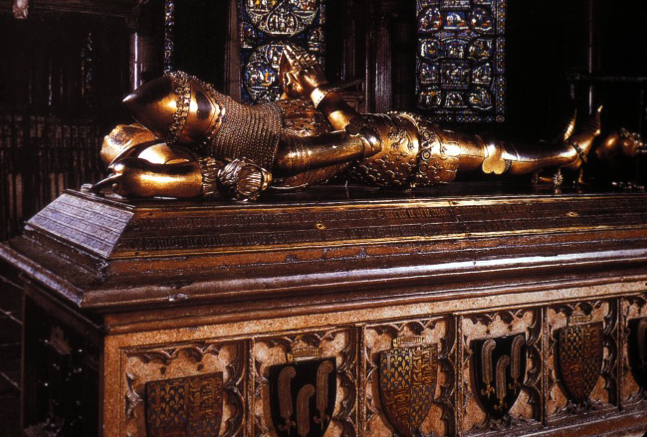
We were reading from A Child's History of the World this week. We learned about Gothic architecture with its flying buttresses, stained glass windows and spires. I decided we needed to look up a Gothic cathedral online. I randomly chose to google Canterbury Cathedral. Wow! I was so glad I did! They have a wonderful virtual tour. We spent half an hour exploring. Besides getting to see the inside of the cathedral, we were thrilled to see bronze effigy of the Black Prince, who we just read about last week in Our Island Story.


We also saw the candle marking the place where Thomas Becket was murdered, which we had read about earlier this term. It's so exciting and meaningful to make connections like this, and it seems to happen without effort as long as we're reading and learning. This is the beauty of the science of relations. It is like going to a new and unfamiliar place and unexpectedly meeting someone you know there.

I highly recommend this virtual tour to anyone doing Ambleside Online Year 2! 
(We're in Term 2, Week 22, to be exact.)