Showing posts with label Games. Show all posts

Tuesday, October 27, 2015

Review: IEW Timeline of Classics and Other Resources

Institute for Excellence in Writing is well-known for its writing programs, but it has other resources as well. I had the chance to use and review three of them: Timeline of Classics, Teaching with Games Set, and A Word Write Now.

Timeline of Classics
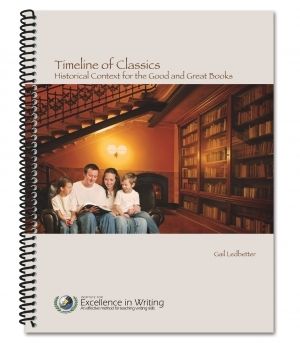
Of the three resources, the one I'm the most excited about is Timeline of Classics by Gail Ledbetter. This is a well-chosen book list of classic literature, biographies, the very best of historical fiction, and even plays and films, all arranged chronologically. It is divided by time period: Ancients, The Middle Ages, Renaissance and Reformation, and The Modern World. The pages are very simply laid out with just the right amount of information: a description of the time period and/or the setting, title, author, and the level each resource is appropriate for (Elementary, Middle, or High School). Each page also has an intriguing quote from one of the recommended books.

Since we are studying the Middle Ages right now, I turned to that section of the book. I could see at a glance which resources were appropriate for elementary school. I opened my library's website and started searching for and reserving the titles that sounded interesting: The Sword in the Tree; The Making of a KnightCastle Diary... I noticed a recommendation for a historical atlas, and thought, "Yes! I need to buy one of those." (I had just been trying to google historical maps online with very limited success.)


Any homeschooler that uses a literature based approach for history will appreciate this resource. It hits just the right balance of selectivity and comprehensiveness, and could easily be used as the basis of all your history studies on its own. I anticipate referencing it regularly for years to come.

Teaching with Games

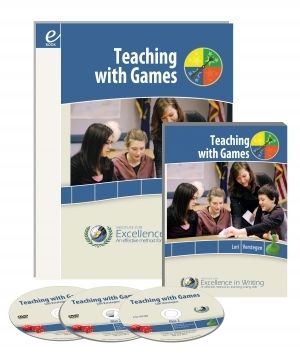
The resource my boys were most excited about was the Teaching with Games Set. This parent/teacher resource includes two DVDs containing workshops led by Lori Verstegen on teaching with games, a spiral-bound book with rules and templates for all the games, and a CD-ROM with a PDF of the book and some bonus materials (extra games!). There are twenty games, most adaptable to any age group, many adaptable to more than one subject area. The games range from "No-Prep" games that require nothing more than a piece of paper (at the most), to matching games, Jeopardy-type question games, math games, and "Make as You Teach" games.

I was amused with the fascination this set held for my boys. It is a parent resource, but SA(7) spent hours poring over the instructions for the games, and JJ(5) immediately chose "The Space Game" (a home-made board game) as his favourite. They both watched the game demonstrations on the DVDs with me. We played several of the games, and as usual in this house, the math games got played the most.


"Fun Times" was a big hit, providing plenty of multiplication practice. I chose to make our own game board for this with multiplication facts between 1x1 and 6x6. (The original had multiplication facts from 2x5 to 7x10, and required modifying a pair of dice.) SA and I (or JJ, who soon figured out how to find the answers on the board based on the factors on the top and side...) took turns rolling the dice and multiplying the two numbers on the dice. We put our tokens on the answers, and the first person with four in a row was the winner. The game had some twists to add to its excitement...rolling doubles and landing on shaded squares on the board had special consequences.

Teaching with Games is a worthwhile resource that could be helpful to Sunday-school teachers and classroom teachers as well as homeschoolers. To be perfectly honest, I can be a bit lazy about coming up with games or activities to go with our studies. The boys were very pleased that I got to review this, and I'm sure they will keep me using it for some time to come.

A Word Write Now
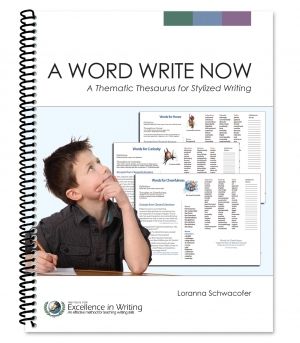
The last resource I used was A Word Write Now. This student thesaurus by Loranna Schwacofer is creatively organized by character traits, descriptive words, and words for movement and the senses. The idea is that children do not always know exactly what word they are looking for. This thesaurus directs the student to a category of words and provides a range of ideas as to how they could express themselves using different parts of speech. Each page also includes examples from classic literature.

My boys are not old enough to use a thesaurus, so I used it myself. I often consult an online thesaurus as I blog, so I thought perhaps this one would do as well. It was not really a good fit for my purposes. My use of a thesaurus usually goes like this:
- I notice I'm overusing a word
- I type the word into a search engine
- I pick a better word from the synonyms that come up. 
I'm very task-oriented in my thesaurus use, in other words. This thesaurus is more oriented to creativity. It is all about exploring and enjoying words. I expect it will be very useful at some stage as my children learn to write, but we're not there yet.

If you are looking for a student thesaurus, I suggest you check out the samples online at Institute for Excellence in Writing and see if this is something that might work for you.

Other bloggers on the Schoolhouse Review Crew have reviewed these resources and also Phonetic Zoo Spelling from Institute for Excellence in Writing. Click on the link below to see what they have to say!

IEW Review

Crew Disclaimer

Monday, September 28, 2015

Review: Wonky and Tapple Games from USAopoly

We love to play games in our family. We play card games about once a week as part of our school day. Aside from that, the boys pull out games almost every day and play them on their own. Game pieces are scattered across my floor more often that I like to pick them up! Almost every Sunday finds us at Grandma and Grandpa's house, playing board games.

The boys were very excited to receive a box from USAopoly last month with two games in it: Wonky: The Crazy Cubes Card Game and Tapple: Fast Word Fun for Everyone. The box was ripped open immediately. Since Papa was home from work that week, he played both games with them right away. Since that day, both games have gotten lots of use. Tapple even got taken along in the van on errand day to keep the big boys content while I took care of baby AJ's needs.


Wonky: The Crazy Cubes Card Game 


USAopoly Review

Wonky is played with cards and nine slightly oddly-shaped wooden blocks in three different sizes and colours.

Players each receive a hand of cards, and the tallest player begins the game by playing a card and placing its corresponding block on the table.

Play proceeds until *CRASH!* the tower falls. The player responsible for the crash must pick up more cards (This is not good, since the object of the game is to get rid of all your cards!).

It can be a challenge to stack the blocks, especially if your hand of cards only has large blocks after smaller blocks have already been played. Thankfully, there are some special action cards that allow you to skip your turn, change the direction of play, or get your opponents to pick up extra cards.

To win, you must either play all your cards, or successfully place the ninth block on the tower. We have not managed a nine-block tower yet.

This game is recommended for ages eight and up, but both my seven-year-old and five-year-old had no problems playing. SA(7) really enjoyed this game, and I know it will continue to be a favourite with him. JJ(5) enjoyed it as well, but lost interest if a round lasted longer than ten minutes.

One thing we noticed is that playing Wonky on the floor worked better than playing it on the table. Anyone jiggling the table could cause the whole tower to come crashing down. The floor allowed for more stable towers (as long as the baby wasn't around!).

Tapple: Fast Word Fun for Everyone


 USAopoly Review

Tapple is a fast-paced, addicting word game. It is played with category cards and a "Tapple Wheel" containing twenty letters and a ten-second timer.

The beginning player chooses the category "In This Room," and we're off!

Player 1: (tap C) Chairs! (hit timer)

Player 2: (tap P) Piano! (hit timer)

Player 3: (tap B) Books! (hit timer)

Player 1: (mind blank.) ... (timer dings!) Player is out!

Player 2: (tap D) Drum! (hit timer)

Play goes on until there is only one person left. That person gets the category card and a new round is begun. The first person to collect three category cards wins the game.

Tapple was my favourite of the two games, though my mind went blank at the crucial moment far too often! It was especially fun to play with a slightly larger group when we took it along to Grandma and Grandpa's for our weekly game time. It was also great as a fast two-player game.

This game is also recommended for ages eight and up, but SA(7) had no problem with it. We modified the rules a bit when playing with JJ(5). We allowed him to choose any word beginning with the correct letter, rather than having him stick to the category. I found this game lent itself well to modification depending on the needs of the players, whether for more challenge or for less. We even allowed MM(3) to play, just allowing him to tap a letter and hit the timer on his turn without saying a word. This left fewer options for the remaining players, but it was hard to play this game at our house without including him. The ticking and dinging timer is like a magnet for three-year-old boys!


Overall, we had a lot of fun with these two games from USAopoly. We will continue to play them often, and that's a high recommendation coming from me!

For more reviews, check out the link below:


 USAopoly Review

Crew Disclaimer

Tuesday, April 15, 2014

Palindromes: Our Best Math Lesson Ever!

SA and I did this math activity together last term, and I've been intending to share it ever since. It was the best week of math we've ever had. I could see and hear the learning happening, and we both enjoyed every minute of it. We worked away at it every day, and often SA would ask to just do a bit more after our 10 minutes was up.

I have to be honest and tell you that I didn't put a lot of thought or planning into this lesson. I opened up one of my math game/activity books as I do every Monday morning (in this case Family Math). The purpose of the activity was to provide "many hours of highly motivated addition practice." Because SA had just learned how to add and carry, I thought it might work for us. So I printed off 100 Charts for SA, JJ, and myself (though I noticed, revisiting it, that Family Math called for a 0-99 Chart. It will work either way.).


Maybe you've heard of palindromes before, and you're thinking, "I thought they were words or sentences that spell the same thing forwards and backwards." And you would be right. The number variety also "spell" the same forwards and backwards: 44, 121, 1111. 

Our first step was to find all the palindromes. We found and coloured 11, 22, 33, 44, 55, etc. with one colour. Those were the 0-step palindromes. 

Next, we started to turn the non-palindromes into palindromes. We flipped the numbers and added them together. For example, we added 12 + 21 = 33. Aha! A palindrome. That one just took one "flip and add." We coloured the "one-step palindromes" with a second colour, and started making a colour key at the bottom of the page. Some numbers took longer: 19 + 91 = 110, 110 + 011 = 121. That was a two-step palindrome. There were even a couple that we didn't solve (I'll let you find them. You're welcome.). We ended up making a separate colour for numbers that still hadn't turned into palindromes after ten "flip and adds." After a while we started to see an interesting pattern on our pages.

We did not duplicate each other's work, even though we each had our own pages. SA would figure some of them out, and I'd figure others out, and then we'd both colour our numbers according to what the other person figured out. JJ (3) would just copy our colours.

After we were working on it for a while, SA began to notice certain patterns. The first one was after doing number 30. 
"Mama!" he said excitedly. "40 is a one-step palindrum, and 50, and 60, and 70, all the way to 90!"
"Palindrome," I corrected. "And why is that?"
"30 is 33, so 40 is 44, and 50 is 55." He was busily colouring them all blue.
"Why, you're right!" I exclaimed, and got busy colouring all of mine as well.

A little later, I noticed that 12 + 21 = 21 + 12. (In other words, we should be able to colour them the same colour without doing the sum all over again.) I tried and tried to get SA to notice this. If he added up 23 + 32, I would add up 32 + 23 beside him. But he did not get it, even when I drew lines between them to connect them. Then suddenly, two days later, he suddenly found it himself, and he was so excited about it. I had to laugh. 

Later in the process, he realized that any two-digit number that adds up to eleven is a one-step palindrome, and any two-digit number that adds up to ten is a two-step palindrome. (See his paper below. He likes drawing arrows between things when he makes these realizations.) In other words, 92 is a one-step palindrome because 9 + 2 = 11, and 82 is a two-step palindrome because 8 + 2 = 10.  


Today, while I was writing this post, he said "44 is blue and green." In other words, according to his colour scheme, 44 is both a zero-step palindrome and a one-step palindrome.

I think you can see by now why I thought this was our best math lesson ever

- SA was completely engaged. Each addition problem was not "drill and kill"...he was genuinely interested in what each sum would be and whether it would turn out to be a palindrome. 
- This was a long project that he had to persist in to find the pattern. I sometimes worry he doesn't have enough opportunity to build persistence in math, since it often comes so easily to him.
- It gave him a chance to explore and make his own connections in math. I know that any discoveries that come to him this way are truly learned. 

I highly recommend this math activity for any child who knows how to add and carry. It will provide lots of practice, and may pave the way for some real math discovery!

Tuesday, January 21, 2014

Math Game of the Week: Bean Count!

This term, we have been doing a "math game of the week" together on Mondays. Then we do the same game whenever we feel like it throughout the week. This week's game is from Peggy Kaye's Games for Math. In the book, it's called "Star Count", but since we used beans, we call it "Bean Count."
I got out a few papers, the pencil crayons, and a Dice. I divided a paper in two with a pencil crayon and wrote "SA" on one side, and "Mama" on the other. Then we took turns rolling the dice. For the first roll, we made large circles or squares. For the second roll, we put that number of beans in each circle or square. The person with the most beans won that round.
We actually started by drawing stars in the circles, but switched to beans when I noticed that drawing stars was taking more mental effort than the game. We played four rounds. I won twice, and SA won twice. He had the last win, and it was a good one, so we quit while he was ahead.
You can see that this game is meant to get him started thinking about the concept of multiplication. We didn't use any multiplication terminology yet...no "times" or "groups of." I just let him play the game and let him make whatever connections he's ready to make at this time. Later, when we do study multiplication, he'll think, "Hey, I know what this is!"