Showing posts with label Planning. Show all posts

Friday, August 29, 2025

Changing How I Plan

I have been working hard to get my school year plans together in time to start next week. It's quite a challenge with my boys going into Grades 12, 10, 8, 5, and K. And then there's the 1-year-old. I am using The CMEC with a few tweaks and adjustments.

The past few years, I always made a comprehensive timetable (schedule) that laid out each school day for each child. This worked extremely well for me. Our school days were focused and ran as smoothly as I thought possible with four students plus baby or preschooler. There was never any question in anyone's mind what anyone should be doing at any given time...we just had to glance over at the big schedule posted on the wall. Moreover, while each day of the week was different, every Monday, every Tuesday, etc. of the term followed the same pattern so we were able to get into a comfortable groove. 


However, while all this has been an incredible and often painful workout for my executive functioning skills --have I ever told you how much I hate planning?-- it really has been doing very little for my students' executive function. I've been feeling more and more convicted as my oldest sons' high school years slip away that they really need to practice doing this for themselves. But how could I let go and have our days still go smoothly?

Changing gears is so hard for me. I just didn't have the mental energy to figure out how to do this in the last couple of years with a challenging pregnancy in 2023 and a baby who needed surgery (cleft lip) in 2024. But this is our year. 

I've made a skeleton timetable for my oldest three. (I'm doing a regular timetable for my fourth in grade 5 and a loose one for my fifth in Kindergarten.) It is a weekly spread that includes all the things we do together, like meals, daily news, chores, Shakespeare, Plutarch, and picture study. And then it has blank space. They will have to fill in when they're doing each subject. 

I have also scheduled a daily check-in with all three (at different times) to make sure they are:

    -filling in the timetable

    -logging work completed as they go along (I'll have them mark on their timetable itself)

    -orally narrating any lessons that they haven't done a written or drawn narration for

    -doing work in their Book of Centuries, Commonplace, and Nature Journals 

I am sure we will be adjusting a lot of things as we go. Please don't take any advice from me on this yet...I am just sharing a work in progress. I am hoping that as time goes on and they get used to this we will be able to check in weekly rather than daily. But I know they will need the accountability and coaching at first.

There is an added challenge this year as my oldest is taking a university course, and the oldest two are taking a composition class from Wildwood Learning Centre. These things are completely new to us so it will probably take a little while to figure out how to fit in homework, etc.

I will try to come back periodically and share how it's going. 

Friday, September 4, 2020

Easing In

I feel like I should put "Easing In" into quotation marks.

This year, my oldest is in Ambleside Online Year 7. I also have a Year 5 student, a Year 3 student, and an extremely eager Kindergartner. Add in a seven-month-old and you may begin to grasp the chaos here. 


Planning was a special challenge this year. I had gotten into a scheduling groove over the last few years, but babies and schedules don't mix, at least not at my house. I have had to regress to a routine. Don't get me wrong, I loved my easy-going routines when all my children were little. But I find it hard to get all the work done (without taking all day) now that my children are getting older.

I ended up with a loose plan, inspired by the schedules at Piney Woods Homeschool. I can be fairly inflexible about my plans, but this year I decided beforehand that I would keep tweaking every week until the days were going fairly smoothly. Each child has their AO schedule (order modified slightly and colour coded) plus a sheet of paper with their "Daily Independent Work" and "Work With Mama" lists. The idea is that everyone gets started on their independent work while I spend time with each one, youngest to oldest.

My Year 7's list looks like this (the colours refer to the way I've colour-coded his AO schedule):

Daily Independent Work (about 2 1/2 hours)

Enrichment Narration (purple): 15-20 min
Math 30 min
History Narration (red): 30 min
Copywork 10 min
Science (green) 20 min (Narration OR Science Journal or Nature Journal Entry)
Piano Practice 15 min
Narration (blue) 20-30 min
---
All of this work should be done before doing computer time (alternate  Duolingo and Typing and Coding practice)

Work with Mama (about 2 hours) (I expect an increase in independence in some of these areas over the year, but for now I need to be close by, anyway. Most of this is done at the same time as his Year 5 brother, so I "kill two birds with one stone".)

Poetry 10 min
Writing 20-30 min
    Written narrations each week will be done on
        -New Testament
        -One reading from red or blue category
        -One reading from green category
        -One current events topic from the past week
    Fridays will be a fun writing exercise (Bravewriter).
Shakespeare/Plutarch/Beowulf (alternating) 20 min
Dictation/Grammar (alternating) 20 min
Latin/French/Grammar of Poetry (alternating) 30 min
Map Drill 10 minutes once per week
News and Current Events story read and discussed at lunch

I also have a list of things they can choose to do in the afternoon, hoping to get to each item about four times per 12-week term.

Drawing Lesson (YouTube or from a book)
Microscope Activity, or field work from Signs and Seasons
Piano Lesson
Composer Study (YouTube)
Shakespeare Play (YouTube...we watch as far as we've read that week.)
Nature Journaling
Nature Walk
Painting Lesson (YouTube or from a book)
Baking Lesson 

----------

Of course, his is the longest list. AJ(5), who also insists on his own list, has:
Poetry 5 min (A Child's Garden of Verses)
Miquon Math 10 min (we play with Cuisenaire rods and casually talk about math concepts that come up.)
Reading Time 10 min (I read him a story. Pinnochio is the current one.)
Learning to Read 5 min (He is learning to read three-letter words. I wouldn't push if he wasn't ready, but he is. Very.)
I spend time with AJ first. This fills his love tank so he is more happy to go off and play on his own when he's done.


I decided to "ease in" this week. I gave the boys their back to school presents on Monday morning (school supplies that somehow seem much more special for being wrapped up), and we started with everyone doing math plus one reading and narration. Somehow this managed to fill the whole morning, so I felt a bit of trepidation about the whole plan.

Tuesday was awful. But then, Day 2 is always terrible. I tried to have everyone work through their Daily Independent Work lists. Again, this more than filled the morning, and this was WITH the baby having a wonderfully long morning nap.

Wednesday morning I had to go to the doctor for some bloodwork. When I came back, everyone was working on their lists. I quietly started the "work with Mama" lists, youngest to oldest. It went really, really well! My oldest did not complete his independent list, but I was happy with what we accomplished.

Thursday morning I got up at 7:00 and found SA(12) doing his math. We hit it out of the park that day. Everything was done by lunch.

And then came Friday. It was a bit like Day 2 again. SA was extremely stressed about getting everything done...so much so that he developed some hives. (He is a conscientious ISTJ who will put a lot of pressure on himself to follow the plan as written.) I will have to keep an eye on this.

So we had two good days out of five, though every day had things to be thankful for. I'll be tweaking a bit this weekend, but not hugely yet. I have to give us all time to settle into some sort of flow first. I will make a better (slightly simpler) checklist.

I took time to count three things I was thankful for every day. Here are some of my favourites:
-MM(8) fell in love with "Big Joe Mufferaw" (a Stompin Tom Connors song scheduled on Ambleside Online's Canada page.)
-Basic Christianity by John Stott seemed to touch a chord with SA(12). This was a personal substitution I made in the curriculum when I was unable to get How to Be Your Own Selfish Pig for a reasonable price. I think I've made a good choice there.
-Writing time went very well this week. This made me happy because I've decided that writing (written narrations, copywork, dictation) is going to be a particular focus this year. I saw some good advice as I was planning my year: "Choose one thing to do really well, and let everything else be good enough." Writing is that thing this year. Everyone had really good attitudes about it, and did really well with focusing on putting their ideas on paper without worrying too much about getting all the spelling and grammar correct. (This is a challenge we've been working on for a while, and we seem to have made a leap forward since last school year.)


Monday, July 22, 2019

Time to Reflect

Hi, I'm back! I won't ask if you missed me. :)

It's that time of year again. Planning time. Before I really get into planning, I like to think about last year. I try to give thanks first for the wonderful things. Here are things I'm most thankful for this year:

1. Reading Time with AJ(4). Every morning after chores, I sat down with AJ and read a picture book (usually from the Ambleside Online Year 0 list) and shared some nursery rhymes and songs. In term 3 I also started reading Leading Little Ones to God with him, which is a book I remember enjoying when my parents read it to me when I was little! Reading Time with AJ was a way to try to fill his love and attention tank before I got really busy with the other boys' school time. I could see that it was hard for him this year as his playmate MM(6) started school and turned into a bookworm, but this special time of connection with me was a highlight of each day for both of us.

2. Morning Time (the lessons we do together) continued to be a strength and a joy to all of us. This year at breakfast each morning I read a rotation of literature (King Arthur and Oliver Twist) and biographies (Michael Faraday, George Washington Carver), followed by our Bible and hymn memory work, and our Bible reading and narration. We then separated for chores and some individual lessons (for the oldest) or play time (for the youngest) and came back together for poetry, picture study, or composer study; grammar; foreign language; and Canadian history. Not all of it was strong...foreign language got dropped in the third term and grammar lessons became few and far between at that point too, but...

3. We were able to keep plodding on even when I was not well. In January I started having heart palpitations. This led to being diagnosed with Hashimoto's thyroiditis in February. At that point, symptoms I had been ignoring for months suddenly got worse until the synthroid kicked in about four to six weeks later. I felt good for a month or so (just in time to go to AO Camp Meeting!), then went through another three weeks of symptoms in May (back pain, chest pain and blue lips). This time, pregnancy was increasing the strain on my thyroid and I felt better again a few weeks after my synthroid dose was increased. Why is this in my "thankful" list? Looking back, the entire season feels like a blur as I just kept putting one foot in front of the other. BUT my two oldest boys grew in independence in a way that I otherwise would not have pushed them to, and it was good for them. The well-established daily routine continued, one day at a time. Yes, there were things that we dropped. But I'm still so grateful to be able to have the boys at home, even when circumstances are difficult. I like what we're learning together even when all the boxes are not being checked. This imperfection is also part of "Education is an Atmosphere." The way we deal with trials within the family is as much part of their education as anything else.
"By these things children live and we may not keep them in glass cases; if we do, they develop in succulence and softness and will not become plants of renown." (-Charlotte Mason, A Philosophy of Education, p. 97)


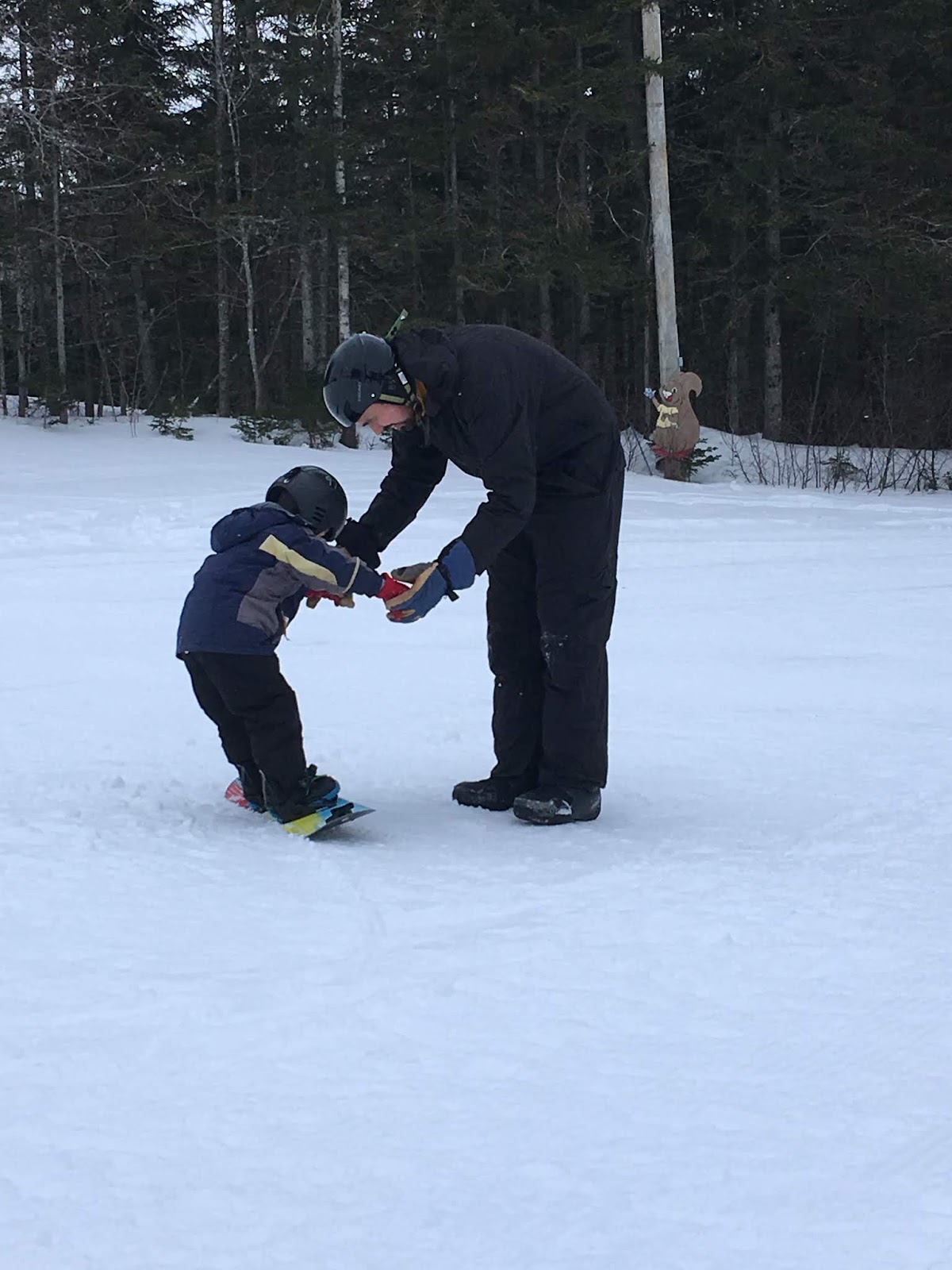
4. Snowboarding every Friday afternoon this winter. This was a HUGE highlight! A group of homeschoolers got together for the school rate at Brookvale for skiing and snowboarding. We went as a family, and all learned to snowboard, even AJ(4). AJ and I were still on the bunny hill at the end of the winter, but everyone else moved on to more challenging hills. Having this commitment "forced" us to get out and enjoy the fresh air and sunshine even when it was cold. We all enjoyed it so much, and it made the winter fly by much faster than it normally does.

5. AO Camp Meeting was a huge blessing to me this April, especially as I was feeling down about what I was not accomplishing during my weakness and fatigue. The emphasis on applying Charlotte Mason's principles "however imperfectly" blessed me, as did the emphasis on prayer. I loved it, and can't wait for the audio files to come out so I can relive it. I met so many lovely people, too...Amber, Leslie, Emily, Becca, Sheena, Gabby, and Esther, who I stayed with the night before the conference; Anne, Jeannette, Brandy, and Dawn who before had only been online acquaintances.

These are the things I'm thankful for this year. I feel like #3 was the most significant, #4 was the most fun, and #5 might have the most potential (depending on how much I soak in and apply) but who can tell how they will all shake out over time?


Wednesday, September 5, 2018

Planning Woes

School planning was painful this year, and I mean that literally. Figuring out the schedule gave me a headache for four days in a row. This is the first time that I have acknowledged to myself that I do not enjoy school planning.

This is a problem, because I really do enjoy having a plan. I tend to follow my plan well, and I will readily admit that one of the reasons I love homeschooling is because I feel a great sense of accomplishment every day, week, term, and year that we follow the plan and actually do as many elements of a Charlotte Mason education as I can squeeze in. I can see my children's growth as we faithfully do the little things, day after day after day.

I need to think this through now, while the memory of the pain is still fresh. Why was it so hard?What can I do to make planning less of an ordeal next year? 


Why is it so hard for me?

1. This is my first year with three students. SA(10) is starting Ambleside Online Year 5, JJ(8) is starting Year 3, and MM(6) is starting Year 1.

2. I also have a preschooler, AJ(3), in the mix. I feel I need to spend some quality time with him at the beginning of our school time in order to make him feel loved and included and (hopefully) pre-empt any negative attention-seeking behaviour.

3. My Year 5 student is not quite independent yet. He is just beginning written narration this year. I still read with him in Shakespeare and Plutarch, and work with him on Latin and dictation. I think all these things are fairly normal, and yet I can see that my second child is already much more independent than my oldest was at his age, and I wonder if I need to push SA a little harder towards greater independence.

4. I do things in my homeschool that simplify our days and make them more joyful, but do add to the decision-making at the beginning of the year. For example, we do several lessons each day together as a family, usually a literature selection, sometimes natural history or geography, always Bible, and often Canadian history (In addition to all the obvious things we'd naturally do together, such as poetry, composer study, picture study, nature study, recitation and memory work.). This means that rather than just leaving each AO year as it is, I have to decide which of SA's readings we will do together, and also which of JJ and MM's readings I will leave out as a result so that they are not overloaded (this is the harder decision of the two). Of course, leaving the Years as they are without adapting to my family would have its own planning challenges.

5. I figure out Canadian History from scratch, since my chosen curriculum is American-based.

6. I try to do all the CM things. Again, it's the planning, not the doing, that does me in. While there are always some things I end up dropping unintentionally as the year rolls on, it always seems to be because I didn't plan that subject well enough, or didn't put it in a good place in the schedule.

7. Making playlists (for composer study, hymn review, folk song review, and poetry review) took longer than usual this year because I switched from Freegal to Itunes and needed to build them from scratch to include review for the songs we learned in the last four years. Itunes had more choice than Freegal and that resulted in greater decision fatigue. I switched because Freegal makes updates to their app three or four times a year, and almost every time I've had to remake my playlists from scratch. I'm hoping my playlists will stay where they are in Itunes. If they do, it will mean much less work for me going forward. Only the composer study playlists will have to be made up in their entirety, folk song and hymn playlists will just be added to one at a time as we learn new songs.

8. Planning requires an amount of focus that is difficult with four children around me. Every time I get into the flow, I have to switch gears and make everyone a meal, or do some laundry and basic cleaning. Also, when I am so focused on my computer screen, the children start to misbehave.

9. I am reluctant to change anything about my homeschool. I love Ambleside Online. I know there are other CM curriculum out there that do more hand-holding when it comes to planning, but I would find it very hard to break up with AO's wonderful booklists. I love doing certain things as a family. I love getting most of the homeschooling done in the morning so afternoons can be free. I'm not really willing to give any part of that up. 

Does that mean I just have to accept the four-day headache as part of what it takes to homeschool the way I want to homeschool? (That's a genuine question. It's possible the answer may be yes.)

What can I do to make planning easier next year? 
(and always...)

1. I could go over to another CM curriculum that has more scheduling helps for multiple students. But see #9 above. Still, it's possible that this could be a solution. (I looked into AO for groups when it came out, but because I'd already been combining my students all along, I saw that it would take just as much work to adjust that plan for my current students as it was taking to adjust the regular plan. Also, I now have students in two forms, and in a couple of years I'll have students in three forms, which would still mean working with two to three schedules.)

2. I could get a consultation somewhere and talk it through with someone experienced. The thing is, I think I make beautiful plans. They cover everything I want to cover. We actually do them (imperfectly, but still faithfully and consistently). I am planning things that work for us. I don't know if following someone else's ideas or plan would work as well. So I'm not sure if this would actually help me with the headache.

3. I could think through my planning process and have realistic expectations for how long planning will take me. For the record, here's what it took this year:

- Brainstorming: 1 week. I think through the past year, what went well, what didn't. I think about CM's principles. How is our balance is when it comes to atmosphere, discipline, and life? How have I been fostering the "science of relations" in our home? I consider if there's anything new I want to incorporate into the new school year. I look at the AO booklists. I think about each child individually, their gifts and their challenges, and specific ways I'd like to help them grow this year. I look at a calendar and think about when to start and where the terms will fall. I write every thought in a notebook. I also start to read something for inspiration...one of Charlotte Mason's volumes, or something else. This summer I was reading Karen Glass's Know and Tell.

- Book buying: 2 days. I go to bookfinder.com and buy all the living books I need. I also order math curriculum. I make a chart of what I've ordered, where I've ordered it from, and when I'm expecting it to arrive. I like to have the books in hand before I start scheduling.

- Morning time planning: 1-2 days. This is the learning we do together. I plan for our breakfast learning routine (1 literature or other reading and narration, Bible, hymn and catechism memory work, Bible reading and narration, and prayer) and our "tea time" learning routine (poetry appreciation, poetry and folk song recitation and memory work, picture study, grammar, foreign language vocabulary review, Canadian history, drawing, nature journalling.) I modify an AO schedule and put in each of these things in the order I plan to do them in every day. For the memory work and recitation, I choose what we will do each half-term, and print off what I need for the term coming up.

- Memory Binders: 1-2 days. I have two memory binders for myself and each student: one for Bible, hymns, and catechism, and one for poetry, folk songs, and picture study. I print off copies of my selections for the coming term and put them in page protectors in our binders. I also upload prints of the art we will study to Staples so they can print them in colour for me and I can pick them up next time I'm in town.

- Canadian history and geography planning: 2 days. I look at AO's schedule for my oldest child for the range of dates covered in history for that year, and I look at my collection of spines to figure out which one(s) I want to use. I also pick supplementary biographies or other books. I read or skim everything and schedule it all out. Thankfully this is a subject we do as a family and I don't have to plan more than one year at a time.

- Planning individual subjects: 1-2 days. I figure out what I'm doing for foreign language, piano, drawing, handicrafts, etc. I also think about what I'll do with my preschooler while the others are busy and can't play with him.

- Buying school supplies: 1 hour. I usually don't need much, just some art or handicraft supplies, notebooks, pencils. 

- Scheduling: 1 week (for three children and one preschooler). I consult PNEU schedules as input, though not as a rule for my home. I work with the AO schedules and modify them as needed for each individual child and for the things we do together as a family. 

- Printing: 1 day. I print off copywork pages, math workbooks for one of my students, my oldest's Plutarch selection for the term.

- Rearranging the school room: 1 week. This year I took all the books off the shelves and put them all back again after the shelves had been anchored more securely. I think my normal time is probably more like 1 day to put last year's books away and arrange this year's books and supplies.

- Playlists: 2 days. Again, I expect this to take much less time in the future.

Where am I? I think I just counted over four weeks of planning!!! I honestly didn't realize it all added up to that much. I just started and kept going until I was done. Well, that was a helpful exercise...I will know for next year that it just takes that long.

4. I could try to get help with the children during the scheduling week. I do need to do my scheduling at home, where the books are...I can't escape to a library or anything like that. My husband did take the children out two Mondays in a row towards the end of my planning, and that was tremendously helpful. Maybe I need to let him know that I need that regularly for four or five weeks. Maybe the kids can go to Grandma's for a couple of days. Maybe there's a Vacation Bible School nearby that can give me a few hours every day for a week. (I have resisted VBS so far because I have bad memories from my childhood...but maybe there's somewhere I can trust.)

I think I'm getting somewhere with those last two points. I need to have realistic expectations, and I need help. I honestly did not know whether anything good would come out of this writing exercise when I started. Thanks for sticking with me! I'd still like to hear what works for you. Does it take you this long to plan? If it takes less, what do you leave out? Or do individual things take you less time? If you've struggled with planning in the past and have come through victorious, I would especially love to hear your story.

Thursday, August 31, 2017

Morning Time Plans, Part 2

Our second part of morning time comes after we have all done our chores and played outside. I also hope to have had some preemptive one-on-one time with the preschoolers by the time we start.

I aim to begin this at about 10:15 every morning. We will have tea or drinks and snacks while we do the first part, then clear away in time for our Canadian loop and Language loop. (The 5 and 2-year-olds will also likely run off and play once the food is done.)

To make this really clear, we are only doing one item in each "loop" per day. The memory work and recitation is all reviewed every day.


TEA TIME LOOP (15 min) (cycle through, one per day.)
- Poetry Appreciation: Tennyson, De La Mare
- Art Appreciation: van Ruisdael, de Hooch
- Music Appreciation: Corelli, Telemann; Sol Fa lesson: Children of the Open Air Level B
- Mathematics Appreciation: Family Math and Mathematicians are People Too
- Poetry Appreciation: childrens’ choice (skip if we have four-day week for some reason)

Memory Work/Recitation (10 min)
- Folk Song: “A Ballad of New Scotland”, “Brave Wolfe
- Poetry: SA – “The Charge of the Light Brigade”, JJ – “Seeds”, “The Mother Bird”
- French Song: “Vous Qui Sur la Terre Habitez”, "Je Me Confie en Toi"
-  Shakespeare: MacBeth “Sleep no More” and/or “To-morrow, and to-morrow, and to-morrow”
-  Review (one previously memorized folk song OR poem OR French Song OR Shakespeare)

CANADIAN LOOP (20 min) (cycle through, one per day, doing map/timeline work once per week)
- Canadian History: The Story of Canada OR Great Canadian Lives
- Canadian Geography (hoping to do The Map-Maker: the Story of David Thompson if it ever arrives in the mail!)
- Map/Timeline Work (Canadian Oxford Junior Atlas Activity Book)

LANGUAGE LOOP (20 min) (one per day)
- French Lesson: Watch The ULAT lesson OR review AND read French children's book
- English Grammar: KISS Grammar Book 1 (First lessons include material for copywork and dictation as well.)


Notes
Tea Time Loop
Up until the end of last year, we've read poetry on Mondays, Wednesdays, and Fridays, with Art Appreciation on Tuesdays and Composer Study on Thursdays. This year I'm adding in Mathematics Appreciation. I read several chapters of Mathematicians are People Too last year as part of our breakfast reading rotation. In past years we also used to do a fair amount of math games and activities, but I slacked off over time. This year I decided to combine the two and make them part of this special, relaxed time in our school day.

For poetry, we are following the Ambleside Online suggestions for Years 4 and 2. Unlike in previous years, I am giving each boy their own poems to learn for recitation. (We always learned it as a family before.)

For Art Appreciation in Term 1, I looked through the AO rotation for artists roughly in the time period we are studying in history this year (1640-1780) and found Jacob van Ruisdael and Pieter de Hooch (painters from the Dutch golden age). I like doing this, as I think it helps us immerse ourselves in a time period, but I don't go out of my way to do it (connections happen anyway!). I printed the selections suggested by AO on letter-sized paper at Staples and put them in page protectors in our individual binders. We always spend two weeks on each painting, just looking and talking about it the first week, then trying to fix it in our minds' eye and narrating the second week. I am hoping I will have enough space on my "school wall" to hang up the current picture during the weeks we are studying it. 

For Composer Study, we're using the AO rotation this term. 

Memory Work/Recitation
I chose two Canadian folk songs, as they fit well with our Canadian history. A Ballad of New Scotland is a sort of advertisement to attract people to settle in Nova Scotia in the 1700's. Brave Wolfe is about the Battle on the Plains of Abraham. I found both of these songs in my copy of Singing Our History by Edith Fowke and Alan Mills. This wonderful resource is out of print, but you may find it used (check bookfinder.com for prices including shipping). I highly recommend this resource and others by Edith Fowke if you want to coordinate Canadian folk songs with your studies in Canadian history.

Last school year, I taught the boys "A La Claire Fontaine" as our French song. Though I told them the translation at the beginning, I didn't find that it stuck well (aside from the lovely tune!). This term, I decided to turn to a French version of a psalm we already know well in English. "All People that on Earth do Dwell" is one of the boys' favourites, and that's why we will learn "Vous Qui Sur la Terre Habitez." For the second six weeks of the term, I chose a simple hymn from Jeunesse en Mission (Youth With a Mission): "Je Me Confie en Toi." Sometime in the future I will return to French folk songs, but for this year I will focus on easy and familiar hymns to help build their understanding.

Canadian History and Geography
We are continuing to do Canadian history and geography together, as last year. 

Language Loop
We began using The ULAT last year for French. I was not completely satisfied with how we did with it, but as I've been thinking about it, I realize it was because I did not have a daily system for review of what we were learning. I did not want to sit in front of the screen daily for a video review. I'm going to step back a couple of lessons, and use a notebook to make a list of what we need to review each day in between our lessons. In addition, I plan to find and read French translations of a few classic childrens' books that my children already know well in English, starting with The Very Hungry Caterpillar. (I'm not sure of everything that I'll use...I have a stack reserved at the library and I'll see.)

We are also beginning English grammar and studied dictation this year. I am using KISS Grammar. If you click on that link, you will discover that the website is very, very difficult to navigate and find exactly what you need. Here is the page with links to each workbook. I am beginning with book 1, and I will allow JJ(7) to participate with SA(9) as well, but only if he is interested. (Delayed grammar is something I don't quite see eye to eye with Charlotte Mason on...I know I was ready for grammar and loved it from the time I first encountered it in grade 2 or 3. But of course I would never push it on a child who isn't ready.) The first workbook has short passages that the teacher's guide suggests using as dictation exercises. I can kill two birds with one stone! Now I don't have to think about figuring out what to use for studied dictation with SA for the first little while, anyway.

Ambleside Online also recommends beginning Latin in Year 4. I have acquired a Latin program (Visual Latin), but looking at it I realize that SA needs some grammar before he begins. I expect I will probably start next year, in Year 5. I am quite excited about it, though...I think both grammar and Latin will appeal to SA's logical and orderly mind.

Disclaimer
I'm going to offer this disclaimer again. These are my plans. There will be things that will be adjusted as we go along. There are things that will work for my family that won't work for yours. Use your own discretion. Again, I'm building on the work of previous years, and strongly advise starting small and building from there if you are just beginning.

Here are some links from previous years, when the boys were younger:
Our Very First Poetry Teatime (4 years ago)
Our Circle Time (1.5 years ago)

Wednesday, August 30, 2017

Morning Time Plans, Part 1

Morning Time is the part of our homeschool day that we do together as a family. At our house, we divide it into two parts, both anchored to food: breakfast time and tea time. I started this when my oldest was four or five, and doing two shorter stretches made more sense than one longer one. It still makes sense.

Our Morning Time has expanded over the years. In the beginning, it was very simple. We read the Bible, sang one verse of a hymn, and prayed after breakfast. The boys called this "Read-an-Sing-an-Pray." We read poetry at 10:00 Tea Time. The end.

When SA turned six and we officially started school, we added some Bible memory work to "Read-an-Sing-an-Pray," and he started narrating the Bible story we read. We also started Art Appreciation and Composer Study, substituting it for the poetry at Tea Time on Tuesdays and Thursdays.

In SA's year 2, we added a read-aloud as well at breakfast, beginning with Pilgrim's Progress. In his year 3, we started rotating through a few read-alouds, and began using a "memory binder" to habitually review some of our former memory work (a very necessary addition!).

Now SA is 9 and in Year 4. JJ is 7, MM is 5, and AJ is 2. This is the year Ambleside Online adds Plutarch and Shakespeare. I plan to add it to the end of the breakfast, after our prayer so the younger children can go and play, but are welcome to stay if they like. Here's my plan for the breakfast portion of Morning Time this term:

BREAKFAST READING AND NARRATION LOOP (Cycle through, one per day.) (15 min.)
- Church History/Biography: The Little Woman OR Trial and Triumph
- Elementary Geography
- Tales: Blue Fairy Book OR Canadian Wonder Tales

Memory Work/Recitation (10 min.)
- Hymn/Psalm: "We're Marching to Zion," Psalm 32:1-6, Psalm 86:1-7
- Bible: Philippians 2:1-11
- Review: 1 Psalm or Hymn and 1 Bible passage per day. (Occasionally skipped if time is tight.)
- Catechism: Continue with The Catechism for Young Children

BIBLE READING AND NARRATION LOOP (One per day) (15 min.)
- New Testament: Mark
- Old Testament: Joshua/Judges

Prayer (ACTS, Prayer List) (10 min.)

SHAKESPEARE/PLUTARCH LOOP (One act/lesson per day) (20 min.)
- Shakespeare: “MacBeth”
- Plutarch: “Romulus”


Notes:
Breakfast Reading and Narration
For the breakfast reading, I begin reading once I'm done eating. Nine times out of ten, the boys are still eating, and they enjoy being read to while they finish. Then they usually take turns narrating, including the five-year-old. Though I never ask, he insists on being included. (And narration flows out of him much more readily than out of the older two. Ah, extraversion...)

For Trial and Triumph, I'm following the readings for Ambleside Online Year 4 (three chapters per term). The Little Woman is Gladys Aylward's autobiography (as told to Christine Hunter) . We finished Pilgrim's Progress last year and I decided to do a missionary biography before starting PP again. This one was on my shelf. Gladys Aylward is special to me because it's a story my father told to us when we were children.

I'm going through Charlotte Mason's Elementary Geography because somehow I've neglected this subject for the last three years. It had something to do with not having the physical book. Now I have it, and we'll just read it a chapter at a time until it's done.

I'm reading tales, even though they are not on the AO schedule for Years 2 and 4 (our current years). We loved them so much last year, and we were not finished the books, so I decided to continue. I really want this morning read-aloud to continue to be a delightful experience for my preschoolers as well as the rest, and this is for them.

Memory Work
In memory work, we normally start a new hymn and Bible passage every 6 weeks (rather than every month as in Ambleside Online). This just works better for me as we usually have a break and I have a moment to plan then. We don't do all of the AO hymns, as I want to include psalms as well. The psalms I've chosen are ones we are learning as a church. (Our church is transitioning to Sing Psalms from the old Scottish metrical psalter, so singing the same psalm repeatedly for a month until we know it well.)

In the past, we've always read our Bible memory passage together in unison each day until we know it. Lately I've noticed that they don't always pay complete attention, and trail off. Also, I've been thinking about recitation and its purposes. For this reason, while we will continue to learn one Bible passage together as a family (this has value, too), I will have the boys take turns reading the passage aloud on alternate days with a view to them being able to recite it at the end of the term. They do read well as a matter of course, projecting their voices with confidence and expression. (I think this is just because of example, as my husband is a preacher and reads well himself.)

In catechism...sigh...I have to admit we have never made it through the entire thing in the last four years, despite the fact that it's a very simple one! I just keep working away at it.

Bible Reading and Narration
In Bible reading and narration, we just read a short Bible passage and the children narrate. As usual, I'm following the Ambleside Online schedule for my oldest child. Lately I've been reading Paterson-Smyth's commentaries on the Old Testament passages we do, and using that to set the scene beforehand, or to spark a bit of discussion afterwards. It's all very simple, though. Because the Bible is the one book that has been constant throughout the last three years of homeschooling, this is where I've really seen how effective simple reading and oral narration is.

Shakespeare and Plutarch
And finally, the two new additions! Shakespeare and Plutarch are intimidating to me, but I will just jump in and do it. I myself have not read either Shakespeare or Plutarch before, so I will be learning as I go. I chose Plutarch's Romulus because I am using Mrs. Beesly's Stories from the History of Rome to introduce the stories, and "The Building of Rome" is the first chapter in that book. I plan to read Beesly first, and then follow Anne White's study guide at our own pace. We will read a little every other day until we are done. I have no ambition to finish a "life" in a term...we'll just keep going next term if we're not done yet, and then start a new one.

I am still wondering if I made a good choice with "MacBeth" as our first ever Shakespeare play. I am not following the AO rotation this year because I wanted to begin with stories my children seemed to like from Lamb's Tales from Shakespeare last year and build on that. For our comedy, I will go with "The Taming of the Shrew," and for our tragedy, "MacBeth." After that, I will do a history, though we are not familiar with those stories yet. The reason I jumped into the tragedy before the comedy was because I found a resource on Audible that seemed really helpful. We will listen to the Shakespeare Appreciated introduction together. I will pre-listen to the version of the play with commentary for my own benefit. Then we will go through the play together, act by act, listening to the version without commentary and reading along. As with Plutarch, I will not worry about finishing a play in a term...we'll just keep going until we're done.

Disclaimer
I feel like I need to add a disclaimer here. These are my plans. If my plans don't work well, they will be adjusted. My plans may not work for you. If you're new to Morning Time, I strongly advise that you start simple and build over the course of years. It is better to make a strong foundation of habit than to try to do too much at once, burn out and never do it again. For me, I am just adding one time slot (Shakespeare and Plutarch on alternate days) to last year's successful morning time plans.

I hope to be back tomorrow with Morning Time Plans, Part 2.

Friday, July 7, 2017

Time for a Brain Dump!

Hello friends,

It has been too long since I've written here! We just finished our school year earlier this week. The school year felt long to me. I made the choice last fall to take Mondays off, but that meant our terms took longer to finish. Last week we still had two or three weeks to go, but I made the choice to cross out what I could and read the rest, narration-free, at breakfast for the summer. (The children want to hear the rest of the stories!) We did some low-key exams over a couple of days and were done.

The rest of the week has been fairly relaxed. SA(9) had his birthday, and so did I. I took a break from my diet and exercise in time for birthday cake. My mother came over and we went to the beach. We gave away three kittens but still have Oscar, Cat about Town and Meeko the Mighty.

Oscar, Cat About Town

Birthday Indoor Picnic

Neapolitan Ice Cream Cake (Yes, those are dark chocolate Kit Kats!)

MM(4)

Greenwich, PEI

 My mind is buzzing with Things that Must be Done, and I'm finding it hard to relax. I know I need to write them down so I can deal with them.

There is the Sweep and Smile course that I'm taking from Mystie of Simplified Organization. We're starting week 5, but I need to reboot. (It's a wonderful course, by the way. If you need any help in the homemaking area, jump on board the next time she offers it!)

There is Diet and Exercise. I lost 25 lb from March-May, but lost steam in June. I have another 25 to lose, and I need to recommit.

There is book tidying and organization. I'm behind again.

There is reflection. What went well in the last school year? What needs improvement? What am I thankful for this year?

There is school planning. Ambleside Online or AO 2.0? Continue to combine as much as possible with my upcoming Year 4 and Year 2 students, or treat them as if they're in different "Forms" (I'm speaking in terms of content...of course my Year 4 will have additional subjects and skills to work on.)?

There is prereading. SA(9) will be reading more of his books on his own this year, and I want to get a head start on him.

There is my personal reading...Homer's Odyssey with a study group, Northanger Abbey with a book club, continuing with my C.S. Lewis project, The Living Page. Oh yes, and I want to read through School Education quickly again before SA jumps into Year 4. Maybe I'll even have the self-discipline to blog about it here.

There is the Natural History Illustration MOOC I'm taking to boost my nature journalling.

There is SUMMER! I need to make sure we don't miss the opportunities of summer while I'm doing all this working and planning. For one thing, I want to make sure we go to the beach once a week. I also want to plan a few field trips... a waterfowl preserve, a historic site, maybe a zoo...

How about you? How is your summer going? AO friends, are you going for 2.0 or sticking with 1.0 for now? I want to hear about it!

Sunday, November 13, 2016

Living & Learning Update #4: Flat Stanley, Shoeboxes, Scheduling App

Living

SA(8) had a cousin from Saskatchewan send him a Flat Stanley. On Tuesday we went out and took a couple of pictures at Peake's Quay (where the Fathers of Confederation landed) and Province House (where the Fathers of Confederation met and Canada was born.). The tiny figure on the step is SA, holding Flat Stanley.


Yesterday SA(8), JJ(6), niece I(9) and I went to the Operation Christmas Child packing party at our church. In the last few years we've just packed our own boxes, but the party was great fun! 82 boxes were packed in just over an hour.


Learning

This week was much nicer weather than last for our #FallOutside2016 nature challenge! We are trying to get outside every day for at least 15 minutes this month. This week started out gorgeous. On Wednesday we even had lessons outside because it was so warm... it actually went up to 13 degrees (about 55 Farenheit)! We stayed outside almost all day that day. We didn't get all the schoolwork done, but it will probably be June before it's that nice again and we wanted to enjoy it.


MM(4) has been very earnest lately about trying things on the piano. He looks very carefully at his brother's piano book and tries to figure it out with his fingers on the keys. Afterwards he comes to me and asks if I heard him playing.


In other news, I have discovered a lovely app for my iPhone called 30/30. It seems perfect for scheduling Charlotte Mason-style short lessons. I put in my "Daily List" of lessons we do together as a family. For each item on the list I can add a specific period of time. When the timer rings, our lesson is over and it goes on to the next item (I have it pause at that point until we're set to go with our next lesson.) So far it has worked really well to keep us on track. Because that list is quite similar for us every day, I just make minor adjustments to the list each evening. This may even end up replacing my paper and pen daily checklist!

I have lists for each child for the work they do separately as well. That works a little less well because they work at different things at the same time. (SA does copywork while I read to JJ, for example). I may figure out how to make it work yet, though.

Has anyone else tried this app for homeschooling to-do lists?


Reading

In light reading, I read Ruth Reichl's Garlic and Sapphires this week. I loved it. She was the New York Times restaurant critic for a while and this book is about her various disguises as she did that.

In slightly heavier reading, I started Kathleen Norris' Acedia & Me. It seems very promising. I read her Amazing Grace earlier this year and found it very thought provoking and worth reading, though I come from a very different background and disagree with some foundational things she seems to take for granted.

With the boys I started Caddie Woodlawn for their bedtime reading.


Wednesday, October 5, 2016

My Daily Planning Routine

I've mentioned my "average day" schedule before. Now that I'm in the swing of things this school year, I'd like to share what I do every day to keep things going smoothly.

I have a clipboard full of plain lined paper.
Every evening I look at my schedule, I look at my Ambleside Online charts, and I think about what else I have planned for the next day.
Then, I quickly write down a checklist of what lessons we will do together as a family, and little checklists of what lessons I will do with each child individually.


And that's all there is to it! Ten minutes, tops.

I find that if I'm ever too tired in the evening and skip this step, the next day is practically guaranteed not to go smoothly. I think it's not the list that makes the difference so much as the process of making the list. Making the list helps me mentally walk through my day before I find myself in the middle of it.

Tuesday, July 26, 2016

Show and Tell: The "Schedule"

I use the term "schedule" loosely in my homeschool...being tied to the clock does not work well with babies and toddlers in the house! However, we do have a routine, and I have found it helpful to post our "average day" on the wall so the children know what to expect.


In keeping with my habit of pinning our school activities to normal household routines that always happen no matter what (meals and snacks, for example), I have divided our chart into smaller charts. Somehow it seems slightly less overwhelming that way too...


This routine is very similar to our routine last year, except that this year, I have a new Year 1 student! I have planned to do several lessons together with my Year 3 student (the Morning Time and Tea Time routines are done together), but I still need about 45 one-on-one minutes with JJ(6). That's 10 for math, 10 for phonics and reading, 10 for piano, and 15 for beginning narration.

 
When I total it up, total school time for my Year 1 student is 2 hours and 15 minutes, and for my Year 3 student is 2 hours and 30 minutes. This does not include our "Morning Time" routine, but it does include our relaxed "poetry teatime" routine and 20 minutes of Phys. Ed. and play in the middle of it all. For me, of course, the total is more like 3 hours and 45 minutes. I hope that will decrease a little if SA(8) gets more independent with some of his lessons. 


I am trying to get most of the work done in the morning so the afternoon can be much more free. I will be trying throughout to do as much as is reasonably feasible outside, even during the morning.
 
We have been having a break from screen time this summer, and I will continue with that as long as the weather is nice. In the winter I will probably return to our usual allowance of screen time at 4:00.
 
Keep in mind that this is only my plan! No doubt it will evolve over time as we work it out.
 
How do you organize your school days?


Monday, July 25, 2016

Show and Tell: Maps for the New School Year

I'm sure a lot of you do the same thing as we do: go back and forth from the dining room table to the couch, to the backyard to do your homeschooling. We have a normal-sized house, adequate but not expansive ...no space for a dedicated room for homeschooling here!

I had an idea this year for all the maps we need for our lessons. I put a tablecloth on the table, laid out the maps, and put a clear vinyl tablecloth (from the dollar store) on top of it all.
I'm finding the vinyl tablecloth a little thin and will be looking for one of a bit heavier weight, but I think the idea will serve us well. I may also look for some clips to hold it all in place. The vinyl has been sliding a little bit, though the tablecloth underneath and the maps stay in place remarkably well.
 
Most of the maps are outline maps, unlabeled. We will write in the names of the places as we read. The map below is one of Newfoundland, the Maritimes, and part of Quebec for our study of Jacques Cartier this term. I also have maps of Canada, Europe, the Great Lakes, the Exodus from Egypt, and the Mongol Empires of 1200-1480 AD. All of these relate directly to our lessons coming up this year.

 
For the maps themselves, I searched online for maps in the public domain, saved them, and sent the files to Staples to print them in the format I requested. Most are 11x13 on cardstock. 11x13 was the largest size I could print before the price jumped from 89 cents to $14.99, and I thought cardstock would be a bit more durable than paper. If you are using Ambleside Online, I realized just after I did all the work of finding maps that the forum there has links for all the maps you might need!
 
We also have a world map and a Canada map on the wall next to the table to give context to these smaller maps.
 
What about you? How do you use maps in your homeschool? I'd love to hear how everyone else does it!

Wednesday, June 15, 2016

Keep a Thankful Heart as You Plan

Are you an idealist?

I can be an idealist when it comes to homeschooling. I have great ideals in Charlotte Mason's philosophy and methods, and I do my best to live up to them. But I fail sometimes. I lose energy, and things I planned don't happen. These things creep on me almost imperceptibly, until I realize suddenly that we haven't done x, y, and z for weeks. This happens especially at the end of a school year, when spring arrives and boys' attention spans shrink.

The result is that as we wrapped up this school year last week, my first thought was to take stock of everything that went wrong and to plan how it will be better next year.

  • SA(7) did only two (of twelve) nature journal entries in the last term. Obviously, that was not well-planned.
  • I did not increase the amount of reading for narration that SA did on his own over the year as I had planned. I was enjoying reading aloud to him, and I didn't consider what was best for him.
  • I feel SA's copywork got a little more sloppy over the year as he gained speed, and I did not deal with it.
  • I didn't go outside enough with my children.
  • I didn't sit down every day with JJ(5) to teach him to read.
  • And on, and on...
I felt like a failure!
(Don't laugh, you older homeschool moms... I'm realizing as I write this that this doesn't sound all that terrible.)

Once I had a little rest, I realized that my feelings did not reflect reality. Yes, there were things that I could have and should have done better, things that I will plan to improve next year. But there are many, many things to give thanks for, too.

I'm writing this list to remind myself, and you.

Don't jump into planning for next year before giving thanks for the blessings of last year.

Look at all of it with a thankful heart, and you will feel so much more ready to go on and do what must be done.

Here's some of my thanksgiving list.
  • We are so rich in books. Not just any books, good, living books. Even better, we don't just have them on the shelf, but we are reading them and getting to know them well through narration. SA has gotten to know the books in Ambleside Online Year 2 this past year. When I asked SA for his favourite, he picked two: Robin Hood and The Wind in the Willows.
  • SA(7) has a twinkle in his eye when it comes to poetry that wasn't there before this year. This year, a dear friend gave us Robert Frost's You Come Too, and it became his favourite. He has always enjoyed our poetry tea time. In kindergarten, he loved it for the snacks that he could form into mathematical equations on his plate. In Year One, he loved it because it was a predictable and steady part of our day. In Year Two, he has found a poet he loves. This makes me so happy!
  • Despite my failure to sit down with him every day, JJ(5) learned to read. He decided he wanted to. I had an Explode the Code book that he worked in independently, and he insisted on sitting down with Alpha Phonics a few times a week for a while. Then I pulled out an easy to read book one week, and another one the next week, and he hasn't looked back.
  • For the first time, MM(3) learned the Bible passage we memorized this term (and is very proud to recite it...).
  • Our math lessons were revitalized in the last term of this year by the addition of inspiring stories of mathematicians, by me sitting down with him to explore new concepts orally a few times a week (using MEP), and by the judicious use of DreamBox for fluency. SA had been losing a bit of his sparkle as he sat down day after day with his Singapore Math. He still does Singapore as his core, but the joy and creativity is back with these additions.
As I begin planning for next year, I don't only need to consider my failures. I also need to remember what we did well, and continue the good work there. Of course I continue to reach for my ideals. I'm not saying my failures are okay or that I don't need to improve. But to be healthy and happy in my homeschooling, I will keep a thankful heart.

How about you? How are you doing as you plan for next year? Do you take time to give thanks?

Monday, May 23, 2016

It's Hard for Me to Deviate

As I'm busy planning for next year and ordering books, I'm really running into the fact that I have a hard time deviating in any way from my chosen curriculum (Ambleside Online). I think that really, this is mostly because of my personality. (I am ISFJ, but my "F" is very near the middle and I think my "T" side really comes out when it comes to this.). Some people might call me inflexible. I prefer to call myself steady. I am not the homeschool mom that switches curriculum in the middle of the year. I do my research, choose what looks best, commit to it, and make it work. Indeed, when I chose AO, I had fallen in love and fully expected to use it mostly as written for all of my homeschooling years. Maybe that part was a bit idealistic.

Why do I stick to AO with such tenacity?

Love. Loyalty. Gratitude. Respect. Trust.
I trust AO, because it has been worked out by moms who have learned and studied and lived Charlotte Mason's philosophy. I am grateful for the booklists they have provided out of that experience and knowledge. With four young children and just a beginning knowledge of CM, it would have been very, very hard for me to put together the books needed for the great feast I want to offer my children without a lot of trial and error.

So I am thankful, and loyal. And I feel guilty for being tempted to tweak. It feels like cheating on AO. I do not trust myself enough yet to be confident in my tweaking. And yes, in my heart I know I am being ridiculous. So laugh at me. :) This is my journey. I have to go through some trial and error anyway, it seems.

Here's where I want to change right now.

- I want to substitute another Shakespeare book instead of Lamb for the sake of JJ(5) who is starting Year 1. While we enjoyed it, it was very challenging in Year 1, and I did not like the simpler Nesbit option (Not detailed enough to be interesting, I thought). So I'm looking at getting some Bruce Coville books, and possibly Geraldine McCaughrean. I haven't seen her Shakespeare, but we enjoyed her Canterbury Tales, so I'm thinking it might be a good option for us. I feel fairly comfortable tweaking in this case. I understand that my purpose is to introduce my children to the stories of Shakespeare's plays so that they will be familiar when we get to study the actual plays.

- I'd like to skip the Burgess Bird Book with JJ and study insects instead. He just loves bugs. This is much harder for me, even though we did not really like the Bird Book (We love the Animal Book in Year 2, though!). What if the books I choose for insects are not as good? What if studying birds at this stage is crucial and we miss out on something because of it? When I type it out, it seems irrational, but it's how I really feel. I'm afraid to let go of AO's hand. I'm planning to choose some of the books on the booklists at A Modern Charlotte Mason. But that's not a hand I know and trust yet, even though what I've seen of it looks lovely. I suppose that if I mess up this time, I still have two more boys to practice on. Are you getting the idea that I'm a bit of a perfectionist? What? You're amused at my agonizing over a choice that seems so insignificant? That's okay. Me too...

- I've been convinced by A Delectable Education podcasts that I should be beginning with Canadian history in Year 1. Should... but it's hard to leave behind some of the books that we loved in Year 1. So hard, I'm not sure I'll manage it. I might start with a half tweak in this area.
You should know that I did AO as written, American biographies and all, with my oldest child. Of course, I need to substitute Canadian biographies for those American ones when I begin with my second child, and I will. (Now to find the perfect ones...) But I’m not sure if I’ll be able to leave behind the British history AO includes and put in more Canadian history. How could I leave out stories like King Alfred and the Cakes? I’d have to find something wonderful. On the other hand, JJ has been extremely interested in the Canadian history I’m reading with SA(7) right now, so perhaps I should consider doing that class together…

- The same podcasts have been proposing a different way of organizing the CM homeschool around history so that the whole family studies the same time period at once, each student using books at their own level. (I mean it is different from AO. It is actually based quite consciously on how Charlotte Mason organized her schools in Forms.) This idea is very attractive to me, though I do not necessarily consider it essential in order to faithfully provide your child with a Charlotte Mason education. There is interplay between ideas in different time periods, and connections could still be made between children no matter whether they are studying the same period or different periods in history. But it would be pleasant, and give a sense of unity within our homeschool. I would continue to follow AO for my oldest child, and then consider tweaking for subsequent children so that, beginning with Year 2, all my children would be studying the same time period as him. This would mean finding appropriate books at their level all the way through. I’m really not sure I’m brave enough for tweaking that extensive. I still have another year to think about it before my second child begins Year 2. Maybe the booklists at A Modern Charlotte Mason will end up being a help in this area too, as it is also organized by Form.

What about you? Is there anyone else out there that feels uncomfortable changing anything in your chosen curriculum? Tell me I’m not the only one. Or laugh. I don't mind.

http://amblesideonline.org/


Friday, May 6, 2016

Embracing Routine

A Charlotte Mason education is an abundant one, with its feast of living books and ideas and "extras" that are not extras (Poetry, composer study, art appreciation, and nature study, to name a few.). This is one of the things I love most about it. It's also the thing I find most taxing as an organizationally-challenged mom of four boys aged seven and under. 

The thing that as helped me the most in these early years has been establishing learning routines. There are things that everyone does every day, no matter what. Eating meals comes to mind. I began by pegging my learning routines to things that were already established routines in our home. The After-Breakfast routine of scripture, singing, and prayer was the first routine, and happened every day after breakfast starting when our children were tiny. The Bedtime Reading routine was added when our oldest was about two or three. Then a couple of years later came the Poetry Teatime routine. Later still, we added our Lesson Time routine to the end of Poetry Teatime. Having these routines in place as I've been using Ambleside Online has given me a place to plug in what seemed an enormous feast of learning, and it has not been as overwhelming as it might have been if I had had to set it all in place at once.

Sometimes we homeschool moms have a tendency to read blogs and check Pinterest out. When we do, we find so many wonderful ideas! We want to do them ALL. We want to do them NOW. We start today with several of them, and are discouraged when some of the good ideas don't stick, or when we find we've dropped two or three of them after a few weeks. We compare ourselves to people who seem to be doing it all, and we forget that nobody does it all, especially not all at once!

I want to encourage you to slow down. Yes, you can implement all the wonderful ideas. But take some time to build them into your life. Lay a foundation of the most important things. Set them into your day as a "this is what we do every day no matter what." When that routine is solid as a rock, choose some other important things to add. Once you have some foundational learning routines in place, you will have a place to add the wonderful ideas you come across on Pinterest, and they will stick for as long as you want them to.

 
The After-Breakfast Routine

This routine has always been in place in our home. My boys call it “Read-and-sing-and-pray.” We read a passage from the Bible, we sing a hymn, we pray together. When SA(7) was about five or six, I began to add to this, and it became a “Circle Time” of sorts. First I added a Bible passage to memorize, then later (in Year 1) I added his Bible narration. This year (his Year 2) I added a reading from Pilgrim’s Progress as well.

 
The Poetry Tea Time Routine

This routine began sometime when SA was five and JJ was three. In the beginning, I set the table with tea and snacks every day, and we read poetry. The end. They loved it. Over time, I’ve grown more lax with the tablecloth and tea every day…I discovered that they don’t really love tea so much now that the novelty has worn off, and that tablecloth got spilled on Every. Single. Day. However, we do still always sit down at the table with our snacks and drinks and poetry books at about 10:00 or 10:30. It’s our signal for the school day to begin. (I am hoping to do better with the tablecloth and hot drinks again this year... So far so good.) Starting last year we have done poetry on Mondays, Wednesdays, and Fridays, with art appreciation on Tuesdays and music appreciation on Thursdays. I have added other things to this time as well at different times --instruction in sol-fa, French, drawing --in short, any learning I’d like to do together as a family. 
 

If you've been reading around the internet about "Circle Time" and "Morning Time" or even "Morning Basket" you will notice that the two routines I just mentioned are our "Circle Time." We have found that dividing it in two like this is a very practical option when children are young and have a hard time sitting still.

 
The Lesson Time Routine

This routine began when SA was five with a short reading lesson and a short math lesson or game immediately after our Poetry Teatime. In Year One, it expanded to include math, two readings with narration, copywork, and piano practice. Now in Year Two, the readings with narration have become slightly longer (20 minutes each), and we've added an independent reading and narration (this one is still short at 10 minutes). I have also added some time this year with JJ(5) for reading instruction and math, and for reading aloud to him.

With little children in the house, sometimes it's hard to do lessons at the same time every day. I have found that it helps to have a lesson time routine in which you do your lessons in a certain order, no matter what time you manage to start. That way, the children can at least develop an expectation of how much work there is to do daily.

The Bedtime Reading Routine

The bedtime routine is very simple. The boys get ready for bed, and my husband or I read to them for about twenty minutes. There is no narration, no expectation of anything from them. This routine is completely for the enjoyment of books together as a family. In the beginning, I always did the reading, but lately my husband has begun to read as well when he's home on time. I often choose from the Ambleside Online "Free Reads" for this purpose, while my husband tends to choose more widely.
 
These are the routines we've built in our family so far. I know our routines will continue to change as the children grow older. I expect that your routines will look different than mine. I truly believe that the important thing (if you want them to last!) is to build them one at a time, not all at once.


P.S. I'm still hopeful that someday I will manage to find a cleaning routine that works for me... (Just a little reminder that I don't have it all together, despite these routines that are working well!!!)
 
P.P.S. I apologize that I've been so quiet lately...my internet is still not working consistently. Now that I have Word on my computer I'm hoping I'll be able to write there and just copy, paste, and post in moments the internet is working. Still, it's a challenge, so I'll just do the best I can under the circumstances.