Saturday, November 8, 2014

Beginning With Ambleside Online

I have several homeschooling sisters and friends with children slightly younger than mine. Because I've heard similar responses from several of them when I tell them I'm using Ambleside Online, I've decided to dedicate a post to these sisters and friends.

The responses I can remember go something like this:
"I can't see my child being ready for the books they recommend at age six."
"I've checked out their website. It just seems like SO MUCH to do!"
"I have several younger children. I can't see myself having time to do all that reading aloud."

I am writing from the perspective of a fairly new homeschooler. We have been through one term of Ambleside Online's Year One. That's not very much experience, I know. I also write from the perspective of a mother with young children. My boys are six, four, and two, with another child on the way in January. Still, the experience we have had so far has been very satisfying, and I am convinced that it will continue to be so. It feels like home.

So here's how I would respond to the objections I mentioned.

"I can't see my child being ready for the books they recommend at age six."

To be perfectly honest, I would have had a similar objection a year ago. I didn't think my five-year-old would be ready for narration (telling back) of the challenging books recommended by the time he was six years old. But as it turned out, he was ready, and we began.

Still, even if he had not been ready, that would have been okay. We had a rich "kindergarten" routine that included lots of time outdoors, poetry teatime,  reading lessons, and math. We could have continued with that indefinitely until he was ready for the books of Year One. Depending on their children's readiness, many mothers do wait until their children are age seven or even close to age eight to begin Year One. I think it's important to realize that doing this will not put your children "behind." If children are doing work they are ready for when they are ready for it, and growing steadily from there, they are exactly where they should be.

It's also important to realize that the riches of nature, literature, history, poetry, and everything else are not tied to your child's reading level when you use Ambleside Online. If your child learns to read early, wonderful! But if he is behind in reading, even at an older age, you do not have to wait until he is caught up to begin to feed his hungry mind with a feast of ideas. Reading aloud and narration work just fine, even for the late reader.

"I've checked out their website. It just seems like SO MUCH to do!"

It is a lot to do. There is Bible reading and narration; hymn, Bible, and poetry memory work; picture study, music appreciation and poetry; readings and narration in history, geography, and literature; mathematics; reading or spelling lessons; nature walks and journals; copywork (for handwriting and spelling); foreign language; drawing and handicrafts. I would have been overwhelmed at the thought of it all even just a year and a half ago. And even now, I'm still growing into it. I have no doubt that I will continue to make adjustments as our family grows and I have more school-aged children.

Still, there are several things I can say to this, based on my experience.
1. Each of these many things are little things.
Many of the items I listed take no more than five minutes a day (all the memory work, copywork, foreign language) and none of them take more than fifteen minutes (math, narrations). Many of them become effortless when you work them into your habitual routine. Others can be done as infrequently as once a week (picture study, nature walks, drawing and handicrafts). I know, it is still a lot, but...

2. Each of these little things matter. 
There is no useless busywork here. Even the handicrafts are of the useful skill variety, done with real materials to make a real product of beauty or usefulness. All of the little things recommended, when done regularly over time, cause real growth in your children. I can almost see it happening. SA's vocabulary has grown immensely over the last year. He is asking "Why?" more often. He is recognizing references to composers and to poetry that he has come to know and love. To me, "SO MUCH!" is all worth it.

3. It is okay for you to grow into it over time. In fact, I recommend it.
I incorporated several of these things into our routine when SA was still only five, and they simply became part of our everyday life. First, I incorporated Bible reading and Bible and hymn memory work into our after-breakfast routine. This term, we just added five minutes of foreign language to that (still not terribly consistent with that, but as I just said, we're growing...). A little later, we began to have our poetry teatimes just to enjoy poetry and snacks together. This soon became a favourite part of the boys' day, and they would never hear of skipping it. Then this term, we adjusted what was already a routine to include picture study and music appreciation once a week.

Year One, Term One was still a big adjustment as SA began to learn narration (telling back from books that I read aloud to him). This really became our focus this term, and it became easier and easier over the term to fit in the three narrations a day required to get through the scheduled books. (One Bible narration was incorporated into our after breakfast routine, then two narrations from history, geography, or literature during his "lesson time.")

Still, I found myself neglecting some of the "riches" as we focused so heavily on learning this new skill this term. Foreign language did not really take off, focused nature walks became a bit less frequent, we did less math games and activities, and I didn't even begin to think about handicrafts (though I'm realizing now that my boys learned quite a bit from baking with me and with their Opa, who is a baker.).

Something like this will probably happen to you, too, to some degree. It has to be okay that we will not do things perfectly or even well at times. There will always be room to grow. My answer right now is not to deliberately neglect any of these areas (though I think that may be a legitimate option during some seasons of life...like new babies, or moving, or other crazy busyness), but to commit to grow into it over time. Gradually, I hope each of these things will become a joyful habit for us, because I know we will be the richer for every one of them.


"I have several younger children. I can't see myself having time to do all that reading aloud."

This too is a very real challenge. All I can say to this is that if it matters to you, you will make it work. And it does matter to me. But I will also be honest and say that I can't count the number of times my two-year-old was tearing around and yelling and making things difficult for SA(6) during his lesson time.  Sometimes we ended up cancelling the lessons until nap time. Other times I bundled the younger two outdoors while I hovered near the windows watching them and trying to do lessons with SA at the same time. It was not easy. Charlotte Mason said something about mothers doing wonders when wonders are required of them. I won't claim wonders, but we made it through. That was enough for now.

I should also mention that the Year One readings and narrations may not take as long as you think they might. Each reading/narration session shouldn't take much longer than 15 minutes (including both the reading and the narration). Longer passages can be divided up and read over several days. We found that two reading/narration sessions per school day (not counting Bible) allowed us to follow the schedule at Ambleside Online. Some "weeks" took more than a week, and some took less. We just progressed steadily through until we were done. We may have taken thirteen weeks rather than twelve, but we rarely did more than fifteen minutes per session.

I think the key here is to take things one day at a time, one term at a time. Don't borrow trouble. Try to deliberately build some good habits in your preschoolers, too. I know, this is easier said than done, sometimes. But this season with little ones underfoot will be shorter than we think.


We love Ambleside Online. Going through even one term has been a satisfying experience, even with our shortcomings. And yes, satisfying is the very best word I can think of to describe it. I felt that SA's mind was fed with ideas every day. I saw growth and development in many areas. It was all very slow and steady, and yet the progress was not imperceptible. And so, my sisters and friends, try it. I think you will find it worth your time and effort.


Wednesday, November 5, 2014

Music on My Mind

Music and singing have been occupying a lot of mental space in my head lately. Maybe more space than is necessary, I don't know. I would be very interested in hearing your experiences with this.

My six- and four-year-old boys do not sing on key. Up till now, I have been hoping that singing will still come naturally at some point. Neither of them are tone-deaf. By this I mean that I know they can hear the difference between notes, and I assume that the problem is that they cannot produce what they hear. Thankfully neither of them are self-conscious about their singing yet. My six-year-old has begun playing the piano, and is doing very well with it.

How can I tell they're not tone-deaf? With JJ(4), it's still just a feeling on my part. But I gave SA(6) a little test to make sure. I played a note on the piano, and then a second note. I asked him to tell me if the second note was higher or lower than the first. I did this several times with notes closer and farther apart, high and low. Then I did the same thing with my voice. He got it right almost every time. Then I asked him to sing and hold a note, and I sang several notes around his note until I finally settled on his note. I asked him to wave when I got to his note (which happened to be a perfect middle C, by the way). He did just fine, though I could tell he felt self-conscious about holding the note so long.

In researching on-line, I discovered that children who are not tone-deaf but can't sing on key are often the result of a lack of early musical exposure. This is not the case with my boys. We have always listened to music in our home, and we also have always sung together daily as a family. They gladly choose and sing their favourite hymns after our meals, and they enjoy putting their favourite CD's into the CD player to listen to on their own.

My question now is: Is this just a matter of children developing at their own speed? Will singing still come naturally at some point? Six seems old to me to still not be singing on key, but my experience is limited. Or is there something I should be doing with these boys to help them a little?

I am concerned that doing something about this will make them self-conscious about their singing. I am happy that they willingly sing along anytime we sing, and I don't want that to change.

I would love to hear from you in the comments if you have any experience that I could learn from!


Wednesday, October 29, 2014

Tea Time

What the tea tray looks like when Mama's hungry.


For more on our teatimes:


Tuesday, October 28, 2014

I Don't Remember...

As we are nearing the end of our first term using Ambleside Online Year One, I have been thinking through writing a post about how much we are liking it, and how wonderfully the new skill of narration has been developing in SA(6).

And then we ran *smack* into today.

Today we were home all day after going out four days in a row. (My general rule tends to be that I never go out more than one day in a row. For reasons that will become obvious.)

I woke up in a bit of pain. Nothing serious, just the usual pregnancy aches and pains that happen after I overdo things a little bit. Just enough to dull my usual optimism into more of a "let's just get through this day" sort of feeling.

Unfortunately, SA seems to have woken up with much the same feeling. He dawdled with his math, and only completed a quarter of a page before it was time for his first narration of the day.

If I had just been thinking, I would have known that I should choose an easy passage for narration, or at least one from a favourite book. But I glanced through "Prince Darling" in the Blue Fairy Book and thought it would be fine.

It was not. When I paused for the first narration after reading the first paragraph, he said, "I don't remember."

"That's too bad," I said. "I thought it was quite interesting. Try to listen very carefully to this next part so you can tell it back to me."

So I read the next paragraph, and he told me again, "I don't remember."

Uh-oh. That line usually works on him. What do I say now? "Do you remember any of it, JJ?"

JJ(4) never narrates, so he was very pleased to tell me what he remembered. "There was a lady with a crown of roses."

"Yes!" I said. "Does that help you remember anything more, SA?"

"No."

On to the next paragraph. Still nothing. And so on for five more paragraphs before I gave up.

What can a mom do in such a situation? I felt like giving up on the day and just going to bed, honestly. I even felt a bit like screaming. Thankfully I held it in.

The day did not get a lot better until after supper, when SA asked me if he could finish his copywork (also not done...) and his second narration. We read two of Aesop's Fables. He did well, because he was willing.

He is a routine-oriented boy, and he would not have been quite happy if the day had ended and he had not at least completed the basics of our homeschooling day.

Tomorrow is a new day.


Filed under "funny stories" because it will be funny some day. Right?

Friday, October 24, 2014

Nature Walk Photo Dump

Mooney's Pond, PEI
October 23, 2014


Thursday, October 23, 2014

Living Book Discoveries: Lynne Cherry

As a Charlotte Mason homeschooler, I am always on the lookout for "living books" for my children. Starting out, it can be hard to discern whether a book is, in fact, living. (I'm hoping it will get easier over time. I'll let you know.) I am so grateful for Ambleside Online and other booklists that take away some of the burden of finding the very best books. However, I also like poking through the library and discovering wonderful books for myself.

What do I look for in a living book?
- Written by someone with a love for the subject who communicates that passion directly to the readers
- Well written, engaging, not dumbed down
- Not just dry facts, but ideas

I know I mentioned Lynne Cherry in my last read-aloud post, but I wanted to shine a brighter spotlight on her. She is an environmentalist and the author and illustrator of many children's books. Our library had four of them, so I am basing my opinions on those four. I would love to hear from you in the comments if you have read others of her books, and how you liked them.

Flute's Journey: The Life of a Wood Thrush was our favourite book so far. I used it as a school book with my six-year-old. He narrated well, perhaps better than any other of his school books so far. A week or two later, he and his four-year-old brother told their grandma about the book, and I was amazed at the details they remembered. Comparing it to the Burgess Bird Book (our regular school book about birds), this book's vocabulary is a little more accessible, though not dumbed down. It has the same level of detail, perhaps more, but that detail is communicated in a straightforward, active story rather than in conversational style. Finally, Lynne Cherry's illustrations are meticulous as well as beautiful, and I appreciated not having to go elsewhere for illustrations of the wood thrush at various stages or for maps of its migration.
Most importantly, this book was a delight for my son. If like us, you are struggling a bit with the style of the Burgess Bird Book in Ambleside Online's Year 1, may I suggest substituting this book for a chapter or two, just for the sake of joy in learning and in narration? You will not be short-changed in the knowledge gained.

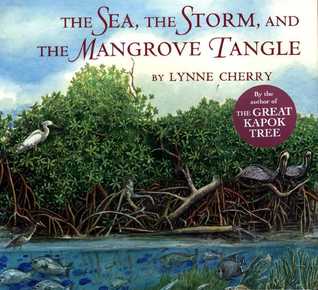
The Sea, the Storm, and the Mangrove Tangle is much in the same style as Flute's Journey. It is the story of how a mangrove grows from a propagule into a huge tangle that shelters fish, seahorses, birds, and other wildlife. We read it aloud together, and the boys enjoyed it. I did not require narration, but I think it would work well as a school book too. It also includes maps of where mangroves grow.

How Groundhog's Garden Grew is quite different from the first two books. It is a make-believe story of how a squirrel helps a groundhog grow his own garden. I think it may be aimed at slightly younger children (3 and up). It weaves in many interesting details about gardening: collecting seeds, transplanting, pollination, perennials. The story ends with groundhog sharing his bounty at a big Thanksgiving dinner with all his garden friends. Like all of Lynne Cherry's books, the illustrations in this book are wonderfully detailed. My boys especially liked the pictures of how a seed grows from seed, to seedling, to full-grown plant. I think I'll take this one out of the library again before our next gardening season.

I mentioned at the beginning that Lynne Cherry is an environmentalist. I am not, at least, not in the same sense. (I believe it's our God-given responsibility to care for the earth and its creatures. I balance that with the belief that the earth's resources are there for us to use. I am cautious about environmentalism for its own sake.) The Great Kapok Tree is the book I enjoyed least of all the ones I picked up from our library, though it was just as beautifully illustrated. To be honest, I would have appreciated a straight-forward, honest look at the species of the rainforest and how they are affected when the trees are cut down. I only disliked the way it was communicated in this book, where it seemed like Cherry was trying to manipulate the emotions of her readers and convert them to environmentalism. However, this book has won many honours, and you may like it even if I didn't.

Check out this video of Lynne Cherry working on one of the illustrations for How Groundhog's Garden Grew.


Tuesday, October 21, 2014

Education is a Not-So-Perfect Atmosphere

What does "Education is an Atmosphere" mean?

When I first began to think about education as atmosphere, I focused mostly on the positive aspects of this principle. Children will learn to love the things their parents love simply, as in the air they breathe. I love music, my children will be surrounded by good music in our home, and they will learn to love it. I love to watch birds, and they will pick up my enthusiasm naturally. My husband and I love to read, and have hundreds of books. Of course our children will be affected by that.

I thought of the relationships the children have in the home and in the extended family, and what they learn from each.

And I admit it, I felt pressure to be intentional, to make the atmosphere in our home the best it can be. We are not naturally art lovers in this home... perhaps I need to work on learning to love it more myself. My housekeeping leaves a lot to be desired... I need to work on that for the children's sake. And there is nothing wrong with that line of thought. Education is a discipline and a life as well, after all. But we do miss something if we consider only the positive aspects of "Education is an Atmosphere."

Last month I was preparing for a Charlotte Mason meeting at my home, and I took the time to read Chapter 6 of A Philosophy of Education. I was very struck that Charlotte Mason begins this chapter on "Education is an Atmosphere" with criticism of those who are too intentional with their atmosphere. Such parents and teachers create a hothouse where children are protected from the realities of the world and surrounded by sweetness and light.

When Charlotte Mason speaks of atmosphere, she is speaking of the atmosphere in the home as it is: an "atmosphere which nobody has been at pains to constitute." (p. 96) "We all know the natural conditions under which a child should live; how he shares household ways with his mother, romps with his father, is teased by his brothers and petted by his sisters; is taught by his tumbles; learns self-denial by the baby's needs..." (p. 96)

I work hard to create good habits in our home (Education is a discipline). I try to be intentional about exposing my children to good books, art, and music (Education is a life). Still, it is freeing to know that the many imperfections and failings in our home are not outside my children's education. "By these things children live and we may not keep them in glass cases; if we do, they develop in succulence and softness and will not become plants of renown." (p. 97)

Atmosphere will be affected and changed by discipline and life, because we ourselves as persons will be affected and changed. Atmosphere is not something we create artificially. Rather, what we are as persons affects those around us. This includes both good and bad elements, of course, because that is real life.

My three boys fight sometimes (and give reluctant kisses and sorry's when I insist...). I struggle with housekeeping and lose my patience once in a while. These things, and the way we deal with them and grow over time, are all part of the real-life atmosphere in our home. And much as I strive for better things, I know that these frictions too are helping my children grow.

Charlotte Mason ends the section on atmosphere with some balance:
"There are two courses open to us in this matter. One, to create by all manner of modified conditions a hot-house atmosphere, fragrant but emasculating, in which children grow apace but are feeble and dependent; the other to leave them open to all the 'airts that blow,' but with a care lest they be unduly battered; lest, for example, a miasma come their way in the shape of a vicious companion." (p. 98-99)
"Education is an Atmosphere" means that we let children experience real life in our homes, but that real life must be permeated by love and balanced by discipline and nurture.