Friday, October 30, 2015

Review: Peter and the Wolf from Maestro Classics

Maestro Classics ReviewAs I was doing some dishes last evening, I overheard SA(7) humming a tune. I looked at my husband. "Is that...?" He nodded. Prokofiev's Peter and the Wolf. Yes, this is the child that couldn't carry a tune in a bucket not so long ago. The humming, slightly off-tune but perfectly recognizable, was thanks to some daily sol-fa work. The actual tune was thanks to a Maestro Classics recording we've been listening to lately. We received an MP3 and digital download of Peter and the Wolf to listen to and review.

Maestro Classics Review

Maestro Classics' recording of Peter and the Wolf is part of their Stories in Music series, a collection of twelve recordings that includes classics such as The Nutcracker and Carnival of the Animals, and also some beloved children's stories set to original music like The Tortoise and the Hare and Mike Mulligan and His Steam Shovel. All of them are performed by the London Philharmonic Orchestra under the direction of Stephen Simon and include extras such as the stories of the composers, more information about the music or the story, and extra music.

Our Peter and the Wolf recording came with the story of Prokofiev; a music-only track without the narration; a talk from the conductor about how the musical themes, not just the instruments, represent the characters in the story; a Russian dance performed by Trio Voronezh; and themes from Peter and the Wolf performed by the same trio, giving it a Russian flavour (This was my favourite extra!). We also received a download of an activity booklet (CDs come with a physical copy). There is a free curriculum guide online to accompany the recording. We didn't use it, but I know some of you might be interested.

At our house, Thursday is music appreciation day. Normally, that means that at about 10:30 AM, we take our snacks upstairs to watch Classical music on YouTube. Each term, we focus on a particular composer and watch a several of his works performed by a variety of performers and symphony orchestras. When we received Peter and the Wolf, we took a break from Brahms and listened to Prokofiev instead. Several Thursdays in a row we listened to Peter and the Wolf again along with one of the extra tracks. We also did a couple of the activities from the booklet. Their favourite was matching the instruments to the animals.

We had actually watched Peter and the Wolf about a year and a half ago during one of our regular music appreciation sessions on YouTube. It had been a wonderful performance, so I was surprised that the boys didn't remember it when we began to listen to this CD. I suppose that should be a lesson to me... we do need to listen to things over and over again for them to become familiar and beloved. I don't think they will ever forget Peter and the Wolf now. Because of this, I have decided to choose one piece from each composer we study to listen to repeatedly until it is very familiar. I think I will also buy some CDs like this one that the boys can listen to on their own whenever the mood strikes them. I sense a Christmas gift idea! :)

For more reviews of Maestro Classics Peter and the Wolf, as well as The Nutcracker, click on the link below.

Maestro Classics Review

Crew Disclaimer

Tuesday, October 27, 2015

Review: IEW Timeline of Classics and Other Resources

Institute for Excellence in Writing is well-known for its writing programs, but it has other resources as well. I had the chance to use and review three of them: Timeline of Classics, Teaching with Games Set, and A Word Write Now.

Timeline of Classics

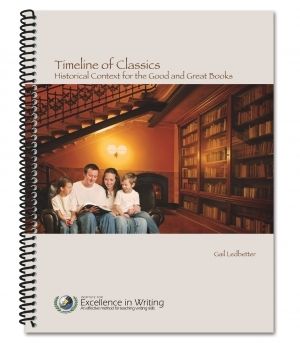
Of the three resources, the one I'm the most excited about is Timeline of Classics by Gail Ledbetter. This is a well-chosen book list of classic literature, biographies, the very best of historical fiction, and even plays and films, all arranged chronologically. It is divided by time period: Ancients, The Middle Ages, Renaissance and Reformation, and The Modern World. The pages are very simply laid out with just the right amount of information: a description of the time period and/or the setting, title, author, and the level each resource is appropriate for (Elementary, Middle, or High School). Each page also has an intriguing quote from one of the recommended books.

Since we are studying the Middle Ages right now, I turned to that section of the book. I could see at a glance which resources were appropriate for elementary school. I opened my library's website and started searching for and reserving the titles that sounded interesting: The Sword in the Tree; The Making of a KnightCastle Diary... I noticed a recommendation for a historical atlas, and thought, "Yes! I need to buy one of those." (I had just been trying to google historical maps online with very limited success.)


Any homeschooler that uses a literature based approach for history will appreciate this resource. It hits just the right balance of selectivity and comprehensiveness, and could easily be used as the basis of all your history studies on its own. I anticipate referencing it regularly for years to come.

Teaching with Games

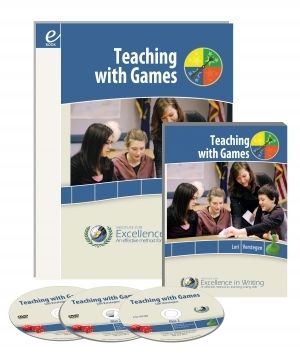
The resource my boys were most excited about was the Teaching with Games Set. This parent/teacher resource includes two DVDs containing workshops led by Lori Verstegen on teaching with games, a spiral-bound book with rules and templates for all the games, and a CD-ROM with a PDF of the book and some bonus materials (extra games!). There are twenty games, most adaptable to any age group, many adaptable to more than one subject area. The games range from "No-Prep" games that require nothing more than a piece of paper (at the most), to matching games, Jeopardy-type question games, math games, and "Make as You Teach" games.

I was amused with the fascination this set held for my boys. It is a parent resource, but SA(7) spent hours poring over the instructions for the games, and JJ(5) immediately chose "The Space Game" (a home-made board game) as his favourite. They both watched the game demonstrations on the DVDs with me. We played several of the games, and as usual in this house, the math games got played the most.


"Fun Times" was a big hit, providing plenty of multiplication practice. I chose to make our own game board for this with multiplication facts between 1x1 and 6x6. (The original had multiplication facts from 2x5 to 7x10, and required modifying a pair of dice.) SA and I (or JJ, who soon figured out how to find the answers on the board based on the factors on the top and side...) took turns rolling the dice and multiplying the two numbers on the dice. We put our tokens on the answers, and the first person with four in a row was the winner. The game had some twists to add to its excitement...rolling doubles and landing on shaded squares on the board had special consequences.

Teaching with Games is a worthwhile resource that could be helpful to Sunday-school teachers and classroom teachers as well as homeschoolers. To be perfectly honest, I can be a bit lazy about coming up with games or activities to go with our studies. The boys were very pleased that I got to review this, and I'm sure they will keep me using it for some time to come.

A Word Write Now

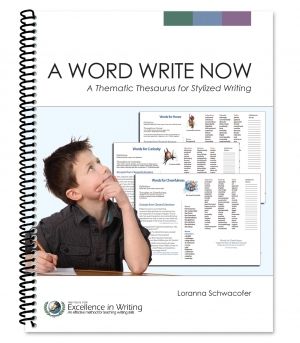
The last resource I used was A Word Write Now. This student thesaurus by Loranna Schwacofer is creatively organized by character traits, descriptive words, and words for movement and the senses. The idea is that children do not always know exactly what word they are looking for. This thesaurus directs the student to a category of words and provides a range of ideas as to how they could express themselves using different parts of speech. Each page also includes examples from classic literature.

My boys are not old enough to use a thesaurus, so I used it myself. I often consult an online thesaurus as I blog, so I thought perhaps this one would do as well. It was not really a good fit for my purposes. My use of a thesaurus usually goes like this:
- I notice I'm overusing a word
- I type the word into a search engine
- I pick a better word from the synonyms that come up. 
I'm very task-oriented in my thesaurus use, in other words. This thesaurus is more oriented to creativity. It is all about exploring and enjoying words. I expect it will be very useful at some stage as my children learn to write, but we're not there yet.

If you are looking for a student thesaurus, I suggest you check out the samples online at Institute for Excellence in Writing and see if this is something that might work for you.

Other bloggers on the Schoolhouse Review Crew have reviewed these resources and also Phonetic Zoo Spelling from Institute for Excellence in Writing. Click on the link below to see what they have to say!

IEW Review

Crew Disclaimer

Friday, October 23, 2015

Copywork in Grade Two

"I can only offer a few hints on the teaching of writing, though much might be said. First, let the child accomplish something perfectly in every lesson--a stroke, a pothook, a letter. Let the writing lesson be short; it should not last more than five or ten minutes. Ease in writing comes by practice; but that must be secured later. In the meantime, the thing to be avoided is the habit of careless work--humpy m's, angular o's." Charlotte Mason, Home Education, p 253, emphasis mine. 

I

The above is the result of a typical copywork lesson right now for SA(7). Three little words, done in five minutes of effort. He prints fairly neatly, but not with ease. Aside from his daily copywork lesson and some numbers in his math book, he writes little to nothing. I worry about this sometimes, particularly when I notice the achievements of others around his age, or even his younger brother JJ(5).

When I was eighteen and in driver's ed, the classroom instructor said something that stuck with me. Some people learn to drive quickly and with ease, while others take more time and effort to master it. What matters is proficiency in the end, not how long it takes to get there. 

My aim is for SA to learn to write beautifully and with ease. This is not a race. It is not a competition with other seven-year-olds. If it takes him years to get to that point, it will be okay. 

Meanwhile, he takes five minutes out of each school day to do his very best printing. He has his bad days, where his pencil "accidentally" makes stray marks and mis-shapen letters. We erase and go on the next day. He does not hate copywork. He is not frustrated. It is enough for now.

There have been two or three times in the last month that he has voluntarily copied something or written something down, and I take that as a hopeful sign. It may be that he will experience a sudden jump in ability someday, as he did with reading last year. It will not be the first time slow, steady, daily effort has laid the foundation for such a leap.

I am very happy with Charlotte Mason's method of oral narration (telling back what has been read aloud) for the younger grades. Because of this, his learning is not tied to his reading and writing skills. He is growing in his composition and communication abilities, and someday his manual writing skills will catch up.

If you are curious, we use Penny Gardner's Italics: Beautiful Handwriting for Children

Monday, October 19, 2015

I'm So Sorry, Boys...

...but Christmas isn't for two whole months yet!

Yes, you may play outside as long as you like!

Thursday, October 15, 2015

Apple Picking at MacPhee's Orchard

This week we did something the boys look forward to every year: apple picking at MacPhee's Orchard. Five of their twenty varieties were ripe, and we chose to pick Spartans and Nova Spies. Sadly, my favourite JonaGolds were not quite ripe yet. I'm not sure yet if we'll manage to come back for them when they're ready... the orchard is about 40 minutes away from our place.

The orchard is a peaceful, quiet place with thousands of small trees. Children can easily pick apples all by themselves. We met several families from our local homeschool co-op there and got to work. SA(7) carefully read the information sheet telling us about all the varieties of apples...their taste, texture, and other defining characteristics. MM(3) pulled the wagon around. As usual, JJ(5) was my most faithful worker.

As we were paying for our apples (only .70/lb!), the boys caught sight of the maple syrup they were also selling. The boys wanted some, but I held them off ...maple syrup is expensive! Finally I decided they could buy some --if they went and bought it themselves (learning experience = added value, to me). 

I gave SA(7) the money, and told JJ(5) to go with him and ask for a small bottle. They started off to the tiny store, but before they got there, JJ came back. "I'm shy, Mama," he said.
"I know," I said. "You just go along with SA. He's not shy."
They got to the little store, but didn't go in. All three of them (by this time MM had decided he wanted to be in on it, too) hung around the door and peeked in. This time SA came back.
"I've never done bought something without you before, and I feel nervous about it," said he.
"Well," I said firmly, "If you boys don't buy it, we're not going to have it."
So they went back again. At the door, they peeked in and looked back at me. "Go on," I encouraged.
They went in. Five seconds later, JJ came tearing out with the maple syrup, and SA came out more slowly with the change.
"Did he give you the correct change?" I asked. 
"Yes," he said.
JJ was dancing with excitement. "He gave me the maple syrup, and he gave SA the money!"
"Did you do it the way I told you?" I asked them.
"Not exactly," said SA, "I didn't ask for a small bottle, I asked for a 500 millilitre bottle, because that's how much the small bottles hold."

So we went home and had apple pancakes and maple syrup for lunch.

Wednesday, October 14, 2015

Wednesday With Words: Poetry of Sound and Feeling

I was reading Edgar Allan Poe's poem "The Bells" to the boys at teatime today and it made me think of the different reasons we love different poems. We enjoy poetry very simply here --no analysis or picking apart, just reading and enjoyment. I'm sure we'll engage in some analysis later on, perhaps in high school, but for now we're laying a foundation of pure pleasure in the words, the sounds, the meanings, the feelings. "The Bells" is one of those poems where the sound of the words sweeps you along and evokes emotion, from the cheerful tinkling of the silver sledge bells at the beginning of the poem to the desperate, frenzied tolling of the iron bells at the end. This kind of poem almost reads itself... it pulls expression from you as you read it.

And that brings me to one of my favourite poems of this kind: "Tarantella" by Hilaire Belloc. It's not quite as heavy as Poe's "Bells," despite the "feet of the dead" and "Doom" at the end.

Tarantella

Do you remember an Inn,
Miranda?
Do you remember an Inn?
And the tedding and the spreading
Of the straw for a bedding,
And the fleas that tease in the High Pyrenees,
And the wine that tasted of the tar,
And the cheers and the jeers of the young muleteers
(Under the dark of the vine verandah)?
Do you remember an Inn,
Miranda?
Do you remember an Inn?
And the cheers and the jeers of the young muleteers
Who hadn't got a penny,
And who weren't paying any,
And the hammer at the doors and the Din?
And the Hip! Hop! Hap!
Of the clap
Of the hands to the twirl and the swirl
Of the girl gone chancing,
Glancing,
Dancing,
Backing and advancing,
Snapping of the clapper to the spin
Out and in--
And the Ting, Tong, Tang of the Guitar!
Do you remember an Inn,
Miranda?
Do you remember an Inn?

Never more,
Miranda,
Never more.
Only the high peaks hoar:
And Aragon a torrent at the door.
No sound
In the walls of the Halls where falls
The tread
Of the feet of the dead to the ground.
No sound:
Only the boom
Of the far Waterfall like Doom.

Did you read it aloud? Could you feel the din and whirl of the dance, and then the abrupt slowdown as you understood the depth of the silence and desolation of the Inn now?

Having children and reading poetry aloud to them has increased my enjoyment so much. I would never have glanced at this one twice back in the days when I only read poetry silently to myself. Some poems are meant to be read aloud, and you only understand their appeal when you do.

Do you have any examples of poems that are best read aloud? I'd love to hear them!


Thursday, October 8, 2015

Field Trip to Orwell Corner

 Today, we went to Orwell Corner, a local historic village.

A little over 100 years ago in this one-room schoolhouse, science in the early years took the form of nature study. My boys didn't see anything strange or different about that at all. This was a humming-bird nest.

MM(3) dipping candles.
We had a lovely long wagon ride.

There were also animals to see, a blacksmith shop to visit, and a general store with many interesting artifacts.

My favourite part of the experience was seeing SA(7) at the blacksmith shop. He was very interested in everything about it, and it was a joy to see the utter unself-consciousness with which he peppered the blacksmith with questions and exclaimed in wonder at the temperature of the glowing metal. He learned a lot today, and told his papa all about it when he got home tonight. I love natural, spontaneous narration!