Thursday, August 23, 2018

Canadian History Form 2 (AO Year 5)

This week, I've been planning Canadian History for the coming school year. Once again, I will be combining lessons for the whole family while following the time period for SA(10)'s Ambleside Online Year 5. (1800-1914). I suppose it is past time that I could make SA do his Canadian History lessons independently, but the truth is that I'm not ready to give up doing it together as a family because we're all enjoying it too much. (If it ain't broke, don't fix it, right?)

This year, I will have students in grades 5, 3 and 1. This plan will take the place of the American history "spine" and biographies in AO Year 5. Of course, I am always careful not to overload my younger students and will take history books out of their AO years to make room for Canadian history.

I want to caution you that this is my personal plan for this coming year. It has not been worked out yet. It's possible that I may decide four weeks in that I have been too ambitious, and start cutting out some of the supplemental reading. I may decide I haven't planned enough and fill it up with more Roughing it in the Bush. It's also possible that I may decide to excuse my Year 1 student from some of the lessons. Anything could happen... use your own discretion! I will try to come back to this post and tell you how it went.

The Books

"Spines"
The Story of Canada by George Brown, Eleanor Harman, and Marsh Jeanneret (hereafter BHJ)
The Story of Canada by Janet Lunn and Christopher Moore. (hereafter LM. My page numbers are from the 1992 edition.)

For more on Canadian history spines, see here. I have been using BHJ  (published in 1950) for several years now, but as we approach more modern times I am hoping to move into LM. For this year, I skimmed through both books and chose whichever readings appealed to me most for the subject. I skipped some sections of both because they overlapped with supplemental readings I was planning to do. Please keep in mind that this is a read-aloud, family plan. For an independent student, I would probably have chosen one spine to keep it less complicated.

Supplemental Reading
Roughing it in the Bush by Susanna Moodie (will not read entire book, may finish later as a free read)
Revolt in the West: The Story of the Riel Rebellion by Edward McCourt
Canadian Yesterdays by Edgar A. Collard, 2 selections: "The Apostle of Nova Scotia" (pp 84-90) and "The Lady on the Cowcatcher" (pp. 1-6)
Great Canadian Adventures by Reader's Digest (hereafter GCA), 11 Selections:
"Lieutenant Worsley's Revenge" pp 346-355
"A Voyage to a New Land" pp 220-235
"Franklin's Last Voyage" pp 207-217
"Tales of the Plains Crees" pp 99-108
"Down the Roaring Fraser" pp 173-179
"Overland to the Cariboo" pp 488-498
"The D-dest Man that Ever Came Over the Cariboo Road" pp 523-531 (I will edit out offensive words as I read, of course)
"The March West" pp 534-547
"Wild and Wooly Days" pp 550-565
"Van Horne Moves the Troops West" pp 368-375
"The Stampeders" pp 500-512

Free Reading (Will likely use as bedtime reading over the course of the school year.)
Underground to Canada by Barbara Smucker
George Dawson, the Little Giant by Joyce Barkhouse

The Schedule

I have spread out these readings over four days a week to give myself some margin for map and timeline work. Also, in real life I schedule a regular time slot for Canadian history and just keep picking up where I left off. This "weekly schedule" will not be a strict rule for me...I may move through it more quickly at times, or more slowly at others. If my pace consistently doesn't line up with the weeks, I will adjust (add more Roughing it in the Bush readings, or take away unnecessary supplemental readings) and keep moving. 

Term 1

Week 1
"The Apostle of Nova Scotia" (Canadian Yesterdays pp 84-90), 2 lessons
"The War of 1812-1814" (BHJ 208-210), 1 lesson
Roughing it in the Bush, 1 lesson (not scheduling chapters, just picking up where I left off every time.)

Week 2
"Lieutenant Worsley's Revenge" (GCA pp 346-355), divide into 3 lessons and do 2 this week.
"The Story of a Shawnee Chief" (BHJ 211-214), 1 lesson
Roughing it in the Bush, 1 lesson

Week 3
"At Queenston Heights" (BHJ 214-216), 1 lesson
"Lieutenant Worsley's Revenge" (GCA pp 346-355), lesson 3 of 3
"An Even Struggle" (BHJ 217-219 ...Plattsburg and LM 90 Sea fights...-91 ...would stay British), 1 lesson
Roughing it in the Bush, 1 lesson 

Week 4
"The New Comers" (LM pp 91-96), divide into 2 lessons and do 1 this week.
"A Voyage to a New Land" (GCA pp 220-235), divide into 4 lessons and do 2 this week.
Roughing it in the Bush, 1 lesson 

Week 5
"The New Comers" (LM pp 91-96), lesson 2 of 2.
"A Voyage to a New Land" (GCA pp 220-235), lessons 3 and 4 of 4.
Roughing it in the Bush, 1 lesson 

Week 6
"The People In Between" (LM pp 122-125), 1 lesson
"The Red River Colony" (BHJ 221-227), 2 lessons
Roughing it in the Bush, 1 lesson 

Week 7
"The Bay's Empire" (LM 126 And the Fur... - 128), 1 lesson
"Ruling Our Law-Makers" (BHJ pp 242-243), 1 lesson
"The Little Rebel" (BHJ pp 244-249), divide into 2 lessons and do 1.
Roughing it in the Bush, 1 lesson 

Week 8
"The Little Rebel" (BHJ pp 244-249), lesson 2 of 2.
"The Struggle in Lower Canada" (BHJ pp 250-252), 1 lesson
"Nova Scotia's Great Leader" (BHJ pp 253-256), 1 lesson
Roughing it in the Bush, 1 lesson 

Week 9
"The Cry for Reform" and "Government by the People" (BHJ 257-259), 1 lesson
"A Famous Report" (BHJ pp 260-262), 1 lesson
"Cabinet Government" (BHJ pp 262-263), 1 lesson
Roughing it in the Bush, 1 lesson 

Week 10
"Lord Elgin's Decision" (BHJ pp 264-267, LM chart on p 109), 1 lesson
"Franklin's Last Voyage" (GCA 207-217), divide into 3 lessons and do 1.
"Wanderers and Artists" (LM pp 129-132)
Roughing it in the Bush, 1 lesson 

Week 11
"Franklin's Last Voyage" (GCA 207-217), lessons 2 and 3 of 3.
"Leaders of the West" (LM pp 132-135), 1 lesson
Roughing it in the Bush, 1 lesson

Week 12
"Tales of the Plains Crees" (GCA pp 99-108), 3 lessons
Roughing it in the Bush, 1 lesson

Term 2

Week 13
"Mountains and Oceans" (LM 138-139), 1 lesson
"The Nootka Traders (LM 140-141), 1 lesson
"People of the Salmon" (LM 142-146), divide into 2 lessons and do 1.
Roughing it in the Bush, 1 lesson

Week 14
"People of the Salmon (LM 142-146), lesson 2 of 2
"From Canada, by Land" (LM 146-151), 1 lesson
"Down the Roaring Fraser" (GCA 173-179), divide into 2 lessons and do 1
Roughing it in the Bush, 1 lesson

Week 15
"Down the Roaring Fraser" (GCA 173-179), lesson 2 of 2
"The Father of BC" (LM 151-155), 1 lesson
"The Gold Fields" (LM 155-157), 1 lesson
Roughing it in the Bush, 1 lesson

Week 16
"Overland to the Cariboo" (GCA 489-498), 2 lessons
"Mountains and Oceans" (LM 158-159), 1 lesson
Roughing it in the Bush, 1 lesson

Week 17
"The D-dest Man" (GCA 523-531), 2 lessons
"Building a Dominion" (BHJ 298-302), 1 lesson
Roughing it in the Bush, 1 lesson

Week 18
"John A. MacDonald and Confederation" (BHJ 302-303), 1 lesson
"Breaking the Deadlock" (LM 165-166), 1 lesson
"The Idea of Confederation" (LM 166-169), 1 lesson
Roughing it in the Bush, 1 lesson

Week 19
"From Charlottetown to Quebec" (LM 170-171), 1 lesson
"The Battle for Confederation" (LM 171-178), 2 lessons
Roughing it in the Bush, 1 lesson

Week 20
"The Law that Made a Nation" (BHJ 305-307), 1 lesson
"Dominion from Sea to Sea" (BHJ 308-314), 2 lessons
Roughing it in the Bush, 1 lesson (This is where I will stop doing lessons from Roughing it in the Bush and either switch it to a free read or put it away.)

Week 21
"Into the West" (LM 180 The Metis... - 182), 1 lesson
"Massacre in the Cypress Hills" (LM 184) and "Scarlet and Gold" (BHJ 316-317), 1 lesson
Revolt in the West chapter 1, 2 lessons

Week 22 (If desired, can choose only one of the GCA supplemental readings for the NWMP, "The March West" or "Wild and Wooly Days" and spread it over more lessons for a lighter schedule)
"The March West" (GCA 534-547), divide into 4 lessons and do 2 this week.
Revolt in the West chapter 2, 2 lessons

Week 23
"The March West" (GCA 534-547), lessons 3 and 4 of 4.
Revolt in the West chapter 3, 2 lessons

Week 24
"Wild and Wooly Days" (GCA 550-565), divide into 4 lessons and do 2 this week.
Revolt in the West chapter 4, 1 lesson
Revolt in the West chapter 5, divide into 2 lessons and do 1 this week.

Term 3

Week 25
"Wild and Wooly Days" (GCA 550-565), lessons 3 and 4 of 4.
Revolt in the West chapter 5, lesson 2 of 2
Revolt in the West chapter 6, 1 lesson

Week 26
"Steel of Empire" (BHJ 321-326), 2 lessons
Revolt in the West chapter 7, 2 lessons

Week 27
"Van Horne Moves the Troops West" (GCA 368-375), 2 lessons
Revolt in the West chapter 8, 1 lesson
Revolt in the West chapter 9, divide into 2 lessons and do 1.

Week 28
Revolt in the West chapter 9, lesson 2 of 2
Revolt in the West chapters 10 and 11, 3 lessons

Week 29
Revolt in the West chapters 12 and 13, 4 lessons

Week 30
Revolt in the West chapters 14, 15 and 16, 3 lessons
Revolt in the West chapter 17, divide into 2 lessons and do 1.

Week 31
Revolt in the West chapter 17, lesson 2 of 2
Revolt in the West chapter 18, 1 lesson
Revolt in the West chapter 19, divide into 2 lessons and do 1
"Lady on the Cowcatcher" (Canadian Yesterdays 1-6), divide into 2 lessons and do 1

Week 32
Revolt in the West chapter 19, lesson 2 of 2
Revolt in the West chapter 20, 1 lesson
"Lady on the Cowcatcher" (Canadian Yesterdays 1-6), lesson 2 of 2.
"Sunny Ways" (LM 196-198), 1 lesson

Week 33
"Gold Fever" (LM ch 198-200), 1 lesson
"The Stampeders" (GCA 500-512), 3 lessons

Week 34
"The Last Best West" (LM 200-206), 2 lessons
"Isaac Barr's Fiasco" (GCA 109-119), divide into 3 lessons and do 1.
"Dreams and Struggles" (LM 207-208), 1 lesson

Week 35
"A Voice for Women" (LM 208-210), 1 lesson
"Isaac Barr's Fiasco" (GCA 109-119), lesson 2 of 3.
"A Turn of the Century Time Trip" (LM 210-214), 2 lessons.

Week 36
"Into the North" (LM 215-216), 1 lesson
"Isaac Barr's Fiasco" (GCA 109-119), lesson 3 of 3
"The Canadians and the Empire" (LM 217-219), 1 lesson
"Canada in WWI" (BHJ 344-346), 1 lesson.

Thursday, July 26, 2018

Great Stories of Canada

Today I'd like to introduce you to a whole series of living books on Canadian history!

Published between 1953 and 1968, "Great Stories of Canada" are the Canadian equivalent of the popular Landmark series in the US. Sadly, they are long out of print, but you can still find them at library sales and thrift stores. I'm including lots of pictures so you can recognize them when you see them there, and snap them up!

The True NorthThe Bold HeartRed River AdventureKnights of the AirThe First CanadianRevolt in the West

This past year, we read Kerry Woods' The Map-Maker: The Story of David Thompson from this series. We read it as a Canadian substitute for a book on Lewis and Clark in the American curriculum we follow, and it was a worthy substitute. It held the interest of all my students, from SA(9) down to MM(5), and I am confident that they will "know" David Thompson for the rest of their lives. We also made great use of the map in the front of the book for our Canadian geography lessons.

The books in the Great Stories of Canada series are written by various authors. I have not read all of them yet, but skimming through the ones I have I am confident that the writing quality is consistently good. We did find one author, Joseph Schull, (Battle for the Rock, about the Battle on the Plains of Abraham) was not ideal for reading and narration in grade 3 because my student was losing track of the many characters. However, I would still recommend the book, and it would probably have worked for an older student in grades 4-6. Other authors include Pierre Berton, Thomas Raddall, Edward McCourt, and Roderick Haig-Brown.


One of my favourite features of this series are the historical maps in the beginning of each book. Thus far in my experience with these books, I have found that the maps contain all the places mentioned in the story and no more, allowing children to follow along easily as they read.

There are also a few illustrations, in most books one or two pen-and-ink drawings per chapter. The quality of these varies a little depending on the artist employed.


The series was originally published by MacMillan, but you may also find editions published later by The Canadiana Company with two titles per volume, like these.
The Canadiana Company

I also include a list of titles and authors for your convenience. Please note that I do not endorse the contents of each individual book, as I have not read them all. Please do your own due diligence!

1. The Scarlet Force: The Making of the Mounted Police by T. Morris Longstreth
2. The Force Carries On by T. Morris Longstreth
3. Raiders of the Mohawk: The Story of Butler's Rangers by Orlo Miller
4. The Nor-Westers: The Fight for the Fur Trade by Marjorie Wilkins Campbell
5. The Golden Trail: The Story of the Klondike Rush by Pierre Berton
6. Buckskin Brigadier: The Story of the Alberta Field Force in 1885 by Edward McCourt
7. The Map-Maker: The Story of David Thompson by Kerry Wood
8. Arctic Assignment: The Story of the "St. Roch" by Sgt. F.S. Farrar, RCMP
9. Captain of the Discovery: The Story of Captain George Vancouver by Roderick Haig-Brown
10. The Bold Heart: The Story of Father Lacombe by Josephine Phelan
11. Redcoat Sailor: The Story of Sir Howard Douglas by R. S. Lambert
12. Red River Adventure: The Story of the Selkirk Settlers by J. W. Chalmers
13. The True North: The Story of Captain Joseph Bernier by T. C. Fairley and Charles E. Israel
14. The Great Chief: Maskepetoon: Warrior of the Crees by Kerry Wood
15. The Salt-Water Men: Canada's Deep-Sea Sailors by Joseph Schull
16. The Rover: The Story of a Canadian Privateer by Thomas H. Raddall
17. Revolt in the West: The Story of the Riel Rebellion by Edward McCourt
18. Knights of the Air: Canadian Aces of World War I by John Norman Harris
19. Frontenac and the Iroquois: The Fighting Governor of New France by Fred Swayze
20. Man from St. Malo: The Story of Jacques Cartier by Robert D. Ferguson
21. Battle for the Rock: The Story of Wolfe and Montcalm by Joseph Schull
22. The Queen's Cowboy: James Macleod of the Mounties by Kerry Wood
23. Fur Trader: The Story of Alexander Henry by Robert D. Ferguson
24. The First Canadian: The Story of Champlain by C. T. Ritchie
25. Adventurers from the Bay: Men of the Hudson's Bay Company by Clifford Wilson
26. Ships of the Great Days: Canada's Navy in World War II by Joseph Schull
27. Mutiny in the Bay: Henry Hudson's Last Voyage by R. S. Lambert
28. Runner of the Woods: The Story of Young Radisson by C. T. Ritchie
29. The Good Soldier: The Story of Sir Isaac Brock by D. J. Goodspeed
30. Tecumseh: The Story of the Shawnee Chief by Luella Bruce Creighton
31. The Row-Boat War: On the Great Lakes 1812-1814 by Fred Swayze
32. The Ballad of D'Arcy McGee: Rebel in Exile by Josephine Phelan
33. The Savage River: Seventy-One Days with Simon Fraser by Marjorie Wilkins Campbell

Happy hunting!

P.S. Have you read any of these books? I'd love to hear how you liked specific books in the series.

Thursday, July 5, 2018

Year in Review: Our Book Stack

I love taking pictures of our book stacks for the year! It never fails to make me feel like we accomplished something good. Many of these books are from Ambleside Online Year 2 and Year 4, though we did some substitutions (mostly for Canadian history and geography).

The Books We Read Together
As last year, we read a fair number of books together. We had a rotation going at breakfast, and another at teatime. I have not included the books we read at bedtime because they were not narrated and we don't think of them as "school books". Some of these books are ones we are reading over several years.

The Little Woman 
Canadian Wonder Tales (ongoing)
The Blue Fairy Book (ongoing)
Trial and Triumph (ongoing)
Elementary Geography
The Ocean of Truth
Drummer Boy for Montcalm
The Story of Canada (Brown et al) (ongoing)
Great Canadian Adventures (selections. ongoing)
The Story of Canada (Marsh) (selections, ongoing)
Famous Indians (section about Joseph Brant)
The Map-Maker
Robinson Crusoe
Kidnapped
Collected Poems of Emily Dickinson (selections)
Poetry for Young People: Emily Dickinson (selections)
A Lakeland Anthology: William Wordsworth (selections)
Mathematicians Are People, Too (selections)


SA(9)'s School Books

Since several of the books we read together were from SA's Year 4 (Trial and Triumph, The Ocean of Truth, Robinson Crusoe, Kidnapped), his stack looks a little short! Not pictured are Plutarch and Shakespeare's Julius Caesar. We read Shakespeare together with an audio production, and I read Plutarch aloud to him. SA's favourite books this year were George Washington's World, The Map-Maker, and Julius Caesar.
Shakespeare: MacBeth
Shakespeare: Twelfth Night
Shakespeare: Julius Caesar
Plutarch: Romulus
Plutarch: Publicola
Madam How and Lady Why (ongoing)
Bullfinch's Mythology: The Age of Fable (ongoing)
The Story-Book of Science
George Washington's World (incomplete)


JJ(7)'s School Books

JJ is a very strong reader, and though I was reading some of his books aloud to him at the beginning of the year, by the end he was reading all of these on his own. You may notice that we left out several of the Year 2 books. This is because we were reading a number of books together (above) and I didn't want to overload him. JJ's favourite books this year were The Little Duke, The Wind in the Willows, and The Blue Fairy Book (not a Year 2 book, but I have fairy tales on constant rotation in this season of life).

Stories from Shakespeare (selections)
The Little Duke
The Burgess Animal Book for Children
Understood Betsy
Robin Hood (ongoing)
The Wind in the Willows
Seabird

The books above do not reflect everything we did. We studied Dutch artists De Hooch and Van Ruisdael, early Canadian artist Thomas Davies, and French artist Jacques Louis David. We listened to music composed by Telemann and Corelli, Copland and Gershwin, and Beethoven. We read French children's books La Chenille qui Fait des Trous, Ours Brun, and Trois Souris Peintres. In the Bible, we studied Joshua and Judges, Mark and part of Acts. The boys also did a number of paper sloyd projects. Outside the home, they participated in a children's choir and took swimming lessons.

SA was well into grade 5 of Singapore Math (Primary Mathematics US Edition) by the end of the year. He started KISS Grammar and did well with it. We did not begin Latin this year, as I wanted him to know more grammar before beginning Visual Latin. Studied dictation also went amazingly well, and we could see definite progress from the beginning of the year to the end. He did well with learning cursive italic handwriting, but did not gain ease with it yet. We did not begin written narrations, as he was just not ready. However, I started to write down his narrations from George Washington's World so he could begin to get used to the feeling of having his words written down. That was hard for him, as he is a perfectionist and it would take forever for the words to come out (a problem I understand all too well!). I ended up teaching him an oral version of freewriting, which is the technique that helped me break out of that paralyzing perfectionism myself. He made progress, and the words started flowing more easily by the end of the year. 

JJ completed book 2A in Singapore Math. We switched from Miquon part way through the year.  He prints with ease, so he began cursive italic this year as well. 

MM(5) started to learn to read, and insisted on doing math while the other boys were doing it. I printed off Year 1 of MEP Math and he completed it. I tried to have some one-on-one time with him every morning before the school day started, and we read Charlotte's Web, Little House in the Big Woods, and part of Little House on the Prairie. Of course, he also listened in on all the reading we did together and enjoyed the pictures, music, and Shakespeare. 

Writing about all we accomplished makes me feel good, even though I dropped the ball on several things (again.). We dropped piano. Once again, we did very little in our nature notebooks after the first term. French was a failure, other than the children's books we read. We could have done more of several things: dictation, poetry, map work, timeline work.  I could have written an entire post on what we missed and what we could have done better, but I'm making a choice to give thanks for what we were able to accomplish. It was a good year.


Tuesday, June 19, 2018

Exams with Friends

It was exam week here last week. SA(9) finished Ambleside Online Year 4, and JJ(7) finished Year 2. I was feeling very "done" by the end of the school year, and though I intended to do full exams with the boys, in the end I didn't have the energy to do all of it. However, we did do something special that I think I will repeat in future exams. We had friends and family over for tea!

Charlotte Mason style exams are not high-pressure academic exercises. They are more an opportunity for the children to remember what they have learned, and to enjoy realizing how much they know. For me they are an opportunity to assess how I am doing in facilitating the "science of relations." There always seems to be at least one area that I neglect to some degree, and exams are always a gentle reminder to get back on track. On the other hand, exams are also always a reminder that no matter how poorly I may think we did in a term, the children still come out of it with Scripture, poetry, pictures and songs hidden in their hearts and a heart-warming eagerness to share all their favourite books and knowledge. 

Really, an ideal opportunity to share with friends, wouldn't you say?

We had two friends come over for tea one morning, and Grandma and an uncle another morning. I wrote up some exam questions and recitation prompts on strips of paper and put them in a teacup.


As we enjoyed our tea and snacks, we all took turns pulling out the strips of paper and doing what they said.


If you'd like to try this in your family, I have some tips for you:

1. Invite encouraging, supportive, loving people. 

We are blessed to have family and friends who are supportive of homeschooling in general and us in particular. I know that for some of you these people can be hard to find. Don't discount the obvious. If daddy is not involved in the day-to-day homeschooling, he will probably be a great person to include in this celebration. 

2. Do not invite "quizzers." 

Sometimes the most loving, well-meaning people can none-the-less be "quizzers." You know them...whenever they meet your children they challenge their knowledge. How old are you? Can you read yet? Do you know all the provinces of Canada? How far are you in math? If you do really want to invite a quizzer, maybe you could drop a hint that your purpose is to celebrate what your children have learned, and the questions in the teacup related to this term's studies are the only ones to be asked today.

3. Ask the right questions. 

Not all exam questions are suitable for the purpose of sharing like this. Here are some that are:
- Recitations. Scripture passage, hymn, catechism, folk song, poetry, and Shakespeare recitations are ideal.
- Show and Tell. This is a great time for your children to show drawings, nature journals, handicrafts, music they've written out, and even math, copywork and dictation notebooks.
- Performance. Playing a musical instrument is an obvious choice, but also think about other demonstrations of skill. If your child has learned to read, have him read something. If he is quick at mental math, try a math question. 
- Child's Pick. Have your children choose their favourite school book of the year and tell something interesting about it. My children surprised me by both choosing their Singapore math books the first tea time. The second time I had them choose their favourite book of reading and narration. 

4. Limit narration questions.

Questions that involve narration are fine, but don't do too many at an occasion like this. For my two oldest children (introverts who need a minute or two to process before the words start coming), these questions feel more difficult and high-pressure in a situation where we are all eagerly waiting on their every word. For more extroverted children, these questions might release a flow of words that will take a disproportionate amount of time in the context of a casual teatime. I limited myself to one narration question for each child from a book that had consistently good narrations throughout the term.


5. Move on if something isn't going well.

Your purpose is to celebrate what your children do know. If, for any reason, they don't know, keep calm and move on to the next exam question as quickly as possible. Do not be embarrassed, do not take it personally. Do not prompt more than once or twice, or allow your guests to prompt. This will happen. For your children's sake, treat it as no big deal and carry on. A bit of humour at your own expense as the teacher can deflect the attention from your students and help them move on as well. 

At our teatime exam with Grandma, I asked my boys a narration question about the great Canadian explorer David Thompson. They each said something, but I felt they could have said so much more. I started prompting ("I noticed you didn't say anything about crossing the mountains. Can you tell me more about that?"), and regret prompting more than once. I should have let it go. The boys also completely bombed a poetry recitation. I helped them a little, but in the end I let it go and moved on. Exams do expose where we have fallen short. We obviously didn't review our poetry recitations enough this term. We will do better at that next term. Moving on...


6. Don't overdo it.

Put lots of questions in the teacup, but don't put pressure on yourself to get through them all. Keep pulling questions out for as long as it feels enjoyable for everyone, both students and guests. If you notice stress or boredom rising, end with one last song and call it a day. For us, with two students and two preschoolers, our limit was about 40 minutes. We got through about ten exam questions in that time.


7. Don't forget the little ones.

I have an extroverted year 0 student that I knew would also like to share what he learned. Of course, he had learned all the recitations his brothers had. I also asked him to tell us about his favourite book, and to read some three-letter words. I did forget AJ(3), and didn't consider that he probably would like to do what his brothers were doing. Thankfully, one of our guests did not forget him, and asked him to tell all about our cat. He was ridiculously proud to do so. MM and AJ also took their turns pulling questions from the teacup.

I hope this gives you some ideas! We really enjoyed the exams we did with friends. I would love to hear if you try this.

Tuesday, January 23, 2018

A Moment in Our Homeschool


11:45 AM, and SA(9) is reading about Phaeton in Bullfinch's Mythology.


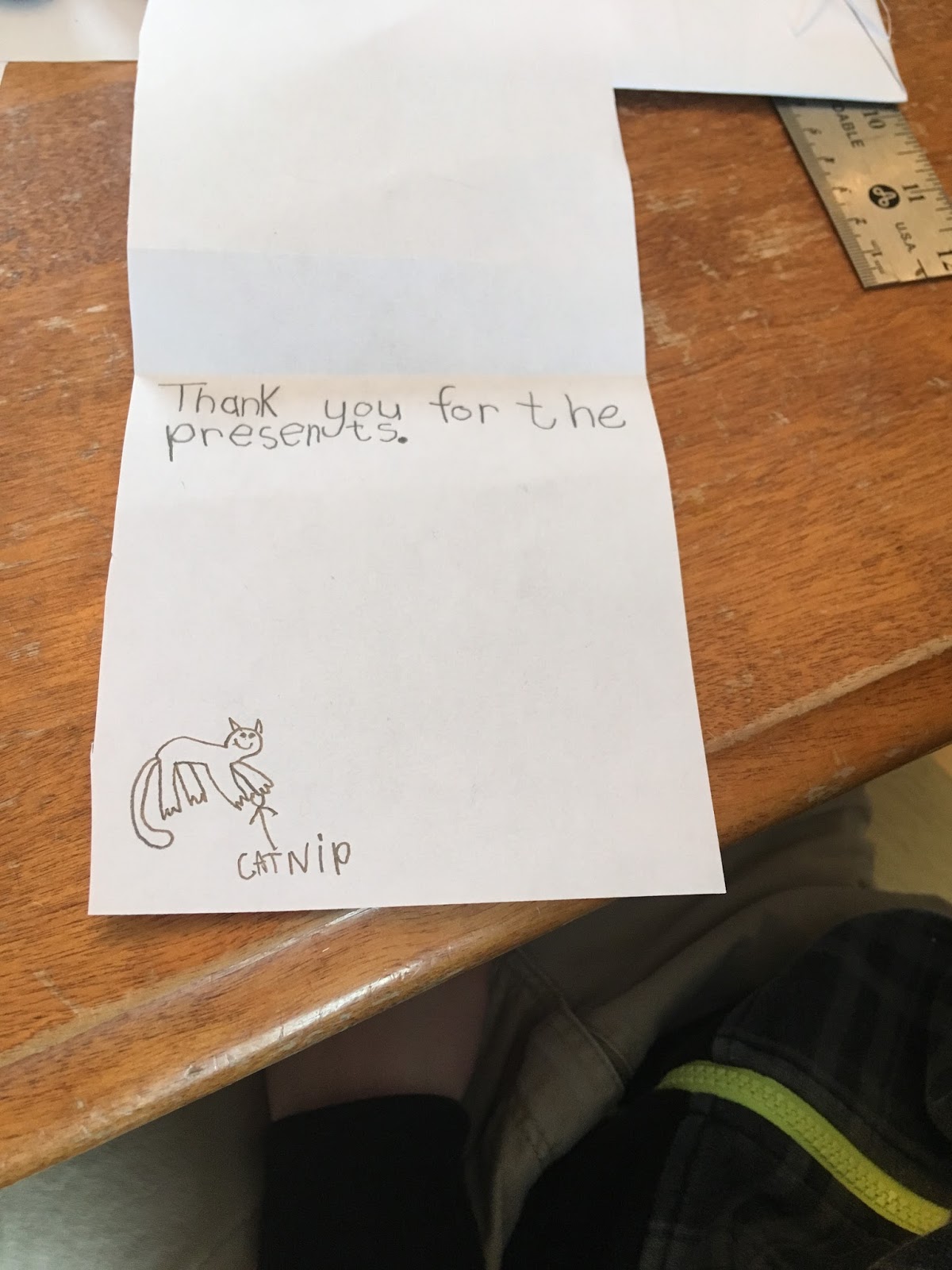
JJ(7) is writing a Thank You card for some Christmas gifts he received. He also folded the envelope.

MM(5) and AJ(3) are playing on the floor with Megabloks. AJ is not yet dressed.

This morning, we have already read and narrated from Robinson Crusoe, reviewed our hymn, Bible memory, and catechism, read the Bible and prayed, done chores (inside and outside), reviewed poetry (Emily Dickinson), sung our folk song (The Riddle Song), done picture study (Thomas Davies), read and narrated from a biography of Joseph Brant (Canadian history), and done math (multiplying decimals for SA). It's almost lunch time, and after that the boys will go out and play in the snow.

Monday, January 22, 2018

My Four Most-Shared Posts

These are the posts that I personally share the most often in response to questions people ask in Charlotte Mason Facebook groups that I'm a part of.
I hope you enjoy them!

Charlotte Mason and Preschool Priorities 1: The Outdoor Life for the Children
This post is part of a series of five posts for mothers of preschoolers. I wrote them in 2014, with my children aged five, three, and one. I had recently started to read Charlotte Mason's own writings, and was zealous to encourage every mother of preschoolers to read Charlotte Mason.
Here is the series:
Why Read Charlotte Mason as a Mother of Preschoolers?
Encouragement for Mothers of Preschoolers
Charlotte Mason and Preschool Priorities 1: The Outdoor Life for the Children
Charlotte Mason and Preschool Priorities 2: Habits
Education is Bigger than You Think


Education is a Not-So-Perfect Atmosphere
When I first started homeschooling, I struggled with trying to create a Charlotte Mason atmosphere. Understanding that the atmosphere she is talking about is one "that no one has been at pains to constitute" helped me to relax.

 A Timeline That Works for UsA Timeline that Works for Us
I still use a version of this timeline with a slight difference: I now create columns for each century to keep it a little neater. I still love this one, though, and it worked well for us in Form 1 (Grades 1-3).


Minimalism for Homeschooling Book Lovers
When I say "minimalism," I mean removing the clutter of books that are not living books and do not bring you joy. I share this post a lot, and it still represents the ideal that I am constantly working towards. My husband prefers that I call it curating rather than minimizing, and I suppose that is more accurate. We have a LOT of books! What can I say? They make us happy.


Wednesday, December 27, 2017

Reading Goals of 2017 and 2018

This year, I started out with big reading plans. Here's how I did with them:

1. Learn from C.S. Lewis
At the beginning of the year, I lined up all of our C.S. Lewis books in chronological order. At the time, I said "I'm pretty sure I will not get through all of them this year." Well, I didn't. I got through five, and am still working through another two.

The Pilgrim's Regress (1933)
Out of the Silent Planet (1938)
The Problem of Pain (1940)
The Screwtape Letters (1942)
Perelandra (1943)

The Abolition of Man (1943) (in progress)
That Hideous Strength (1945) (in progress)

Now that I know my pace, I am setting a new goal of reading seven more C.S. Lewis books in 2018 in addition to finishing the ones in progress.

The Great Divorce (1945)
George MacDonald: An Anthology (1946)
Miracles (1947)
The Weight of Glory (1948)
The Lion, The Witch and the Wardrobe (1950)
Prince Caspian (1951)
The Voyage of the Dawn Treader (1952)

2. Keep up with my book clubs.
I read some good books with my book clubs this year! With them, I finished 
The Iliad
The Brothers Karamazov
The Innocence of Father Brown
Northanger Abbey
Oliver Twist
The Man Who Was Thursday

In 2018, we are continuing with The Odyssey and reading Wives and Daughters by Elizabeth Gaskell. I anticipate we will read an additional four or five classics or other worthy books.

3. Keep reading Charlotte Mason.
I finished following Brandy Vencel's study guide Start Here with an online study group. It was great! Using it, I read For the Children's Sake and most of Charlotte Mason's Volume 6. Then, in the summer I read through Charlotte Mason's Volume 3 again: School Education

I also read Laurie Bestvater's The Living Page. What a great addition to any Charlotte Mason library! It is carefully researched, beautifully written, and clearly demonstrated.

In 2018, I plan to read Charlotte Mason's Volume 2: Parents and Children. Also, in our local Charlotte Mason study group, we're watching the video series from Ambleside Schools International and reading the accompanying study guides which contain passages from Charlotte Mason's volumes.

4. Pre-read at least some of next year's school books for SA.
Well, I did do this, but often it was the night before. In other words, I did not get very far ahead of him. At all. But still, I read some excellent books. Some of my favourites were:
Robinson Crusoe (almost finished)
"MacBeth"
Romulus (Plutarch)

Looking ahead into 2018, I know I need to allot a significant amount of time to pre-reading, especially considering that SA is now at an age that he will be reading most of his school books on his own. Beginning Term 2 of Year 4, I will be reading
"Twelfth Night"
Publicola (Plutarch)
George Washington's World
Kidnapped
The Ocean of Truth
Madam How and Lady Why (already in progress)
Age of Fable (in progress)
Great Canadian Adventures (in progress)

And of course, later in 2018 I will be beginning Ambleside Online Year 5 as well. By necessity, this will likely become my primary reading goal. 

5. Read through the ever-expanding list of books people have recommended and/or lent to me.
I didn't do very well with this in 2017. I have so much to read, I often don't prioritize books that other people want me to read. The one I did manage to finish was probably one of my least favourite books of the year (Wild at Heart). So I'm going to change this goal in 2018:

5. Read books on my own shelves that I have been wanting to read but just haven't gotten to yet.
Krakatoa (Winchester) (in progress)
John Adams (McCullough)
Respectable Sins (Bridges)
As these are all pretty hefty, I doubt I'll get through more than four or five on this list. Still, it's good to set a goal, as if I don't, I may not read any of them.

I know I haven't listed any light reading, and not much fiction. That's not because I won't be reading any. Those just tend to be more spontaneous choices. I will also probably be reading a fair amount of books on health this year, but I can't tell exactly what direction that will take at this point. (psoriasis, autoimmune disease, diet...)

This is almost an afterthought for me this year...I love the idea of it, but with so much else to read I'm not sure how far I'll get. Still, I would like to check off the categories of a "Light" reader (and it's great that I can use books that I'm already reading for other goals to check off several of them.). The categories are:
A biography
A book about Christian Living
A book published in 2018
A book by an author who is no longer alive
A novel
A book for teens or young adults
A book more than 100 years old
A book targeted at the opposite gender
A book your best friend recommends
A book with at least 400 pages
A book of your choice
A book about theology
A book about current events

Do you make reading plans, or do you just read whatever comes your way? I like planning for about half of my reading, and allowing the rest to be more spontaneous.